In planning this trip, I built in what I call "mental health days." These are designed to give us all a break from the horror that is this course's subject matter. After the last two very heavy, dark days, I thought we would all need this. My plan was to head out this morning to the Renaissance-era town of Kazimierz Dolny.
Of course, we still had to get there.
The first task was to find our bus stop. We wandered all over the place until a driver pointed us to the vacant lot where it was. Much later, after we came back, I found a map. It was of no use what so ever, as it doesn't list our stop on it.
When we reached our bus stop, a good five minutes before departure, the small van was already full and was turning away customers. We had no choice but wait another hour for the next bus.
I was determined to get on it, but as there's no place to queue up, I ended up engaging in some elbowing with the couple behind me in this photo.
All our group got on, and all but one had a seat. The last one got a seat after about 20 minutes.
After an hour we reached this beautiful, little town, which really took off with the grain trade in the 14th century.
There's a ruined castle above the town (which some of the students visited later), and the Wisła River flows by it.
After giving them a brief tour of the two main squares (one for Christians, the other for Jews), I told them they had the next two and a quarter hours free and that we would touch base at 2 pm.
[The side of the former synagogue on the left and the former wooden kosher butcher stores in the background. Prior to 1940, half the town was Jewish]
Several of the students and I found a lovely tavern with a beautiful garden to eat lunch. I have to admit, the garden was the best part of the meal.
While it may appear that they are checking for the rain that started to fall as we were eating, in fact, they are acting out a "meme" called "confused girl."
When it did start to rain we bolted inside. The inside space is nice too; I just wished the quality of the food matched.
After we met up at 2, I told the students that I planned on taking a walk along the river to a ferry and that anyone who wised to join me could. Otherwise, we would meet up at 4:30.
The path led through small homes with lush gardens.
After about 20 minutes, we reached the river.
My plan was to take the ferry across, which we did:
[This was a very slow moving ferry]
And to hike to a nearby castle, which we didn't have time for.
[You can just make out one of the towers as it peeks above the tree line in the center of the photo]
Still, the scenery was lovely, and we all enjoyed it (except for the two students whom the mosquitoes kept biting).
The sun kept playing hide and seek all day. At first it was partly cloudy, then rainy, then partly cloudy, and finally sunny and hot on our walk back to Kazimierz Dolny.
My plan was not to take the last bus back to Lublin (at 5:58 pm), but the penultimate bus at 5:01, just in case there were any problems.
We arrived 15 minutes early and no one was waiting, but as the time approached for the bus, people came out of the woodwork. With no place to queue, I didn't want to have any of our group stand, let alone not get on board. I urged the students to be more aggressive in dealing with the crowd. Luckily, we all got seats.
Back in town, I sent the students back to the hotel, while I headed off to the train station to buy our tickets to Krakow.
[The old city of Lublin on the hill. The area of the parking lot used to be the Jewish ghetto, until the Germans burned it in 1943].
I hate buying train tickets in Poland. After waiting 15 minutes in the domestic ticket line, the clerk made a face when I asked to buy 14 tickets to Krakow via Warsaw, and sent me to wait in the other line. When I got to that clerk (on the international rail ticket desk), of course, she could speak no English. I went through my usual sign language (I wrote out what I want in Polish on a piece of paper and hold it up).
Eventually, I got all the tickets, though not all of us are together and we are split between three wagons on both trains. I can relax when we make our connection in Warsaw (God willing).
By the time I got back to the hotel, it was late and I was tired and hungry. For the first time in I don't know how many years, I ate at McDonald's. I'm not proud of myself, but I was too tired to find anything else open on a Sunday evening.
This very nice looking hotel had a very nice looking but empty restaurant. Not a good sign.
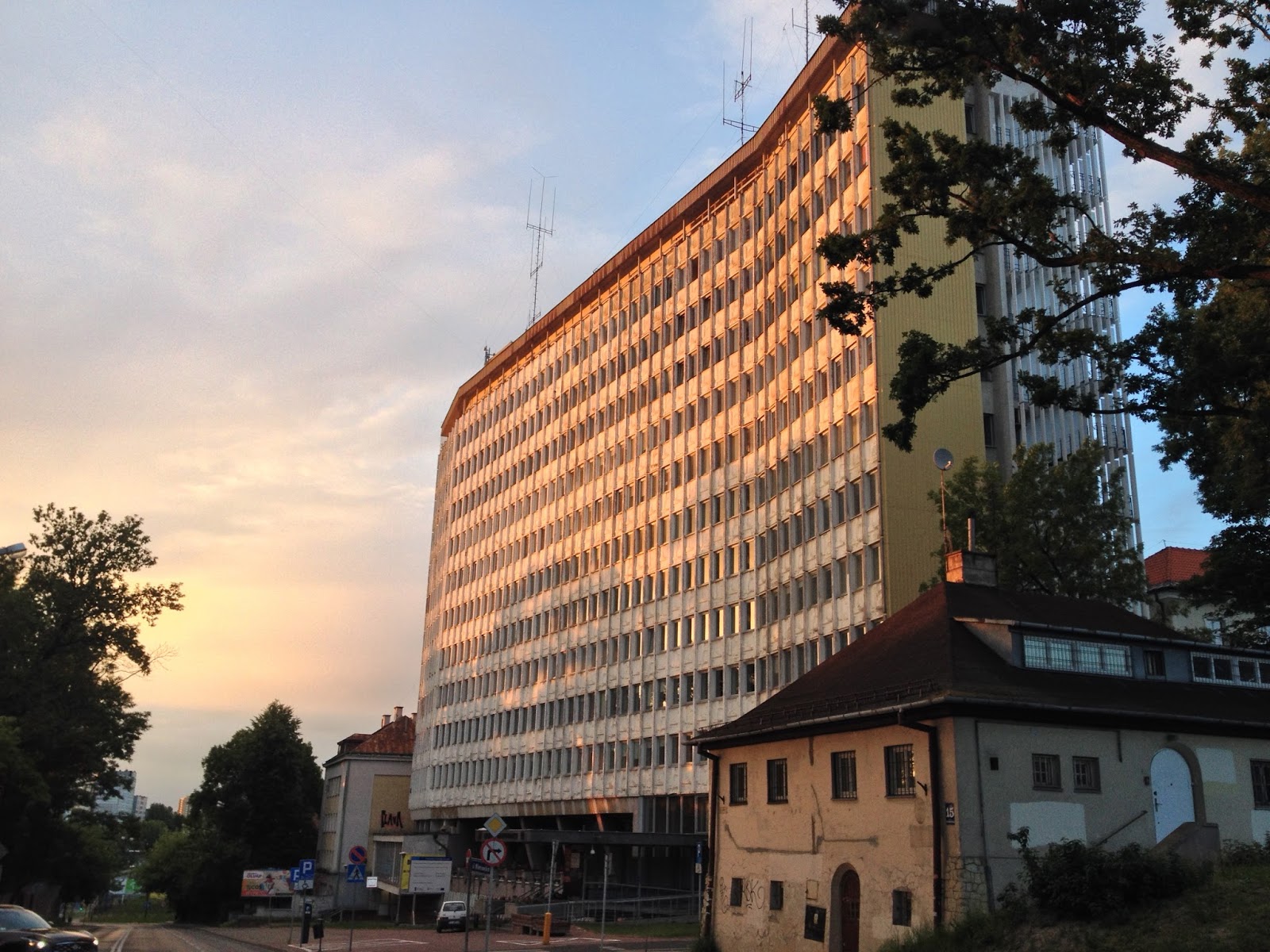
This giant communist-era monstrosity is a block away from our hotel.
That's all from Lublin. Hopefully my next post will be from Krakow.
Sunday, June 21, 2015
Saturday, June 20, 2015
Logistical Problems
I think the students are used to my mini-panic attacks now; they generally find them amusing. Today gave them a lot to find humorous.
The underlying problem is that the university rules make it extremely difficult to hire a charter bus. As a result, even though a charter bus would be the ideal way to travel through the Polish countryside, the university strongly encouraged me to use public transportation. That meant using public buses to get from Lublin to Bełżec. This became a personal nightmare.
The problems started when we got to the main bus terminal. I went up to the ticket window to buy 14 tickets to Tomaśów Lubelski. but she refused to sell me more than 3, telling me instead to buy them from the driver.
The scenic Lublin Dworzec Głowny.
The next step was finding the driver. Our bus was going to leave from platform 16, but I couldn't find it. There were some buses near where I thought it should be, one of which said "Tomaśów Lubelski." I asked the driver if they were going there (or I thought I did, since I could only say "Tomaśów Lubelski" and make it sound like a question). I asked if this was platform 16, and he ended up pointing to the 10 and 6 on my watch. I later discovered this meant something entirely different.
The bus was supposed to leave at 9:50, but at 9:55 no one had gotten on the bus. I asked again. Finally, he said that this was for international travelers only (they were going to Ukraine), and that I wanted platform 16. He pointed and I finally found it far behind the other, more prominent platforms. We had missed our bus by 5 minutes.
The next bus didn't leave for another hour and ten minutes, but the original bus driver took pity on us and allowed us to get on his bus where he would drop us off in Tomaśów Lubelski. We got on the bus, and as we waited I wondered when we would leave. It turns out we left at 10:30 (when the little hand was on the 10 and the big hand on the 6, as he had pointed to earlier when we had spoke past each other).
As the bus was about to leave the station, a woman on the bus came up to the driver and started asking questions. It appears she was on the wrong bus, and she and the man she was with left. After that, off we went. I told one of the students I though the woman was speaking Polish with a Russian accent and the older man in front of us turned around to ask how I could be sure she was speaking with a Russian accent and not a Ukrainian accent. I told him I didn't know, but that it just sounded Russian to me.
We started talking and he told me about himself. He's an anaesthesiologist (I'm not sure I spelled that correctly), and is a professor of medical engineering (I think, he had a strong accent). He wanted me to know his family history, but I'm not sure I got all of it. There was the great great grandfather denounced and murdered in Tsarist Russia for preferring Russia over Ukraine. There was the great grandmother sold from Ukrainian family to another for several kilos of flour. There was German grandfather who married the Russian grandmother in Moscow, while the other grandparents were a mix of Ukrainian and Polish. He currently lives in Tarnopol, but was in Poland to give some lectures.
I asked him about how the war in Donetsk is affecting him and he said that given his background, he's not sure which nationality he identifies with, but feels closest to Russian. Hearing Ukrainian nationalists calling for all Russians in Ukraine to be killed makes him nervous. He's also concerned about WWIII breaking out as he's read in American online news that some Americans want to attack Russia, and he's read in Russian news online that some Russians want to attack America. I told him I was confident that Putin and Obama would not go to war.
He also wanted to know if I had heard about Yellowstone's volcano. According to Russian news, the volcano is about to erupt and destroy America but the U.S. government is suppressing the information. I told him I had read many stories about the super volcano beneath Yellowstone (it's real, and it's really dangerous), but that it was very unlikely to erupt in our lifetime.
Eventually we reached Tomaśów Lubelski, and the driver let us off at a stop. I wasn't sure this was the right one, since we had passed the bus station, but I noticed some old, weathered signs and this was the right place. Two minutes later a small van pulled up that seats 14 passengers. Our group was 14, but there were already people in the van. Thankfully he took us and we piled in for the 15 minute ride to Bełżec.
I had warned the students to bring food as there was likely nothing open nearby (there wasn't), so we had a small simple picnic outside the entrance to the camp (I didn't want to eat inside).
The entrance was sign was made with a material that was designed to run and stain.
The museum is small, but very moving. They have excerpts from Lanzmann's Shoah, including outtakes of Jan Karski talking about how he saw the cattle cars loaded at Izbica camp. One large sign, quoting a child's cries from the gas chamber, is something that I simply cannot look at or think about; I find it too painful.
During the archaelogical survey of the site between 2002 and 2004, various items brought to Bełżec by people who were murdered there were discovered, including these Jewish star arm bands.
The exhibit ends in a large, massively large room, called the Hall of Contemplation. The hall is darkened, with a large, heavy door and no where to sit. The only thing in the room is a stone text, which I need to translate.
From there we headed out to the memorial. The design of the memorial is quite striking, particularly in contrast to some of the other places we had already been on the trip.
Many of the students commented on their feelings of claustrophobia and isolation walking through to the symbolic site of the gas chambers. The walls rise quickly up around you until all you can see are walls and the only sounds are your own footsteps.
Like the Umschlagplatz (deportation square) in Warsaw, the memorial only contains first names of people murdered here, not last names. I found my great grandmother's name, Gitel, and lit a memorial candle beneath it and said kaddish.
Then we climbed the stairs to the top of the memorial. The whole thing is a field of volcanic stone, sometimes with rusted metal objects a part of it. The entire effect is of a vast volcanic wasteland of destruction after a violent eruption has destroyed everything.
Several of the students compared this memorial to the one we saw in Lidice, Czech Republic. That memorial to the destruction of the town and the murder of most of its inhabitants had made some of the students uncomfortable, with its manicured, green lawns, resembling more a park than the place of an atrocity. Bełżec, on the other hand, reflected the atrocity in its volcanic, hellish destruction.
I noted that the sculpture (because this is one vast sculpture) consists of stones, and a traditional Jewish practice is placing stones on a grave. This set of stones covers the graves of the some 500,000 people, almost all Jews, who were murdered here.
We then left the camp and caught the bus back to Tomaśów Lubelski. As it happens, we had the same driver and he let us pile into the van, again bursting past the safety limit. My hope was to find a bus to the Renaissance-era town of Zamość, and we were in luck: the bus came just a few minutes later. Here again, we had to pile in and hope the bus driver would take all of us. Thankfully, he did.
The first thing I did when we got to Zamość was to photograph the bus schedule back to Lublin. Here it is, in all its Polish transport glory:
I gathered from this that the last sure bus from Zamość was at 7:20 pm. As it was only 4 or so, I figured we had time for a leisurely and much-needed dinner. One concern I had was that my money was running low as I had had to pay for all our bus tickets in cash. Unfortunately, the bank wouldn't accept my ATM card.
We went to the main square, which was designed by an Italian architect imported to design this privately owned Renaissance-era town.
The Armenian merchants houses (1630).
The city hall building, put up somewhat later in 1651.
The Sephardic synagogue (1610), replacing the earlier wooden structure from 1590.
After relaxing and unwinding in the square, we headed back to the bus stop. We just missed the 7:00 pm bus, and there were already people waiting on the 7:20 bus. I told the students to get on the bus and take any open seat. That left four of us still waiting. And we waited for nearly 20 minutes until the driver came back from break. Somehow, we managed to cram everyone inside (though it took a while to explain that I was paying for the 14 of us). One student was standing for about 20 minutes until a seat opened up. After much drama, we reached Lublin just before 9 pm.
But my drama wasn't over yet. I kept trying to use ATMs to replenish my funds, but the different ATMs kept denying my requests. I went back to the hotel, retrieved my other ATM card, and finally was able to get the money I need for tomorrow.
Friday, June 19, 2015
Strong Emotions
The last few days have evoked a lot of strong emotions. On Wednesday, we visited the new Jewish Museum in Warsaw and saw the fragments of the Warsaw Ghetto wall. On Thursday, we began with the Museum of the Warsaw 'Rising, about the 1944 revolt that led to the deaths of 200,000 Varsovians and the utter destruction of the city. Today, we came to Lublin and visited the hybrid death camp/concentration camp known as Majdanek. Tomorrow, we head three hours south to the site of the Belzec Death Camp. This has been a rough few days.
Although the Museum of the Warsaw 'Rising is more than a little confusing in its arrangements (several students toured in reverse order not realizing that had to take the elevator hidden behind a corner), most of the students liked its immersive aspect and felt that the confusion contributed to the chaos of the 'Rising.
This is the fifth time I've been in the museum, but the students discovered there are narrow tunnels beneath the entry level that I've never seen.
The 3D movie that uses computer animation to show what destroyed Warsaw looked like in the spring of 1945 after the Soviets liberated its rubble is very effective. I noticed many Poles walking out of it crying, seeing their capital city (since reconstructed) as a pile of ruins. The former Warsaw Ghetto is noticeable as there, the destruction was total: not even broken walls remained.
From the 'Rising Museum, I wanted to head up to see two Ghetto monuments. I ended up getting turned around, so we went to the Umschlagplatz first, and the the monument at Miła 18, where the main ghetto bunker stood. We talked about resistance, how hard that was, and also the issues surrounding rescue and collaboration.
By now it was after 1 pm and we were all tired and exhausted. To make things simple, I decided to pick up the tab for lunch and took them all to Zapiecek, a rather kitschy pierogie chain restaurant. I thought it was a good chance to introduce them to Polish food in a safe environment.
The students all seemed to enjoy it, and several are now looking for more chances to eat pierogies.
I went for the sausage and fried onion.
After we were all rested and had used the bathrooms, we headed off to the reconstructed Stare Miasto and Old Town Square. There were lots of opportunities for souvenir shopping here, and I pointed out some good places to buy amber. Still, it's more than a little disturbing to see vaguely anti-Semitic toys for sale:
Two years ago, the "Jewish"-style restaurant we ate at in Łodz gave us these rabbis holding coins as a present for coming.
All over Warsaw, you can still see traces of the horrific conflict that destroyed the city. Most of this building was reconstructed, but one could still see bullet scars on the parts that survived.
We made our way past Warsaw Castle, down a street full of famous cathedrals, shrines to Chopin, and fancy boutiques and cafes. Just off the main street, however, lies a warren of dive bars known as "the Pavillion." It also has this really cool mural.
Several of the students went back last night. Most loved it, but one was very uncomfortable by the aggressiveness of some of the sketchy men there.
I went off to the bane of my existence: the train ticket booths at Warszawa Centralna station:
When it was my turn, I approached the window.
Me [in Polish]: Hello. Please forgive me, I do not speak Polish. Does madam speak English?
Clerk [in English]: No. Just little.
Me [In Polish]: Tomorrow, please. Train to Lublin [pointing at schedule]. 14 ticket please. With reservation. Two class.
Clerk [in Polish]: mwah mwah credit card?
Me [in Polish]: Yes! Yes! Credit card.
She then printed out the tickets. I wished I had looked at them in detail then; it would have saved me some grief today on the train. She broke our group of fourteen into three groups: six, six, and two. The first two groups of six were in Wagon 14; the last group of two was in Wagon 12. That led to a lot of chaos this morning.
I decided to find a nice place to eat for dinner, so I headed to a neighborhood I had had good luck in before. One restaurant there, Ole Tapas, was in the guidebook as very good, so I decided to try it. It's a steak place, so they brought out a selection of steaks for me to choose from. I decided to try the local Polish "limousine" cow, along with some grilled asparagus and a glass of a nice Rioja.
The steak was excellent and prepared just right.
They had two desserts on the menu: a Spanish-style creme brulee, or a fruit tart. I asked what fruit, and the waiter said peach. It also came with bison-grass flavored ice cream. Like Zubrowka, I asked? Yes, he said. I ordered that.
The tart was perfectly prepared. The crust was very flaky and buttery, while the peaches were firm and good. An excellent dessert. As for the ice cream, it was sweet and cold, but otherwise had no discernible flavor.
I was so tired yesterday that I tried to go to bed early, and then pack up everything this morning. I slept nearly 8 hours, but was still feeling tired when I got up. I headed down around 7:15 am for breakfast. The hotel does have a lovely breakfast buffet; the students are going to miss it.
After hearing about some of their adventures last night, we headed back to Warszawa Centralna to catch our train to Lublin.
Ah the joys of Polish regional rail. Cramped carriages (8 to a cabin, as opposed to 6 everywhere else), smaller overhead compartments, and less air. It's like flying coach.
And just to make sure we got to really enjoy it, our train was delayed en route by nearly an hour. As a result, we arrived in Lublin at noon, rather than around 11 am. After buying our three-day metro passes, I then had to find our bus to take us to near our hotel.
I had gone online this morning to confirm the bus route. The city's website said take bus #34 from the main railway station to Al. Solidarnosci, getting off at Lubomelska 2. There's just one problem: according to the official posted route for line #34, it doesn't make that stop. After running back and forth across the road in the rain with all our luggage, I asked the driver if he stops at Al. Solidarnosci. He said yes. I told all the students to get on the bus.
Now that it was raining, but buses windows steamed up, so that made it even harder to see where we were going. With the help of a passenger on the bus, we actually got off at the right stop, and we could even see our hotel in the distance from the stop. From there it was just a short walk to it.
Even though we were early (we arrived around 1:00 pm), they let us check into the rooms. I urged the students just to drop off their stuff in their rooms and meet me in the lobby to go get lunch. We walked 15 minutes to the late medieval and renaissance era Old City, where we had lunch.
I went back to a place that specialized in buckwheat crepes and ordered their "Old Polish" version. The other students got either savory or sweet crepes.
After lunch, we took the tram to Majdanek. This camp always shocks the students, for a variety of reasons. First, it's right up against the city. It's natural to assume that the Nazis hid places like this away from public view, but the camp could be seen, and smelt, for miles around. In fact, as we sat by the giant urn holding over one ton of human remains, church bells could clearly be heard echoing through the camp, which affected some of the students quite strongly.
Some of the students felt claustrophobic, as if they would not be able to escape from the camp. Others wondered how the people nearby could go about their daily lives while their fellow human beings were trapped behind these barbed wire fences. Another wondered why we are so passive today in the face of evil.
Because of our late arrival, we had less time in the camp than I had hoped and we were quite rushed. Arriving at 3:30, I discovered the exhibition spaces close between 4:30 and 5:00, while the camp grounds close at 6:00 pm.
There's a new museum in Majdanek about the lives of prisoners in the camp that opened last year on the 70th anniversary of its liberation by Soviet troops, and it's very, very good. Among the items on display was this illustration from a manual for guards on appropriate and inappropriate ways for prisoners to behave when being unloaded from trains.
This one shows the correct and incorrect ways that prisoners should be marched.
I managed to get them to the crematorium before they closed it, and then we sat for over 10 minutes in silence as I let them process what they had seen. We then discussed the camp, but I needed to make sure we got to the main gate by 6:00 pm. We just made it (it's quite easy to hop the fence, but I wanted to avoid that). We were all very somber going back to Lublin.
At least our neighborhood is nice. This is the street we walk down to get from our hotel to the old city center and back.
I needed a nice dinner after such a long and difficult day. I settled on a cafe by the Krakow Gate and ordered their chicken breast with asparagus, cut to resemble tagliatelle noodles.
I also ordered a dessert. In retrospect, I should have tried their halvah cake, but when he mentioned szarlotka, I couldn't resist ordering it.
The meringue on top was a good idea; I really enjoyed it. The apple cake, on the other hand, tasted a bit odd. It might have been because it was warm, and I think szarlotka tastes best cold, or perhaps it was because the apples tasted overcooked, with a consistency approaching apple sauce than apple pie. It wasn't bad, but it wasn't great.
Did some laundry tonight and it's now hanging up to dry. Tomorrow we can sleep in a little bit later (we leave at 9 am rather than 8:15), but tomorrow will also be a very hard day emotionally, as we are going to Belzec.
Subscribe to:
Posts (Atom)