Monday, June 24, 2013

A Free Day in Vienna

From the beginning, I planned today as a free day, our first “mental health day” of the trip.  The idea is to give the students a breather after particularly difficult experiences.  We’ve been studying the Holocaust and visiting places of perpetration and places of commemoration pretty much non-stop since they arrived on June 15th.  Nine days in (out of twenty three) seemed a good place for our first break.  Also, yesterday was our visit to Mauthausen, which was hard both physically and emotionally.

Last night, the heat wave finally broke with a massive storm.  At 1:00 am, the windows rattled and the rain poured down.  I decided to close the windows as the sound of the rain was nearly deafening. We also enjoyed a massive drop in temperatures.  As a result, I managed to sleep until 7.

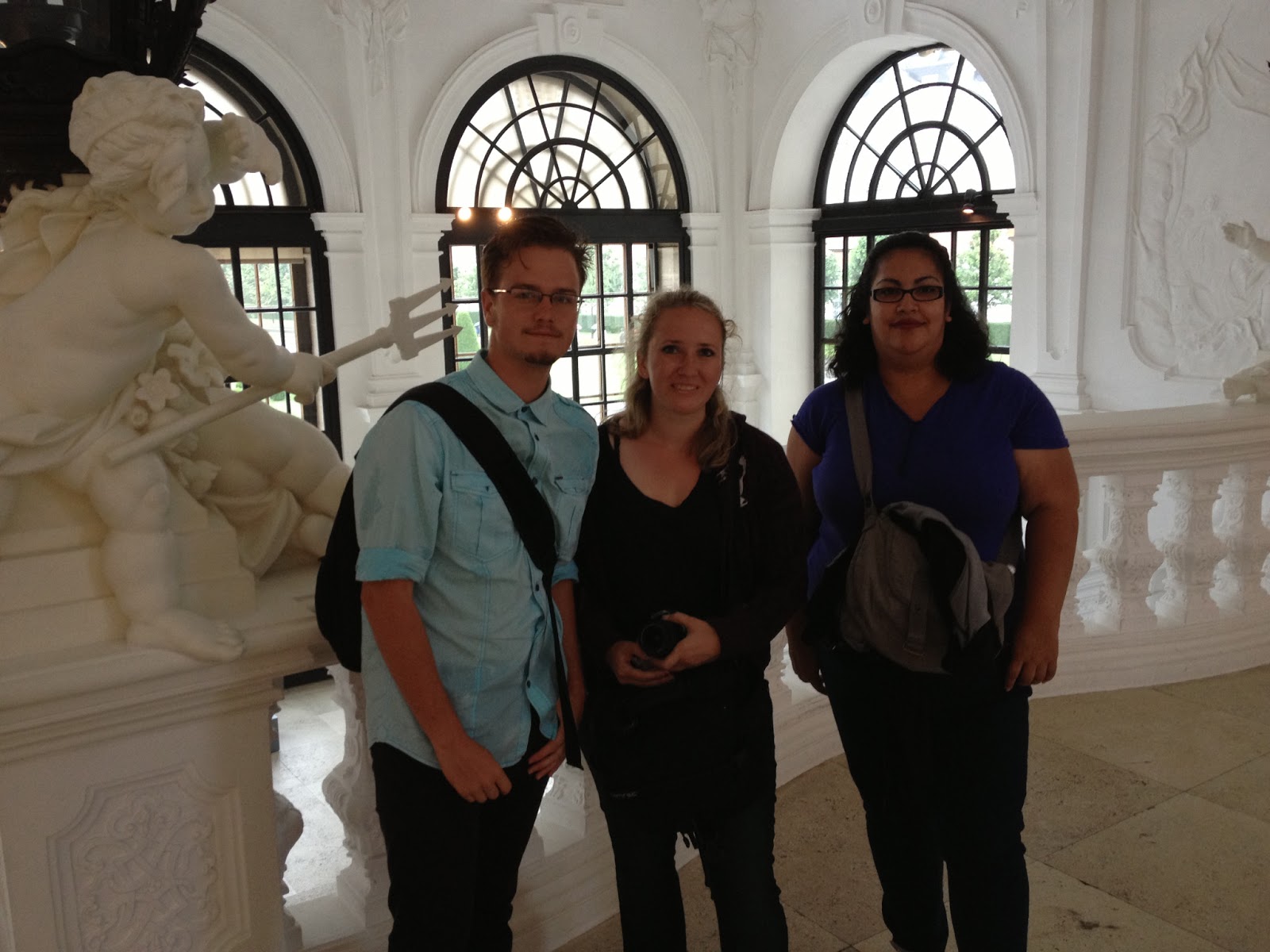
After breakfast, we all went our separate ways.  Some students went to the famous Riesenrad in the Prater Park (immortalized in Orson Welles’ The Third Man), while others went to the Zoo.  I took three students and headed up to the Belvedere Palace.  


Built by Eugene of Savoy in the 17th century, the upper and lower Belvederes now house a significant collection of Viennese art.  We made our way through stiff winds and pouring rain to the upper Belvedere first.  This was definitely a day for staying indoors. 

Like most museums, the Belvedere doesn’t like you taking pictures, but this seems to just to make it more of a challenge.  One of the students has a very nice professional camera, but it’s rather large, and so as she walks, the guards in each room basically followed her suspiciously (and deservedly).  Her camera makes a distinct click, so it really calls attention to what she’s doing.  I told her she needs to buy a silencer for it.  When my cell phone is on mute, it doesn’t make a sound at all.  The two of us competed for who could take the most photos without getting caught.

I mostly took photos of the paintings I particularly liked or found particularly interesting.  Of course, I was limited by the placement of guards in the room.

Let’s start off with this Biedermeyer-era photo of a family in mourning for the loss of their mother and his wife.


I also found this depiction of a British naval engagement to be almost comical.


This painting is entitled “Caesar at the Rubicon.”  Presumably the question is only will he cross it to eat the sausages?


The order of the exhibition seemed a little confused, so at times we would go from 19th century academy art to Secession-era landscape painting like this:


and then back to baroque.

My favorite stuff is on the ground floor and includes Klimt:

Emil Nolde:

and this really amazing self-portrait by Joseph Floch:


I was also pleased they had a nice collection of Czech cubist and radical paintings to make up a little for the closed museum we tried to visit in Prague.

After lunch we headed down to the lower Belvedere where they had two special exhibits.  The first was an amazing collection of Austrian symbolist works, which is a movement that emerged in the latter half of the 19th century.  Here’s how the museum describes it:

As early as the 1870s, Symbolism started to evolve from the spirit of décadence, which discovered for itself the cryptic aestheticism of decay and of the mystical and unfathomable. The Symbolist movement superseded the official style of Historicist painting, shifting its focus to the subjective perspective of psychological processes, which found expression in a suggestive language of colour and form. Its abandonment of banal reality led some artists to create idylls, while others invented cosmic visions. This new aestheticism, propagated by such artists as Max Klinger, Franz von Stuck, Fernand Khnopff, and Jan Toorop, was transmitted in Austria and Central Europe first and foremost via the Vienna Secession. In Austria, Rudolf Jettmar, Alfred Kubin, and Karl Mediz turned out to be among the most consistent exponents of Symbolism. Yet Symbolist ideas also played an important role for leading personalities of the avant-garde, including Gustav Klimt, Egon Schiele, and Koloman Moser.

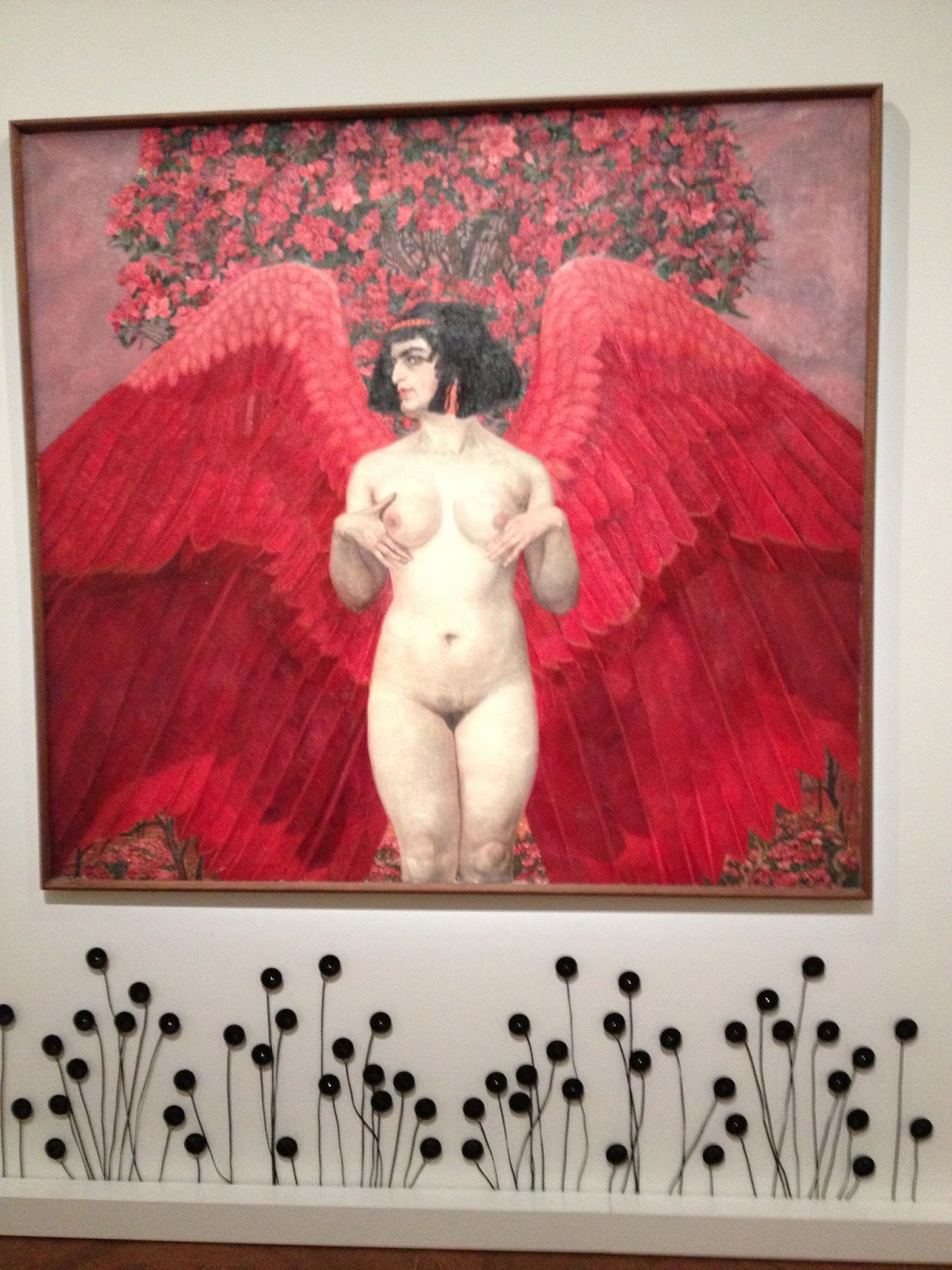
Some of the paintings, like The Evil Mothers by Giovanni Sagantini, were fascinating, though with two guards to a room, it was almost impossible to sneak a shot.  The only one got was of the image used in the advertising for the exhibition:  the Red Angel

I will admit to one tiny moment of silliness.  There was one painting that depicted a Frankenstein’s monster-like creature, with yellowish eyes, and hands red with blood, lumbering through a snowy scene.  I turned to one student and asked “wouldn’t that go well in a child’s bedroom?”

The exhibition concluded with a discussion of the Symbolist love of Wagner and Nietzsche’s critique of both.

After that we headed to see the special exhibit of the work of Friedensreich Hundertwasser and his time in Japan in the 1950s.  The exhibit explored the origins of his rejection of straight lines and social conformity.  It was quite interesting, but with so many guards (what is it, the Austrian full employment program?), there was no way to snap even a single shot.

We then returned to the pension, where I ran several errands.  The landlady asked me to pay in cash so that required several bank visits to withdraw the necessary amount.  I paid the bill and then went to the station to see about our train tickets to Budapest.  Part of the rail line was damaged in the flood so we have to change to a bus to get around it and then transfer to a regional train line.  I could have taken a bus the whole way, but as I don’t know where to catch it or where in Budapest it lets out I decided not to.  Besides, the regional train will let us off just a few blocks from our hotel.

The clerk at the train station also thought that the damaged track would probably not affect our overnight train to Warsaw, but I will check that out tomorrow night after we settle in.

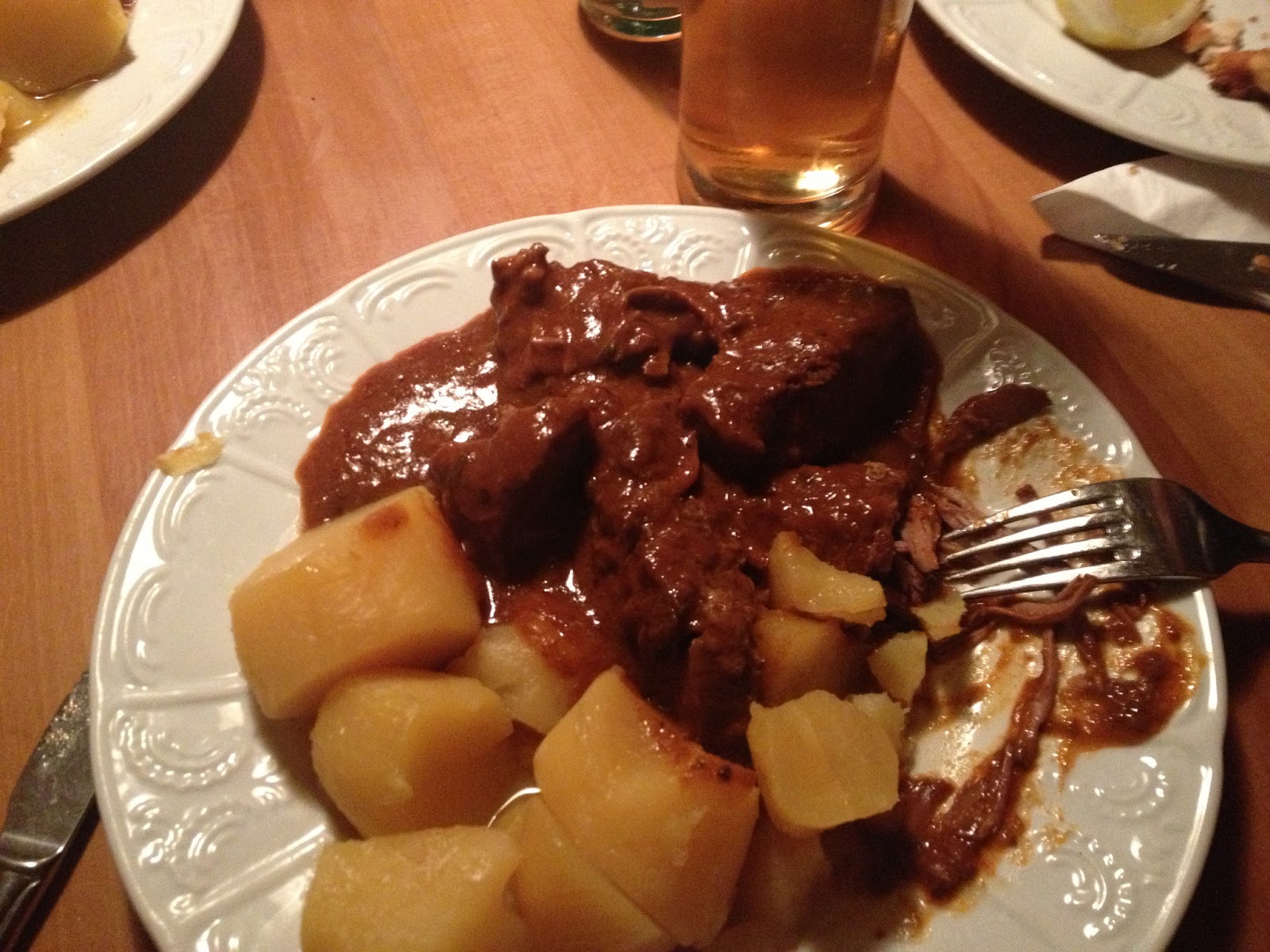
For dinner, I took those students interested to the city center.  I wanted to eat dinner at Café Hawelka, but they don’t have savory food.  Instead, we went next door to the Reinthaler Beisl, where I had some beef goulash and potatoes and sparkling apple juice.  

Then we went back to Café Hawelka for dessert:  Buchteln and coffee or hot chocolate.

Buchteln are made out of a yeasty bread dough filled with prune lekvar, allowed to rise, and then baked.  They are delicious, particularly fresh out of the oven.


Afterwards, we returned to the hotel.  I made an accounting of my expenses here in Vienna and now need to start to pack up.

Sunday, June 23, 2013

The Hell of Mauthausen

The rooms in the pension are ok.  The ceilings are high, but the pillows are low,  and the beds sag.


Breakfast was fine:  coffee or tea and juice, rolls, butter, and jam, cheese and meats.  I managed to get all the students fed and out the door by 8:25 to go the Westbahnhof for our train. 


There’s no direct train to Mauthausen; you have to change in Linz to a local.  We only had five minutes to make our connection and it turned out that the platform wasn’t the one identified by the ticket plan, so I ran from one platform to another.  We got on, huffing and puffing, only to find out that the train was going to be delayed 6 minutes, which became 16.


Eventually, we reached Mauthausen, which is basically a village on the banks of the Danube.  


 I stopped them near the station to have them read about a young woman who worked nearby and what she saw and did to help prisoners in the concentration camp. Then we walked the 2.5 miles to the camp.

It had been seven years since I visited the camp and I forgot how far and how long the walk was.  The sun, heat, and humidity didn’t help.  Nor did the clouds of mosquitos that descended on us as we walked through a shady grove.  Some of the students were really hurting.  Finally, we reached the camp around 12:30 pm.


Since none of us had eaten since breakfast, we grabbed a quick lunch in the café, and then headed into the camp.  In order to catch our return train at 3:01 pm, we needed to leave Mauthausen camp at 2:00 (it had taken us an hour to walk there).  That meant our tour of the camp was somewhat rushed.

In going through the exhibits I focused on images drawn by surviving prisoners of conditions in the camp.  That took about a half an hour.  Then we went through the basement where prisoners were killed and then their bodies burned.

This is a list of the names of prisoners killed in the camp:


Here’s a detail of that list.


Then we went to the cremaotorium


And finally, the gas chamber.  This is the door.


Unlike the death camps, the gas chamber at Mauthausen was only used to kill small numbers of people at a time.

With it rapidly approaching 2:00, we walked down to see the quarry where many of the prisoners slaved and died


and then at 2:05, we started to walk down the hill back to the train station.  On the way back down, I noticed that the house nearest the camp had a bizarre display in front facing the camp.  I've decided it's a folk way of warding off the evil eye of the camp.


Even though we walked back mostly downhill, the students and I found it rather strenuous and my shirt was soaked with sweat.  Later, I could see salt stains on the front and back.

We actually reached the station with 4 minutes to spare, only to find out that train was 6 minutes late.  Unfortunately, I rushed the students on the first train to come in, which was going in the wrong direction, and one student was nearly trapped on it, as she went to the bathroom before I realized my mistake.

Because of the delay, though, we missed our connection in Linz.  By the time we reached the platform, the doors were closed and it was just beginning to leave.  Luckily, another train came along in 15 minutes.  Although we did not have seat assignments, this turned out to be much nicer than the train we booked. 

I ended up chatting with the woman across from me who was born in Austria but had spent the last 30 years living in Berlin.  We talked about some of the artists on display in the Belvedere, and after we mentioned Klimt, Schiele, and Kokoschka, I mentioned Emil Nolde.  “He’s German!” she quickly said, “you shouldn’t list him with the Austrians.”  Later, when she talked about making Austrian Christmas cakes, I asked about Baumkuchen.  Again she said “that’s German!” 

I could tell that the day had really worn the students down, so when we got back to the Westbahnhof, I treated them to a small sandwich at Trzesniewski.  The Wifi’s quite good there, so they all started posting, and some went and got other food.  Eventually we went back to the hostel.

For dinner, we checked out some cafes in the neighborhood, but price is very much an issue for students, so we went to this place called Centimeter, which prides itself on the size of its dishes.  I had the schnitzel, but it was too much for me.  We sat outside because it was cooler, but the humidity and mosquitos really got to us.


I decided to treat the students one more time, so I took them to Café Landtmann, near the Burgtheater.   Along the way, we had a spectacular view of Parliament at sunset.

Café Landtmann is a famous, traditional Viennese café, and almost as importantly,  it had an air conditioned terrace.  

I ordered the Eszterhazy Torte with traditional “Oma’s” hot chocolate, which came with some very firm Schlagobers on top.


One student got a cornucopia of strawberries, placed inside a chocolate coated cone, which was filled with cake and strawberry mousse.


There was also a farmer’s cheesecake with raspberries (in the background, above), and a Chocolate Truffle "Törtchen."


Afterwards, we took the tram back to the pension. 


While it is cooler than Prague, the weather today was still pretty awful.  Even now, with the temperature falling, it’s quite sticky.  We’re supposed to get rain tonight with much lower temperatures in the morning.  I really hope so.

In the meantime, I think the students are really enjoying Vienna, particularly after Prague. When I ask, some say they prefer the less-crowded atmosphere of Vienna.  I think they are also liking the desserts.  Tomorrow is their day off, so hopefully they will have a chance to revel in the city.  I'm certainly liking it more this time than in the past.

Saturday, June 22, 2013

In Vienna


We reached Vienna this afternoon with little difficulty.  The weather here is ok; it’s still somewhat warm and humid, but not as bad as Prague at its worst.

The pension is in the Neubau neighborhood, which is rather nice and filled with small shops, cafes, and bars.  It’s located only a block and a half from the Neubaugasse U-bahn stop.  The pension is small; it’s family owned and operated.   It has an “old Vienna” feel to it.

The grandmother who runs it checked us in.  There is Wifi in the pension, but it seems to work intermittently, cutting in and out.  After we checked in and dropped off the luggage, I took the students to the Naschmarkt for a very late lunch (I called it a “linner”). 


Then the group split in two:  one went shopping while I took the other to the Secession Building.


The main exhibition hall, unfortunately was closed as they set up a new installation, but we were able to spend some time with the Beethoven Frieze by Klimt.

Afterwards, we walked through the Naschmarkt. 


One of the students wanted to take a photo of a cheese display but was a little scared of the guy behind the counter.  I asked him if she could take a photo and he said it was ok.  I started to talking with him and I mentioned Hebrew among my languages.  At that point he said “ma nishma” (“how are you doing?).  As we chatted, he kept stabbing the table top with this cheese-covered big knife.  I asked where he was from and he said “Gaza.  Do you understand?” and he kept stabbing the table top.  I said I understood and quickly backed away.

We met up with the other students and headed down to the inner city to Stephansplatz.  We stopped for drinks at Café Weinwurm, where I had milchkaffee, and the students tried other fruit drinks.  The bells of Stephansdom were pealing when arrived and it started to very lightly drizzle.  It was rather humid.

After we finished our drinks I took them into the church, but they were having mass, so we couldn’t leave the back area to see anything of the interior.  By the time we came out the drizzle had stopped, so we took a leisurely walk through Graben, making our way to Judenplatz.


I showed them the memorial to Kristallnacht, and it looked as if someone had either put vegetables or flower stems in the door of the memorial. I can’t tell what they intended.

On our way to the U-Bahn station, we passed some kids playing in blue shirts with white lacing, which I recognized as those used by Zionist youth groups.  Turned out they were with Hashomer Hatzair, and were busy engaging in a protracted water fight.  The only surviving synagogue in Vienna is just around the corner.

After we got back to the pension, I left the students to go to the Westbahnhof and buy our tickets to Mauthausen.  I had no problem buying group tickets and to and from the city for tomorrow, but I can’t buy tickets for Budapest because the tracks are still closed due to recent flooding.  They suggested I try again on Monday and see if it’s possible to book the tickets.  Otherwise, we’ll be taking the bus.

I decided to grab a quick meal in the station and was pleasantly surprised to find that Trzesniewski has opened a branch there.  They make small, finger sandwiches with egg, lox, onions, herring, etc.


I got four different ones:  farmer's cheese and lox, pickle salad and egg, egg salad and tuna salad, egg salad and herring:


Friday, June 21, 2013

Lovely Prague


This is the fifth time I’ve been to Prague.  Most of the time, Prague has been quite lovely; the city the tourist guides all promise you.  But the first time, and this time, Prague has displayed a different face, an angry face, a face of fury and bile.  When Prague is cool and dry it’s a remarkable place, but when it’s hot and humid, the way it was our first two days here, it can be unbearable.  While the subways are air conditioned, almost nothing else is.  Sleeping, sitting, eating, these all become deeply uncomfortable activities.

Thankfully, the heat wave broke last night.  It stormed and rained (and I slept through all of it) and when I awoke (still too early) it was suddenly pleasant outside.

Today we went to Lidice, the town annihilated on Hitler’s orders to punish the Czechs for the assassination of Reinhard Heydrich (who was also overseeing the Holocaust).  All the men in the town were shot, all the women sent to concentration camp, and most of the children were sent first to Lodz ghetto and then to the Chlemno death camp.

My graduate student again asked to lead a discussion of the town and I heartedly agreed.  As usual, she did a terrific job.


Inside, we toured the museum dedicated to the destruction of the town, though most of the emphasis were on the men and children who were killed, and less on the women who went through the camps and survived.


Afterwards, we walked through the peaceful surroundings that once made up the town.  Hitler had every home, business, and church dynamited and all the trees were cut down.  The area has now been transformed into a vast memorial.


Each murdered child is separately depicted in the statue, but the murdered men only receive a plaque.  The contrast between the quiet, idyllic beauty of the place, and the horrors perpetrated there could not be more dramatic.


We then returned to Prague and I took the students to one of my favorite cafes:  Cukrkavalimonada.  The have a very eclectic menu, and some of the students tried drinks like hot grog and Irish hot chocolate, while most of the rest of us had the home made elderberry lemonade.  Last time I had the pasta primavera, so this time I ordered the “salty pancake with spinach,” which turned out basically to be a crepe.  I rolled it up and it was delicious.

  
I knew I couldn’t pass up their desserts, so I ordered the raspberry pie.  It was very good and I think the students also like the place.


The John Lennon wall is just around the corner.  Begun as kind of a hippy expression of the 1980s under communism, the wall has taken on a life of its own.


The café and John Lennon wall are in the neighborhood of Malastranka, which is a nice quiet counterpart to the mayhem of the Stare Mesto old quarter.  I wanted them to get a chance to a see a different side to Prague.  Afterwards we walked to the Charles Bridge; we had already seen it the day we arrived, but the weather was so miserable that day, I think they more suffered than saw it.

After some souvenir shopping, we made it the Old Town Square to see the astronomical clock chime the hours (though I warned them that this is vastly overrated.  Like many celebrities, it’s more famous for being famous than for any intrinsic value. 

I really wanted to see the cubist museum again in the House of the Black Madonna, but the sign on the door indicated it closed last September.  Now I had an answer as to why I couldn’t find ticket prices posted online.  Instead, we went to the Museum of Communism, which I’ve always enjoyed.


From there we headed to the Municipal House Café, which is one of the most beautiful in the world.


I ordered the vanilla ice cream sundae with hot raspberries and it was delicious.


We met up with the rest of the students who had gone off shopping and then headed back to the hotel.  Some of us looked for a restaurant nearby, but what we found was pretty awful:

Over cooked duck, gritty red cabbage, and dry bread dumplings.  I won’t miss Czech food.

I won’t exactly miss the hotel, either.  I had read online that the elevator had problems, but I heard one student say “I’m scared of it.” 

 
It’s not just that it’s rather small, but that there’s no inner door and the machine jerks to a stop each time.  Many of them walk up 5 or 6 flights to their rooms rather than take it.

The students like the free WiFi, but because it's only in the lobby, they camp out here in their spare time.


While the hotel is convenient, just across the street from the metro, it’s rather noisy.  It’s on the corner of two major streets, so there isn’t just traffic noise, but also sirens, and loud pedestrians.


I also won't miss the food.  Last night, the menu had a particularly odd menu.  Check out the first entry.


The general category is "chicken meat."  According to Google translate, that first time reads:

"150 gr  "Uterus" pocket (ham, cheese, asparagus)."


Tomorrow we leave for Vienna, and not a moment too soon.