Thursday, June 28, 2007

Back to Work


[Cafes in Krakow's Rynek Glowny (main square)]

One thing I have noticed this trip is that the second time around is much easier. Whenever I have arrived in a city that I visited last year, I find that I quickly remember where almost everything I need is. That has made things much more relaxed and simpler; I'm not facing that enormous learning curve I had last year, where I struggled to figure out the most basic things. Now, I'm much calmer.

I'm also enjoying the trip more. Certainly that was true of Prague and Vienna, cities where I had a much better experience this time. In Poland, I found that I'm getting my bearings quicker and I'm less stressed over the language issue. A lot of stuff has come back.

For example, after checking into my hotel, I walked to the Rynek Glowny to get some lunch. I was heading to an ok restaurant I ate at last year when I remembered there was a better one around the corner. It's called Gospoda U Zdzicha. I remembered the mushroom soup was good, so I had that, but instead of the cabbage peirogies, invariably sauteed in lard, I ordered the plum peirogies instead. The soup was as good as I remembered, and the peirogies turned out to be filled with prunes, and accompanied by a vanilla custard-like sauce. It wasn't bad, and I didn't leave feeling bloated or greasy.

Today was a back to work day for me, after all the hiking in Zakopane. I so wish I could find a way of taking students there next year so they can see what is the most beautiful part of Poland, but I can't see away of fitting it into a course. On my bus ride to Zakopane, by chance I had noticed that there was a museum devoted to the Polish Home Army, located just behind the bus station. It's one of those amazing chance things that makes all the difference. I can only imagine what things I'm missing by chance as well.

Now, I wouldn't recommend the Home Army Museum to the casual tourist. First, it's not that easy to get to. You need to head behind the bus station, across some roads, along the side of an overpass, and then you get to the museum. Second, all the exhibits in the museum are only signed in Polish (though there is a small brochure they hand out that summarizes the main points of the museum.

So why did I go there? It was an amazing find for me. I'm working on an article on post-communist Holocaust memorials and here is this museum, opened first in 1991, that commemorates the activities of the Polish underground during World War II. Because it was opened so soon after the fall of communism, it provides an early example with which to contrast the Museum of the Warsaw Uprising, opened last year in Warsaw.

As I expected, the museum completely ignores the Holocaust, let alone the behavior of the Home Army during the Holocaust. Instead, it traces the development of the Second Polish Republic between the wars, the invasions of Poland by Nazi Germany and then the USSR in September 1939, and the organization and struggle of the Polish resistance during the war. There are special exhibits on the the Warsaw Uprising of 1944, and the murder of Polish officers by the Soviet Union in Katyn in 1940.

The only references in the entire museum to the murder of virtually all of Poland's Jews by the Nazis, some 10% of the Polish population and representing half of all Polish deaths during the war, consists of a diagram showing the various badges prisoners wore in concentration camps, and various maps of Warsaw during the 1944 uprising that indicate "ruins of the ghetto" through the blanking out of streets that were leveled in the ghetto uprising of 1943.

Needless to say, there's nothing in the museum on the very limited support provided by the Home Army to the Jewish underground, and the refusal by some Home Army commanders to permit Jewish volunteers to join their partisan units (or the evidence that some Home Army partisan units killed Jews when not killing Germans). All these points had been debated in Poland in the ten years prior to the opening of this museum, so they surely were aware of them. However, given that this museum was the first chance to commemorate a group that had been viciously suppressed by the Stalin and the Soviet Union -- who arrested Home Army members, shot some, and sent the rest to gulags in Siberia -- we shouldn't be surprised at the decision to present an account that is wholly praiseworthy. It makes the more nuanced presentation in Warsaw all the more remarkable.

After leaving the museum, I returned to my hotel to pick up my umbrella (just in time, too, as a brief rain storm swept through), and then I headed down to Kazimierz to get a ticket to a klezmer concert tonight. I'm hearing the Lerner Moguilevsky Duo at 7pm in the Tempel Synagogue. This is a beautiful "oriental"-style synagogue that was moderately reform, and is the preferred location for the klezmer concerts during the Jewish festival.


[The ark and bimah of the Tempel Synagogue]

I think I will get a light dinner afterwards.

After picking up some info in Kazimierz, I've decided to change my plans for tomorrow. Originally, I was going to take the train to Bobowa to see the synagogue there, but I've decided not to go. First, I found out that there's a lecture tomorrow at 11:30 at the Galicja Jewish Museum on the plans for the new Museum of Polish Jewish History, of which they just broke ground two days ago in Warsaw. The talk is in English and is by one of the planners of the museum who will discuss their choices in how to organize it. I can't miss that.

Second, there will be a public discussion of a new book on talks between Poles and Jews at the Klezmer Hois at 2 pm. I still haven't confirmed yet whether it will be in English or if not, if there will be simultaneous English translation, but that's too important an opportunity to miss.

Third, this whole trip to Bobowa seems like a fool's errand, 2.5 hours by direct train to get there, all in the hope that the barber in the shop next to it, will have the key to open it up, and then a three-hour minimum return (with change of trains in Tarnow).

Fourth, because I screwed up in my reservations, I have to change hotels tomorrow morning (I thought I had reserved a room for two nights, but only reserved for one night by mistake). This way, I won't be rushed as I check out of one place and into another.

Finally, I would like to say that I have been very fortunate with the weather. Although there have been brief rain storms, I've had none of the hot, muggy weather of last summer. Today the high was 16 in Krakow, less than half of what it was last year at the same time. That makes life so much easier. If it stays like that in Central Europe until July 10th when I return, I will be very happy.

Wednesday, June 27, 2007

The Fields and Rivers of Podhale (revised)


[Me, dressed as a Gorale (highland) peasant, on a raft in the Dunajec River]

(You may notice that the photos from today's entry are all from my camera. However, because the photos are so large it takes too long to load them and I'm afraid it may take too long for you all to download the pages, so I won't be doing this again for a while. However, I am going to upload one last image from yesterday)


[Me, in the cave, yesterday]

I spent the day today travelling through the region known as Podhale. In Polish, Podhale means "beneath the mountain meadows," and this is the area where my grandmother's family comes from.

I had some doubts last night about the wisdom of taking a rafting trip given the weather, but it turned out great! After a leisurely breakfast I caught the bus at 10 am. We headed north from Zakopane towards Nowy Targ, and then turned east, driving past Lopuszna, the town my great-great-great grandfather lived in. Zakopane is at the base of the Tatra Mountains, which in turn is part of the Carpathians. North of the Tatras are a set of small foothill ranges, such as the Gorce (where my grandmother's family is from), and the Pieniny, where I went rafting today.

Our first stop was a small castle from the 14th century that served as a border outpost for the Kingdom of Hungary for many centuries (this region was the boundary between Hungary and Poland, and now is the border with Slovakia). The castle was a lot of fun, though very small.


[Niedwica Castle]

Afterwards, I grabbed a snack at a stand by the entrance. The favorite Polish snack is something called Zapiekanka, which is basically pizza (sort of) on a baguette. Except instead of pizza sauce they squirt a line of ketchup. I think that says all you need to know about Polish food. Oh, and the less said about my dinner last night, the better. It wasn't the worst hamburger I'd ever had, that was the one I got in Katowice last year and threw away after the first bite. This was just not quite that bad.

After that we drove to the put in site for the rafts. It's on the Dunajec River, at the very eastern edge of the Gorce range and the beginning of the Pieniny.


[The hills of the Gorce]

The rafts are very stable, and there's no risk of getting wet. The Dunajec is very calm; at certain points we went through some very slight rapids, more like rocky patches. Other than that, we just glided down the river through steep gorges lined with trees. I was sitting in the front row, and at one point I got the chance to go to the front and have my picture taken. The oarsman loaned me his hat and vest, hence my clothing in the photo at the top.

After two peaceful hours floating on the border between Poland and Slovakia, we finally landed. This was our lunch stop, so I ordered a small beer and kielbasa. It's saying something when I write that this was the best meal I've had in Poland so far (other than the yoghurt and toast with butter and black currant jam I have for breakfast).

Our last stop was Debno to see the beautiful fifteenth-century wooden church. Before the Holocaust there were dozens, if not hundreds, of wooden synagogues throughout Poland and Eastern Europe. Not one survived. It is only in wooden churches, like the one in Debno, that we can get a faint echo of what those synagogues must have been like.

Some tourists on the bus recommended what they claimed was a good restaurant in Zakopane, so I'm going to try it tonight. In the meantime, I'm going to try to take the funicular to the top of the hill overlooking the town to watch the sunset.

Tomorrow, I'm off for Krakow.

[Additions to the earlier post]:

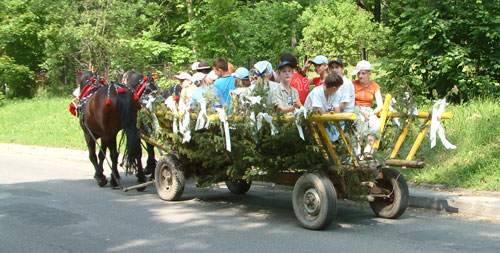
As I wrote above, I headed up to Gubalowka to see the sunset. It's remarkable to see how much development there has been in the past year. I shot the photo that I use as the title picture of this blog at a small farm there last year; this year it's been converted into a race track for little motorized four-wheel buggies. But there still are some traces of its rural past. I saw some farmers loading up hay onto a horse-drawn hay cart. I saw a lot of those by the way, today, at least a dozen. This time I got to take a picture of one close up.


[Hay Cart in Gubalowka]

Then I headed back down for dinner. As I mentioned, some people I met on the tour today recommended a place called Chata Zbojnicka. It's a few blocks up from the train station, set back from the street in a grove of trees. The conceit of the restaurant is that you are eating in the secret hideout of the last of the highland zbojniki (bandits).

When I got there around 7:30, just ahead of a small tour bus, the front door was locked. I wasn't sure what to do, so I waited for the group. They knocked, and a minute later we heard "BANG! BANG!" thumps on the door. It was flung open to reveal an older (not quite elderly) woman, wearing traditional mountain attire, and wielding a small axe (which she had just used to knock back the deadbolts). I couldn't understand anything she said (I've been told she wasn't really speaking Polish, but a highland dialect, but I couldn't tell the difference). She motioned the men in first. I hung back to let the bus group in, but no, no, I had to come in with the men, and then the women followed.

BANG! She struck a tin platter on the wall. Everyone sat down at a long table and I asked if I could join them. Sure. I asked if anyone spoke English. No. German? No. Hebrew? No. French? No. Spanish? No. "Just Polish," they said. Great, I thought, this is going to be an odd evening.

When it came time to take the orders, the group (all thirteen of them) ordered the same thing. I motioned to the waitress that I wanted to order separately. I requested the roast goose with potatoes, apples, and cranberries, along with a large beer.

My beer came first, then came their thirteen hot wines. Then my main course came, but their food never did. It turned out that they didn't order any. At one point the woman who ran the place (the one who opened the door) came by looking the part of a highland Ma Barker. She asked me something and then motioned that I should stand up. I had been warned that they cut the underwear off guests (and, of course, I could see the results of past victims on the wall), so I refused. Later, she tried to cut the underwear off one of the men in the bus group, but he managed to get away.

Every now and then, she hit the tin tray, or threw a metal platter to the ground, just to startle the guests.

The goose, by the way, was excellent, and the cranberries made a really nice garnish. I've noticed that my best meals in Poland last year were duck and goose, so maybe I should just stick to that here in the future.

After I finished, two of the bus group ordered ice cream, while the rest just sat there. I never did figure out who they were (2 men, 11 women) beyond that they come from a town near Warsaw. I paid my bill and made my way out with my underwear intact.

Tuesday, June 26, 2007

Flexibility


[Dolina Kościeliska]

When travelling, you need to remain flexible given the way circumstances may sometimes demand it.

While I love Zakopane, there are two things about it that can make it difficult: the food and the weather. In a word, the restaurants here suck. They range from mediocre to poor, with a big emphasis on large portions of fatty meat, usually accompanied by lots of cigarette smoke. Last night, after fruitlessly searching the main street for something edible, and even toying in my desparation, with resorting to Pizza Hut, I ended up with a chicken shishkabob.

This morning, I awoke to rain, lots of unending rain. Since my plans were to head out early and take the cable car to the top of Kasprowy Wierch, that was now out of the question. I went downstairs and fixed some breakfast and read more Arendt. I decided to spend the morning doing errands and hoped the weather would improve. I went to the post office and sent myself two packages of materials I'd accumulated (like the handouts at the House of Terror Museum), then I went to the local historical museum (all in Polish), and finally, to the store, where I bought some spaghetti sauce for lunch.

Who knew that Uncle Ben's has a line of spaghetti sauces. I bought the bolognese. Unfortunately, this seems to be a recipe for bologonese that doesn't include meat. But it was filling and tasted better than anything I could've gotten in the restaurants on main street.

After I finished lunch, I noticed it had stopped raining, and there were even a few spots of blue between the clouds. I grabbed my bag and caught a bus to Dolina Kościeliska.

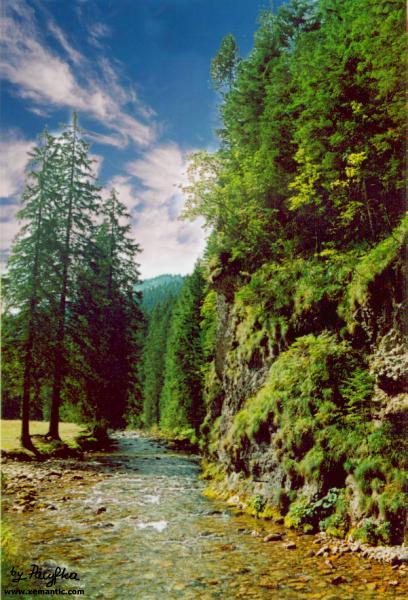
This is a beautiful valley, between the high peaks of the Tatra Mountains. You can take horse-drawn carts here too, but the trail isn't steep and I wanted to walk. After a few minutes it started to drizzle, so I pulled the hood of my windbreaker over my head and kept on trekking.

After about 40 minutes I reached a turning point to something called "Jaskinia Mrozna." I remember my guide book said something about caves in the hills used by bandits, and since the sign said it was only 15 minutes away, I figured it would be a nice detour.

Only it turned out to be 25 minutes of steep climbing. At the top was the entrance to this cave. There was a guide giving a lecture in Polish, but a British family, whose daughter in law is Polish, told me that all he said was this cave had been discovered 80 years ago, that it's called the freezing cave because it's so cold inside, but that there isn't any ice, that it's the only cave that's electrically lit, that it takes about 25 minutes to walk through, and that at points we'll need to duck our heads.

Ok, I thought, why not. The cave is quite cold and damp, and sometimes the walls of the cave are at a steep angle, requiring people to walk at that angle to pass. Sometimes, the ceiling got so low, I had to crouch down and sort of hop forward (since the floor was too damp and muddy to crawl on).


[Jakinia Mrozna, at one of the broader points]

Eventually we came out the other side. It was amazing how much warmer it was outside. At first I thought it was because it had been so cold in the cave, but the British woman pointed out that no, it was because the sun was now shining. While we had been in the cave the weather had cleared out and it was now gorgeous.

On the hike back down, the Polish daughter in law told me that the cable car to Kasprowy Wierch is down for modernization, so that there's no way to the top except by foot (and hiking down it was bad enough last year). She said that they were going rafting tomorrow on the Dunajec river, something I'd wanted to do too but hadn't had the time for.

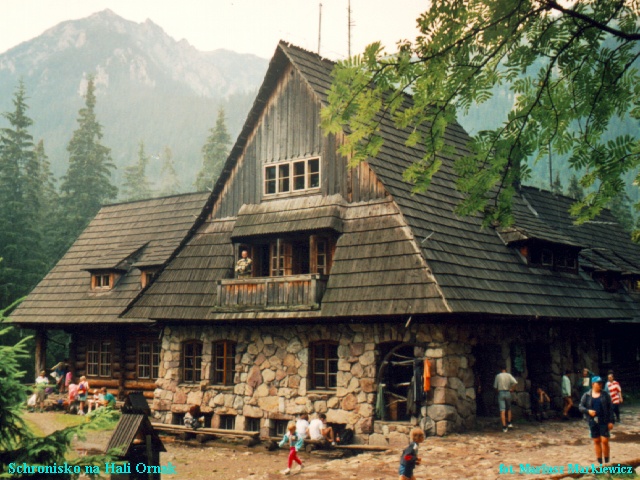
Back in the valley, it was another 1 and a half hike up through the valley, as it wound past cliffs, forests, and meadows, with periodic bridges over the stream. Finally, I reached the Ornak, a lodge run by the park service that provides food and drink to tired hikers.


[Someone else's photo of the Ornak]

I got some hot tea with lemon and a slice of Szarlotka (an apple cake that has a thin bottom and top crusts, and is filled with lots and lots of apple slices). After I nice rest, I headed back down for the 1 hour 50 minute walk back to the bus stop.

The walk was so beatiful; just variations of green in the grass, the trees and the hills. The only sound that of birds, the rush of the wind in the woods, and the similar but distinct sound of the water flowing over stones. Here's another shot of the trail:


[Passing through meadows]

I reached the bus stop around 6pm, very tired, but very happy. Between the six hours of hiking yesterday and the five today, I think I have finally worked off the meal I had at Gundel.

I took the bus to the last stop so I could visit the tourist office. I decided to book the rafting trip tomorrow. They tell me that if the weather is bad and the trip is cancelled, I'll get my money back (we'll see -- or hopefully, we won't).

Now the only thing left is to decide what to do about dinner. Given my choices, I think my best bet is Roosters, the Polish equivalent of Hooters. I'll let you know tomorrow if that was a good or bad choice.

Monday, June 25, 2007

The Eye of the Sea


[Morksie Oko (the "eye of the sea" in Polish]

Some of you have had a few questions about my meal at Gundel and whether I have an expandable stomache. Let me assure you I ate a (mostly) reasonable amount. All the portions I chose were quite small so I could try a lot. For example, the desserts were each maybe enough for two or at most three bites. Basically, petit fours size. I also ate at a very leisurely pace, spread out over more than one and a half hours.

By the way, they offered me Crepes Gundel for dessert (their signature dessert), but I turned them down.


[Crepes Gundel]

First, it was so large that if I had that I couldn't have eaten another thing. Second, I had the Bagolyvar version of it twice that week, including the night before, which was my last dinner in Budapest.

I made my train to Poland without difficulty. I used some of my last Hungarian forint to pick up a salami sandwich, a pastry, and some water for later on the train. I wasn't hungry when I bought it, but I knew at some point, I would feel hungry again.

As it turns out, it was a good thing I did buy them, since there was no meal service on the train.

When I found the sleeping car, the conductor asked for my ticket and receipt, and kept them, directing me to the appropriate cabin. I was a little concerned about not having any proof on me that I had paid (I went so far as to snap a picture of him so I could show any guards who had my ticket), but another passenger told me this was standard practice on sleeper trains.

The good news, by the way, is that I had the entire cabin to myself. In fact, there weren't any first class single cabins on the train at all, had I wanted to get one.

Around 9 or so I got in bed and turned the lights off. I figured I would just rest until we came to our first border crossing at 10:30, but I actually fell asleep. I was woken by knocking on the doors. I turned on the light and looked, and saw there were border agents going from room to room. I got out my passport and waited. "Passport Control!" I handed over my passport and it got stamped. Five minutes later, the Slovakian guards came by and we went through the same routine. Ten minutes later, we pulled out of the station, and the conductor came through and shut all our doors indicating it was safe to go back to sleep.

I stayed up a few minutes to see what Kosice looked like. This is a town in Eastern Slovakia, and is the region that my mother's family comes from. But in the darkness, you couldn't see anything, so I went back to sleep.

Again, I didn't think I would fall asleep, but two hours later there was that knocking at the door again. "Passport Control!" We were leaving Slovakia and entering Poland. I was sort of dazed and I asked the Polish officer to make sure my entry stamp was visible (I had trouble leaving Poland last time because they couldn't find the entry stamp). He showed it to me.

Now that there weren't any more disturbances for the rest of the night until we reached Krakow, now I had trouble falling back asleep. I woke up every now and then, but eventually slept until about 4:45 am. By then, it was fully light outside, and I got up and began to get ready for our arrival in Krakow 45 minutes later.

It's a short walk from the train station to the bus station to catch the bus to Zakopane, and by 8:30, I was here in Zakopane. My hotel is a short ten minute walk from the bus terminal, and my room has views of the nearby mountains.


[Stara Polana in Zakopane; my room is on the upper floor on the left]

I took care of business by changing money and buying pseudophed. Then it was off to Morskie Oko.

One of my primary goals in this trip to Zakopane was to visit this beautiful, high mountain lake, and I wasn't sure if the good weather would hold, so I decided to go there today. It's a 9 kilometer walk from the bus stop to the lake, but horse-drawn carts can go three quarters of the way, so I took a ride.


[A Polish horse-drawn cart; the one I took was not nearly as fancy]

We seemed to have two really slow horses, as all the other carts passed us, as we slowly crept up the path. I chatted with a young Polish couple from Gdansk in the cart with me. They live and work in Oslo, but were back on holiday. At one point, a hiker said something in Polish to the driver and I asked them what he had said. "He said our horse is frail." That's what I had thought he said.

The last 2.5 kilometers has to be done on foot. Then I came to this beautiful dark green lake, ringed by tall scarps (see photo above). I got lunch in the restaurant (chicken schnitzel for once, and, of course, beer). Then I decided to walk along the shore of the lake to reach the upper lake.

To get there, I had to climb a very steep path. In the space of thirty minutes, I had climbed 600 feet, straight up. The path was stone steps clinging to the cliff. While it was a very strenuous climb, the descent was far worse, as, in addition to the jarring damage to my knees, was the very real risk I'd fall. I remembered my hike last year down from Kasprowy Wierch was just as difficult, and I am reconsidering whether I want to hike down or just take the cable car both ways.

Back at Morskie Oko, I continued to walk around the lake, seeing the various waterfalls and streams that flow into the lake. There is nothing more gorgeous than the sound of water falling on and through rocks.

After that it was 3:30, so I needed to think about getting back down. Since I wanted to visit some of the waterfalls I had missed on the cart ride up, I know had a 9 kilometer walk stretching ahead of me, even though I was quite tired. About half way down, I tripped and fell on one of the stone stair shortcuts. Luckily I was wearing long pants (this is exactly why I wear them on hikes). Both knees were banged up, and it tore out the pant over the right knee, but no long term damage. I continued the rest of the way at a slower pace.

I'm back on the hotel, getting ready to take my laundry to their laundry room. Then it's off to dinner and a good night's sleep.

Sunday, June 24, 2007

How to Spend the Perfect Sunday in Budapest


[The main dining room at Gundel]

First, after breakfast, don't do what I did, which is visit the House of Terror Museum. I didn't want to go there, but I had to for work purposes. While this museum purports to commemorate the terror of the fascist Arrow Cross and the Hungarian Communist Secret Police, both of whom used this site for interrogations, in fact, after the first three rooms, the remainder of the museum is wholly devoted to the evils of the Hungarian communists.

Even the material on the Holocaust whitewashes the Miklos Horthy regime, completely omitting all mention of the slave labor camps instituted by the Hungarian government on their own initiative, to work Hungarian Jewish men to death. Instead Admiral Horthy is presented as a noble man who did his best to preserve Hungarian sovereignty in very difficult times. It was my visit to this museum last year that sparked my research project on post-communist Holocaust commemoration.

After collecting the English-language handouts for each room in the museum (my main purpose in going), I headed up to Gundel, the most famous and posh restaurant in Budapest. Normally, this place has a very strict dresscode, requiring jacket and tie, but on Sunday they relax a bit for their all-you-can-eat Sunday brunch.

After being seated and given my complimentary glass of champagne, I started at the salad section. I took some small portions of various items, including a hardboiled egg filled with fois gras mousse and topped with a grape. After that it was time for the main course. They had veal roast, rack of lamb, hungarian stew, schnitzel, bacon-wrapped rabbit in chocolate sauce, grilled salmon over farfalle noodles, and something with pork. I started with two ribs of lamb, some stew, corn, and haricot vert. They were all delicious.

For my second main course, I decided to skip little bunny foo-foo, and went instead for the veal roast. I've never had it before and the texture was reminiscent of liver (though not the taste). I had it with mushroom sauce.

As I began to ease towards dessert, I took a bowl of cold melon soup (with cantaloup balls) and a plate of cheese, watermelon, and grapes (both seeded, of course, since they have more flavor).

Finally it was time for dessert. With so many choices, I could have made that my whole mean (and you can be sure I considered it). I don't remember the names of everything I had. One was layers of poppyseed meringue separated by grand marnier buttercream, another was a "Wine-Cream Roulade." I had a coconut roulade, which was a layer of flourless chocolate cake, coated in coconut, filled with coconut cream filling and then rolled up. At the end they brought me a delicious cafe au lait, with a serving dish with different types of sugar, and chocolate flakes.

The whole bill for all the above (plus a bottle of mineral water and 12% service charge) came to about 7100 Hungarian forint (or about $38). A steal.

Then I took the metro to the banks of the Danube and walked across the Chain Bridge to the Buda side. From there, I took the funicular to the top of the Buda castle hill.


[The view from the funicular]

I shared the cabin with a british woman and her three sons. She was complaining about the expense, but I told her that given the heat, it was well worth it.

From there I headed to the National Gallery. They have a big collection of Gothic, Renaissance, and Baroque art, but if you ask me, the best stuff is on the 2nd floor in the section devoted to pre-1945 art.

After that I started to run short of time. I made a stop at the ruins of the medieval synagogue on the hill, destroyed by the successful Christian reconquest in 1688 (when all the Jews in Buda were either killed or exiled). I made a quick visit to Ruszwurm cafe for dessert. This is the oldest sweet shope in Budapest, founded in 1827.


[Interior of Ruszwurm Cafe]

It was too hot for cake or coffee, so I ordered icecream and mineral water. I had the "Forest Fruit Cup," which consists of vanilla and sour cherry ice cream, topped by blackberries, raspberries, red currents, whipped cream, and blueberry sauce. By that point, you could just roll me down the hill.

I'm back on the Pest side, where I changed some forints into Polish Zloty. Now I've got to race back to my hotel, pick up my luggage and get to the train station before my sleeper train to Poland leaves in 55 minutes. Next stop: Zakopane!

Saturday, June 23, 2007

Esztergom


[Esztergom, as seen from Slovakia

Today was another beautiful day in Hungary.

The sky looked a little chancy this morning, but although it remained breezy and windy all day, it was also sunny. The only downside: I feel a slight cold coming on. Too bad there isn't any "Emergen-C" here for me to take. Instead, I just downed a small bottle of orange juice.

To get to Esztergom, I took the train from Nyugati Station. The name sounds like the villain from some 1930s/40s intrigue thriller. "Those were Nyugati's men: ruthless and devious!"

The train went through the hills and towns north and east of Budapest, before coming into Esztergom. This city was the original capital of Hungary a thousand years ago, and it's where the first castle was located and where the kings of Hungary converted to Catholicism. Destroyed first by fire and then by the Turks, a huge cathedral was built on the site in the 19th century, and the original castle was excavated in this one.

I started, as I always do, by figuring out how I was to get home. I decided to take the high-speed hydrofoil back since the slower boat took four hours and wouldn't get here until 8:30 pm. Then I had dinner at a restaurant across the street from the ferry landing that my guide book recommended. I ordered the cold cherry soup and the "spicy carp." The soup was fine, but unexciting; I've been spoiled by the better one served at Bagolyvár. The spice in the spicy carp turned out to be garlic. I had forgotten how long it takes to eat fish when you have to remove the bones one by one. It was ok.

[Which reminds me, I checked my credit card receipt and the restaurant I ate in last night has changed its name. It is no longer "Vörös és Feher," and is called "Klassze" instead. I don't think they changed the menu or service, however, as both were excellent. Located at Andrassy ut. 41, just a block or so south of Oktogon station.

After lunch I walked up the path to the cathedral. There were stunning views of the whole city and the Danube, with Slovakia on the other side. The cathedral was built in the 19th century and is the largest in Hungary.


(Esztergom Cathedral)

I toured the "treasury" -- mostly reliquaries -- and then headed over to the castle. This traced the history of human settlement on the overlook since the arrival of the Celts to the present.

After that, I headed down into the town again, where I made sure to visit the former synagogue in Esztergom. Turned into a technical school by the communists after the war, there is a plaque in front indicating that the Jews of Esztergom were deported on June 5 and 6, 1944. The plaque was put up in 1995, along with a small memorial statue in front.


(The former Esztergom synagogue)

After that I sat for a while in the town square. The place was very quiet. As I walked towards the boat landing, I saw that most young people were on the island area separated from the town by the small canal. They're having a three-day music concert in the town stadium (people are camped out in tents). The ferry landing was just a block away, so I went and sat under the trees along the Danube until it was time to get on board.

The journey back was uneventful. The hydrofoil was much more cramped than the ship I took last year back from Szentendre. A young couple sat next to me. At first I couldn't figure out the odd aftershave the guy had on until I finally realized I was smelling beer. They had two 12 ouncers in the short ride back to Budapest.

Tonight I'll have one last dinner at Bagolyvár. Tomorrow I check out, but don't actually leave for Poland until 6:30. Hopefully, I'll be able to make one last post before my train leaves.

Friday, June 22, 2007

Szechenyi Gyorgyfurdo (and other Hungarian tonguetwisters)


[The Szechenyi Baths]

So today was a day I set aside just to have fun.

I started out by heading out to the appropriately named "Moszkva ter" (it looks as if it hasn't changed at all since the days of communism) to catch a tram to the start of a journey into the Buda hills.

My first stop was the Budapest Cogwheel train. Built nearly 100 years ago, this carries passengers up to the top of the hills overlooking Budapest. But this beautiful ride up through the Buda suburbs was merely the first step towards my main goal: Gyermekvasút -- the Budapest Children's Railway.

This was railway is run by boys and girls scouts interested in a career in the railway system. While the locomotive's are still run by adults, everything else is done by the children. This includes signaling, selling and punching tickets, bringing the train into the station, etc. Here's an old photo (they don't use this type of locomotive anymore):


[Scout wellcoming a train into the station]

The train runs once an hour, which meant I had about 45 minutes to wait, so I decided to get an early lunch. I remembered there was a "Buffet" five minutes away at the top of the cogwheel railroad, so I walked back. The menu was full of things like liver, brains, and tripe, and I eventually settled on stuffed cabbage, though I was sort of worried what it might be stuffed with. As it turns out, I needn't have worried: they were out of it. I made a new choice: Hungarian stewed beef with "flour pellets." Come on, wouldn't you be curious too?

What came was a fair-sized portion of beef with sliced dumplings in paprika sauce with a dollop of sour cream on top. Not nearly as bad as it could have been. The sauce was mild and even tasty (though I could have done without the sour cream) and I didn't feel heavy or stuffed afterwards (or naseous for that matter, and really, is that all one can truly ask of a rural "buffet" diner?).

I headed back in plenty of time to see the train come in and watch the little kids take the tickets and motion people on board. I have lots of photos, but you'll have to wait til I'm home to see them.

I got off the train half way through its course through the hills in order to walk to the Erzsebet lookout tower, the highest point in the region. It was a streep fifteen-minute walk to the top, but the gorgeous views were worth it.


[Erzsebet Lookout Tower -- recently renovated and restored]

Instead of hiking down or walking back to the train and waiting half an hour for the next one, I read about a different option: the chair lift. There's a chair lift running from the base of the hill to the top. It takes about 15 minutes to travel in each direction. To get on, you stand in front of it, as the chair comes you sit down and pull the restraining bar down from over your head. And that's it. It's amazingly quiet. You can hear birds and animals in the forest as you ride down the hill.


[The Budapest Tourist Agency's picture of the chairlift]

After that, I just caught a bus back to Moszkva ter and my circuit was complete. All in about three and a half hours.

I headed back to my hotel to get my swimsuit and a towel and then it was up to the Szechenyi Gyogyfurdo, or the Szechenyi Public Spa. I came here last year and really enjoyed it; I wanted to make sure I spent more time there this year. After changing into my bright orange and yellow flame-striped bathing trunks (which always gets funny reactions from people in Eastern Europe), I headed out to the main pool (see picture at top). The hot pool with the fountain is for waders, while the big swimming pool in the middle requires a bathing cap.

After about 15 minutes of being burnt by the sun (very bright today, no sign of yesterday's storm), I headed inside to the thermal pools. I spent the next two hours moving from pool to pool, just soaking. After about two hours I headed back to the outside pools, and found a place where I could float in the shade.

I was getting ready to head inside when I realized I had never checked out what was on the other side of the main swimming pool. It turned out to be another wading pool, but this one was a little different. The water was a little bit cooler, and there were two concentric tiled rings in the middle. The outer ring seemed plain, but the inner circle was a jacuzzi, so I found a place inside when someone got up to leave. It was like a cool jacuzzi, with all the bubbles but none of the heat. After about five minutes, though, it stopped, and everyone sighed and got up to leave.

I was about to head inside to change, however, when I noticed something odd about the outer ring: it had been transformed into a whirlpool. I got back in and let the current whip me around. Water was jetting into the circle to create a strong current. It was a blast. After that, I went inside and changed and went home to change for dinner.

A good friend who knows a great deal about wine recommended the restaurant Voros es Feher on Andrassy utca as a good place for a meal and wine. I found it, although I think they have recently changed their name to Classe, and just had an absolutely wonderful meal.

I ordered the duckbreast (medium) over chantarelle risotto with grilled vegetables. To drink, I got a Weninger (red wine) and a bottle of mineral water. The duck was excellent, not fatty at all, and very tasty. In the future, though, I think I may order it medium rare. The risotto was wonderful as were the veggies. The wine paired nicely with the duck (though less so with the risotto).

I decided to order a dessert and thought the cottage cheese pudding with lemon mousse sounded light and interesting. It was. The lemon mousse had the consistency and appearance of light whipped cream, but a nice lemon taste. The pudding, which I really had no idea what to expect, was creamy and there were little specks of real vanilla bean in it. The combination with the lemon worked very well. The whole thing came to 4000 Hungarian Ft. (a little more than $20); not bad at all. Well worth visiting if you're in Budapest.

Tomorrow morning, I'm going to catch the train to Esztergom (assuming the weather holds).

Summer Storms


Well, this blog entry is a little later than I expected it to be. It turns out that unlike, say, Vienna, where internet cafés stay open til midnight, in Budapest, the ones in Belváros close at 7pm, living me unable to post anything until today.

Yesterday morning began very warm and just got hotter. I took care of business first: getting my sleeper cabin to Kraków for Sunday night and my three-day metro pass. Then it was off to the Dohány Synagogue. I decided to skip the synagoge tour since I had done that last year, opting instead for the neighborhood tour. In the meantime, I walked though the synagogue and museum on my own.


[Dohány Synagogue -- the largest synagogue in Europe]

I met up with the tour guide and the family he was showing around and we headed on our way. The tour guide, Janos, is the son of Holocaust suvivors. He told me later that he only leads these groups a few times a week because he finds the subject emotionally difficult. When he found out that I teach the Holocaust he asked me about how we know how many people were killed, particularly in the Soviet Union. I explained the problems historians have in getting accurate statistics and why, particulary for the Soviet Union, it's such guesswork.

We walked through the old ghetto as he pointed out various landmarks such as the Bet Midrash, the mikveh, the Orthodox and Status Quo synagogues (the latter being somewhat comparable to Conservative). I chatted with the family on tour with me. They were Jews from Palo Alto, and the father is the son of a survivor from Czestochowa. They were on their way to Prague and then to Kraków for the Jewish Festival, so I'm sure to see them again in about a week. The wife asked about places to eat in Prague, so I recommended my favorite restaurant and the ice cream parlor in the Lucerne Passaze (though I'm not sure my directions to the latter -- make a left at the statue of King Wenceslas sitting on an upside down dead horse hanging from the ceiling -- inspired much confidence).

My part of the tour ended at the Rumbach synagogue, and headed up to Klauzal ter, which was the central square in the ghetto, for lunch at a restaurant that was supposed to have good Jewish-style food. I walked in and immediately recognized it as a place I had eaten at last year (they have bottles of seltzer on the table). I ordered the boiled beef with potatoes and sour cherry sauce. The food came quickly and was pretty good. I also managed to have two glasses of seltzer (though the first time I splashed it all over the wall behind me by mistake).

On the way to the tram I ran into the tour guide again. He told me he teaches business at the university and he has an anti-Semitic student. How do you know he's anti-Semitic, I asked. Because he's always bringing up outside comments on things, such as, the Jewish conspiracy is behind such and such economic problem. He told me that when he was at the dentist's office two days ago, he heard a young man proudly proclaim to his girlfriend that he was a fascist. The second time he said it even louder and a man to his right went up and punched the young fascist.

At the same time, he thought that the Jewish community in Budapest painted with too broad a brush when they warned of imminent fascism in Hungary. Part of the issue, it appears, is that some far-right groups want to bring back the old pre-war flag, one that is associated with the anti-Semitic Horthy government. At that point, unfortunately, he had to get on his tram, so I missed hearing more about that.

From that point is was on to the Holocaust Memorial museum that I visited last year. I wanted to time my way through it and pick up any materials they might have that I can use in my research project on post-communist Holocaust memorialization. They had a book with the text of the major displays, so I made sure to buy that, and I mailed it back home this morning, along with a book on Hundertwasser and a guide to the Jewish Quarter of Budapest.

[A little pricey at the post office, by the way, and I had a bit of a scare. I didn't have a lot of Hungarian forint on me (about 3300), but I thought that would be enough for one package. I asked the clerk how much it would be and she slapped a stamp on and said 3900. Crap. I didn't have enough. I asked if she would take a credit card, and she pointed to the ATM. Crap. Crap. Crap. I had a lot of troubles last year in Budapest with my ATM card. Well, here goes nothing I though, but low and behold, it worked.]

By the time I got through the museum, my feet were tired and sore, so I thought now would be a good time to visit one of the spas in Budapest. I went back to the hotel, grabbed a bathing suit, and headed to the Buda side. My first thought was the Király, but, it turns out, they are closed til September. I caught a tram and headed to the Rudas, at the base of the Buda hills.

As always, it's a little confusing, as each spa does it a little differently. There's no single price. You pay based on what time you arrive, and then that price is adjusted when you leave; if you leave early you get a refund, if late, then you pay a little more.

I found a changing booth and put my clothes inside, but I couldn't lock it. Finally someone explained that I had to take the plastic credit card I was handed when I arrived into a slot on the door, which in turn will allow me to remove the key, locking in my stuff.


[The main pool at the Rudas Spa -- note Turkish ceiling]

The Rudas has recently been renovated and cleaned up. It was very popular (perhaps because two of the other spas on this side -- the Király and the Rac -- are closed for renovations). There are steam rooms and saunas off to the side, but the temperature inside was scalding, so I pretty much kept to the main pool. After an hour and a half, I felt relaxed (and a little bit hungry), so I left to get some dinner.

It was close to 7pm, so I headed up to Bagolyvár. It was still quite warm, so I was seated in the back garden area. I decided to order alá carte, as I wanted to try the salmon and the cold sour cherry soup. While this doubled the cost of my meal (from 3000 forint to 6000 ft) it was worth it to try. The soup was excellent and the fish was good (and it was nice to have some well-prepared green vegetables (brocolli and brussel sprouts). I was just getting ready to order dinner when suddenly I noticed it was getting dark.

It's only 8 pm, I thought, it shouldn't get dark for another hour yet. I looked up at the sky and noticed it was suddenly full of thick clouds. As the wind picked up, I noticed other guests looking worridly at the sky. The staff unfurled the awning over the diners, so I relaxed, and shifted my chair to make sure I was fully under the awning. Nonetheless, diners started moving inside to the main dining room. As the wind picked up, some people told me that because the wind was so strong, they couldn't keep the awning up, and were about to furl it. I headed inside too.

Less than a minute later, the storm broke, with lightening, wind, and heavy rain (though very little thunder). It took them a while to get their bearings again, and eventually I ordered my dessert: what they called in English "Viennese Crumbs," or what I know better as Kaiserschmarren. These are basically scrambled pancakes, but they made them somewhat different, topping them with apricot jam. They were fine.

I wanted to pay my bill with my credit card, but the machine wouldn't work, so I paid in cash instead (hence my lack of funds this morning). The temperature had dropped dramatically by the time I left, and while the rain had stopped, lightening was flashing through the clouds as I reached Hero's Square and the Metro. I headed to downtown Pest to use the internet cafés, but you all know that story already.

The weather has put some uncertainty in my plans. It is partly sunny today, though much cooler. If the good weather persists, I'm going to take the cogwheel train up into the Buda Hills and take a ride on the children's railway. More later (if I can).

Wednesday, June 20, 2007

Budapest on the Last Day of Spring


[Gerbeaud Cafe in Budapest]

So I ended up skipping the Kleines Cafe last night as they didn't have any room and went around the corner to Gigerl instead. They have a nice outdoor cafe, with plenty of wine. I had a nice piece of schnitzel and some good Gruener Veltliner (a white austrian wine).

This morning I headed off to the Jewish museum after checking out. Got there a little before 10 when they opened, but got in anyway. I saw discounts for students and teachers, and so asked about professors of history. Got it! The main historical exhibit is on the second floor and is unusual in that it is entirely holographic: 21 separate displays on various aspects of Vienna Jewish history. With the audio guide, it took close to an hour to go through all the displays. By that point I had little time for the actual artifacts display on the 3rd floor (which are mostly about introducing aspects of Judaism and Jewish culture for a non-Jewish audience). Then I headed out for the guided tour of the only Vienna synagogue to survive Kristallnacht.

Of course, there is the complicated security check to get into the building. How I'm going to do with this with 15-20 students, I'll have to figure out in the future. The synagogue was constructed in 1825 when the law forbade all non-catholic houses of worship from being free-standing buildings; instead they had to be camouflaged from the street. Ironically, this saved the synagogue because the Nazis couldn't burn it without taking out the whole city block of apartments. Here's a view of what the inside looks like:


[Stadttempel, Vienna (designed by an architect who made theaters -- really)]

The tour (mostly a historical lecture in the sanctuary) took about half an hour. That left me a little less than an hour to eat lunch and take care of all monetary issues before I left Vienna.

I headed to the Buffet Trzesniewski for lunch. This is a tiny hole-in-the-wall that serves open-faced sandwiches. Each is about 1" wide and 2 and a half" long. You can get tiny 1/8 Liter beers, but I had a diet coke instead. Here's what the food looks like:


[Buffet Trześniewski]

I had the "egg and egg" (hard boiled egg slice on top of egg salad), "smoked lachs" (lox on something similar to cream cheese), and "matjes and onion" (chopped herring with onion). Actually it was light and filling.

After that I decided to splurge a little with one last visit to Aida Cafe. There I had one last melange and a slice of kokostorte. This has a base of dry chocolate cake with a thick layer of coconut filling, topped with a thin icing of chocolate. It looks like this:


[Kokostorte at Aida Cafe]

After that it was back to the hotel to pick up my luggage and then to the Westbahnhoff to catch my train. Even if today is the last day of spring, it sure feels like summer already. Temperatures in both Vienna and Budapest are around 33 (low 90s F). The train was mostly empty so there was plenty of room to stretch out, but not much A/C.

Got to Budapest and checked in to the hotel. I turned up the A/C in the room so that it's nice and cool when I get back tonight. Then it was off for an early dinner. It didn't make much sense to buy a day-long metro pass until tomorrow, but I nearly made an expensive mistake. Because I was buying just single tickets, I didn't realize you needed them for each leg of the trip. I didn't find that out until I had transferred. Thankfully I wasn't stopped.

I got to Bagolyvar a little after 6pm, and the restaurant was mostly empty (people have dinner a little later). I was seated on the outside patio and ordered the daily menu special. This was a starter of a beef broth soup with carrots and thin noodles. That was followed by pork stew over a type of pasta made by grating the dough over boiling water. It was light and not at all fatty. The dessert was a sort of palaschinka: a crepe-like pancake filling with chopped walnuts and raisins soaked in rum, topped with chocolate sauce and powdered sugar. It was all very good (and I was sure to pick up plenty of restaurant cards for a friend of mine in Long Beach who requested them).

After that I went to the Opera to find out what is showing this week, but unfortunately, it's dark until Sunday night when I leave. The Operetta, however, is showing something called "Rudolf." I looked it up just now and it's an original piece getting its first production. As it's likely in Hungarian without subtitles, however, I think I may skip it.

I then walked all the way to Vorosmarty ter to walk off dinner. I had a diet coke and Eszterhazy torta in Gerbeaud. I wanted to see if they make it differently than I do. My mother always complains that the buttercream is too rich, and theirs is defintely lighter. I may have to tone down mine. Oddly enough, there was an open-air concert of Mexican folk music opposite the cafe.

Anyway, I haven't decided yet what I'm going to do tomorrow. At some point, I'm taking the "Children's Railway" through the hills of Buda, and I'm definitely going to do a side trip to Esztergom. I also have to find a way of visiting the spas every day.

Tuesday, June 19, 2007

Boring Bratislava


[Australian Aboriginal art]

This is not an entry that's going to win me any accolades from the Slovakian tourism ministry (assuming there is such a thing).

I headed off for Slovakia this morning, sharing the train car with a Malaysian Catholic priest taking a break from his masters studies in family therapy at the university of Dublin, to visit friends in Bratislava. Oddly, the border guards on both sides didn't stamp our passports, but only just inspected them, as we crossed from Austria into Slovakia (same thing on my return, too).

Bratislava, the capital of Slovakia, is not exactly welcoming to tourists. Only as I was waiting for my return train to Vienna did I find the tourist information booth (in a small room off a corridor branching to the left from the first hall you come to as you come up from the platform). I knew the Jewish Cultural History Museum was a fifteen-minute walk from the station, but in which direction? I decided to take a bus towards the center.

I managed to buy a bus ticket and got off in the main square opposite the presidential palace. On the map I looked at last night, the museum looked like it was just off the Danube river, so I made my way down towards it.

The city isn't as bad as you might think: many of the buildings in inner Bratislava are fin-de-siecle beaux arts style constructions. I found my way to St. Michael's Gate, which is the entrance to the Stara Mesto (the old town).


[Michelska Brana]

From there, I headed down to the Old Town Square, but at no point did I find the street I was looking for: Zidovska ulice (Jews' Street), where appropriately enough, the Museum of Jewish Cultural History is located. I asked for directions, knowing that I would understand none of the answers: I just went off in the direction they pointed, and whenever I came to a fork in the road, I asked someone else. I finally found the museum, not where it was listed on the map, but instead at the bottom of Bratislava Castle.


[Bratislava Castle]

I went in and paid the 200 Sk for a ticket (about $9). For that, I could see five small rooms. Actually, the museum is quite pathetic, but it's of significant value for my research and well worth the money in that regard.

The first room was the most important for me. Besides the 5 or 6 cabinets of Jewish ritual objects, there was a display on Slovakian Jewish history. It begins with some speculation that since the Romans came here in the 2nd Century, there might have been some Jews who came at the same time. Eventually we leave the realm of myth and make our way towards the present. Finally we come to the Holocaust, and the brevity of the display was breathtaking. I jotted down some notes on the text for use in my article:

Anti-Semitism in Slovakia in the 1930s was the result of "national tension between the Czechs and Slovaks."

"The Slovak State emerged under the tutelage of Berlin," in 1939, and this led to the destruction of Jewish life in Slovakia.

After the war, the majority of Slovakian Jews, who were survivors, left the country by 1949.

Entirely absent from these brief statements are the following facts:

That Slovakia was ruled by Monsignor Josef Tiso and leader of the Slovak People's Party. Under his leadership, Slovakia closely aligned itself with Nazi anti-Semitic policies, and Slovakia was the first Axis partner to agree to the deportation of Jews in March 1942. In 1942, there were some 88,951 Jews in Slovakia. Over the next several months Slovakian police deported some 57,000 of them to Slovakian-run labor and concentration camps. From there, they were sent to the newly constructed extermination camps in Poland. Over the course of the war, some 70,000 Slovakian Jews were deported to Nazi camps, with over 60,000 of them murdered.

Just a tiny omission.

To be fair, the Slovakian government has established a memorial museum to the fate of Slovakian Jews in the Holocaust. You can find it in the restored synagogue in Nitra. Go ahead, try to find Nitra on a map. Try to find the train schedule to Nitra. When I got back to Vienna, I looked it up on Deutsches Bahn. It only takes 2 hours and 15 minutes, with one change of trains. Nitra is a tiny, out-of-the-way town, 99% of tourists who come to Slovakia will miss it.

The next four rooms in the museum are on Jewish customs, publishing, and a small memorial to Slovakian rabbis who died in the Holocaust. In fact, the museum was so small, I thought I missed something, so I checked with the cashier who said, no, that was all of it.

After that, I had lunch and headed back to the train station. On the train, I met some American college students who had spent two full days in Bratislava. I asked them what they did all that time. "People watch," was their answer. There really wasn't that much to do in the city.

Back in Vienna, I went to the Albertina to see their wonderful exhibit on "Die Brücke." Over 280 works by these artists, larger I think that the exhibits at the museum of the same name in Berlin. Just a terrific collection. Here's one of my favorites, by Karl Schmidt-Rottluff:


[Karl Schmidt-Rottluff, "Du und Ich," a wedding present to his wife]

I also checked out their special exhibit on Australian Aboriginal art, a new artistic movement that has emerged since the 1980s. You can see an example of what this art looks like at the top of this entry.

Then I headed to the Aida Cafe in Stephansplatz to have some kaffee und kuchen. The kaffee was a melange, the kuchen was a slice of Cardinalschnitte Schokolade. This has a layer of lady fingers on the bottom, then a thin layer of raspberry jam, then a one-inch thick layer of light chocolate mousse, followed by another layer of raspberry jam, and topped off with lady fingers and dusted with powdered sugar. Just delicious. I had a nice time, eating my cake, sipping my coffee, and reading Hannah Arendt on totalitarianism (I think I may propose a special topics graduate class on totalitarianism in modern European history).


[Cardinalschnitte Schokolade, as shown at the Aida Cafe website]

Now it's back to the hotel and then to dinner. I'm going to try to have something light at the Kleines Cafe. Tomorrow afternoon, it's off to Budapest.

Monday, June 18, 2007

Hundertwasser


[A painting by Friedensreich Hundertwasser]

After a nice breakfast, I left this morning for my train to upper Austria. The ride was beautiful: we would pass through small, rural valley to forest-covered hills. For a while it looked like it would rain, but it eventually cleared.

After I arrived at the small train station, I passed up the chance to take a taxi, perferring the exercise of the 5 km walk. The footpath led through the small town and down to the Danube for about 3 kms. There were lots of cyclists, as this is one of the major cycling routes in the region. Eventually, the path wound through the rural outlying parts of the town and up into the hills. The path was shaded by trees, and there was the sound of songbirds happily chirping. Every now and then I would pass some chickens or sheep. Eventually I reached the top of the hill were I could get a clearer picture.


[View of upper Austria] (As you can see, I was finally able to upload a few pictures from my camera)

And when I turn in the other direction:


[View of Mauthausen Concentration Camp]

Just as it was in Poland, it is hard to reconcile such places of monstrous evil, cruelty and suffering in areas of such great peace and beauty. I suppose it´s a variation on the pathetic fallacy: we assume the natural world will reflect human actions and emotions. Instead, it is just juxtaposed against them.

This camp was opened after the Anschluß in 1938, and was intended as a punishment camp for political prisoners the Nazis wished to "exterminate through labor." Towards that end, prisoners were to be worked to death in the quarry. Once they died from exhaustion or some other punishment, their bodies were burned in the camp crematoria:


[one of the crematoria at Mauthausen]

The camp itself is quite small. Many of the barracks have disappeared, and the rest are undergoing restoration to save them. The museum is entirely in German, though there is a good audio guide to the camp. Surpringly, there is almost nothing vegetarian in the snack shop at the entrance. Those wishing to avoid unkosher meat (including in the pizza) should bring their own food.

After about an hour I headed back to the trainstation and to Vienna. I needed a break from the regimentation and destruction of the Nazi period, so I went to KunstHausWien to see their Friedensreich Hundertwasser collection.

There´s so much I would like to say about him, but I´m running short on time. Let me just say that whereas most post-war art sees itself as a critique of the evils of western society that led to the Holocaust and WWII, Hundertwasser wants to create art that imagines a future that moves beyond the totalitarianness of reason.

In his paintings, his architecture, and his writing, he embraces a holistic vision of humans moving away from the straight line and embracing the uneven, the curved, the green. Instead of bauhaus, he wants baumhaus; he has trees growing out of his buildings at each floor. He calls them "tree tenants," who pay their rent in providing shade, oxygen, and purification.

I think his art particularly appeals to children in that he very much in touch with his inner child. There is an immense playfulness to his work. This was very much what I needed after witnessing at Mauthausen what happens when adult rationality is taken to its horrific limits.

Here are some examples of his amazing creativity (downloaded off the internet,since no photos are permitted in the gallery):


After a very happy hour wandering through the gallery I had a quick bite to eat in their cafe. It has some very good reviews, but I guess I went their too late in the day. I enjoyed the cream of aspargus soup, but all their vegetarian specials were gone, so I ended up with some rather pedestrian pasta bolognese.

For dessert, I went to Cafe Hawelka near Stephansdom. This is a small, literary cafe, and by 10pm, they were only serving drinks. "No nachspeise?" I asked. "Buchteln," he answered. These are the specialty of the cafe. I ordered some and a melange.

The Buchteln are usually described as doughnuts, but they are more like large pieces of monkey bread. The filling tasted a little too sweet and a little too tart to be either chocolate or poppyseed, so I'm guessing prune. They were very good, as was the coffee. With the extra energy, I've been able to finish this post and do some research on Bratislava.

I'm also going to try to visit the Stadttemple on Wednesday, before my train to Budapest. There are guided tours at 11:30 am, and my train wouldn't leave until 1:52 pm, so it's doable, if I can find the place to get tickets.

Sunday, June 17, 2007

Sunny Vienna


[Frantisek Kupka, "Form of Yellow (Notre Dame)," (1911)]

Well, it's back to relearning the German and Austrian keyboard, with their 'y's and 'z's in the opposite position. Please be patient with any of my misspellings.

I got to Vienna with no problems. Though, I would have been happier if I didn't have to share my seat with two Americans hacking up phlegm for 4.5 hours, and a Czech man sitting opposite me who kept trying to push my feet back so he could have not only his space but half of mine too (I did not back down, and although he repeatedly tested to make sure I was still vigilant, he eventually ceded the territory to me).

Vienna is much sunnier and warmer than when I was here last year. Then it was cloudy, cool, and drizzly. I reached my hotel with no difficulty and checked into my room, which is on the first floor, overlooking a quiet side street.

I had a little time to do some museum visiting so I headed over to MuMoK (the Museum of Modern Art). I had come here last year, but much of the floors were closed while they set up a new installation. And wouldn't you know it, the same is true this year! Still, they had a few floors open, so I headed up to 8 to see excerpts from their permanent collection, covering the period between WWI and WWII. It was terrific!

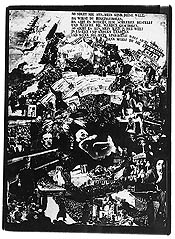
They had some great pieces, including a beautiful Kupka painting called "Stärke Essay," but of course, no postcards available (I've posted a picture done by him that is vaguely similar at the top -- though the one in the museum looked more like a roiling stream of lava eruption hitting the ocean and erupting in steam). There were also some great examples of Soviet avante garde works from the 1920s, and two beautiful and moving collages by Friedl Dicker-Brandeis. Here's one of them:


[Friedl Dicker-Brandeis, "Anti-Capitalist Poster" (1931)]

She was an important artist of the 1920s and 30s, who was imprisoned by the Nazis in the Theresienstadt Ghetto. There she taught children art as a way of helping them cope with the stresses of ghettoization. While she perished with her husband in Auschwitz, much of the work of her young students is now on display in museums in Prague and Terezin.

The post-war materials was stuff I had seen last year and really doesn't interest me that much, so I decided to try to find an ATM that would take my card and just enjoy the ambiance of Vienna. I walked down ultimately to the Stephansdom, where I found an ATM that works (I can only use ATMs attached to banks, apparently).

After that I headed for dinner at Cafe Sperl. This is one of the older cafe houses in Vienna, founded in 1880 (I sat inside on one of the original upholstered window benches, I think). The cafe was mostly empty inside, with most sitting outside on the patio, but I wanted to experience this old classic cafe.


[Cafe Sperl. I sat up towards the front and on the right]

Service was not so much slow as gentle. I ordered the schnitzel and a glass of wine. The schnitzel was excellent, with the veal breaded with sesame, sunflower, and pumpkin seeds, and accompanied with a red current side (the way we in America might put a small dollop of cranberry sauce). There was also a salad of greens with small sliced and cooked potatoes in a kind of mustard sauce. All very good. For dessert I ordered a melange (basically the Viennese equivalent of cafe au lait) and some topfen (cheese) strudel. All of it was very good. Including tip, the whole thing came to about 20 euros, or about what I paid for dinner last night in Prague. I didn't get as much here, but then, Vienna is a more expensive city.

Tomorrow I head out early for Mauthausen. As much as I wish I didn't have to go and could stay here and museum hop (why do I alway book one day less in Vienna than I should?), this is an essential part of this trip. If I hope to take students there next year, I need to go there first myself. Unfortunately, while next year I will take a charter bus, this time I have to spend 2.5 hours on the train and then walk the 5km to the camp (and back). If I hope to have any time tomorrow evening visiting the KunstHausWien (open til 7pm, and half price on Mondays!) I need to leave here by 8:36.

To make this quicker tomorrow, I went to the train station tonight and bought my tickets for tomorrow. I also timed it so I know what time I have to leave the hotel tomorrow morning to make the train (I'm leaving directly from breakfast).

Well, that's all for now. Hope you all have a happy father's day!

Saturday, June 16, 2007

A Perfect Prague Postscript

Ok. For this time, no history, no theories, no intellectualizing. Just one of my food and travel meditations.

By now, I no longer need my guide book to navigate through Prague, so I mailed it and another book back to the U.S. this evening. Then I headed to my favorite restaurant in Malastranka for dinner.

Although it threatened rain and started to drizzle, it never really came down (I suppose that's because I had brought my umbrella). When I got to the Grill U Seminaristy, all the tables were full (since the four exposed tables weren't being used due to the drizzle). They said it would be a short wait, and I said no problem.

I decided that since I had spent all that money (really only $26, but in Prague that's 520 Kc) for so little, tonight I should spend at least as much for something good. I ordered the most expensive of the prix fixe menus: a starter of cheese and Czech salami, the beefsteak flambeed in cognac, and the apple strudel with ice cream for dessert. Oh, and a half liter of beer.

The complimentary aperitif tonight was something call Fernet, which is somewhat like Becherovka, but darker. The steak was excellent as always, with a nice crust and still somewhat pinkish red in the middle. I could choose whatever side dish I liked, so instead of the various forms of potato they suggested, I picked the steamed veggies.

When they flambe the steak, they have a little kitschy skit: the wheel out the flambe table, put on fire helmets, heat the cognac up, turn on the flashing light, and then ignite it. It's cute. A group of Italian guys, one of whom ordered it as well, actually participated in the skit (as all his buddies filmed it on their cell phones).

The strudel was good and the ice cream delicious. They asked if I wanted coffee but I was too full to eat any more. I paid (550 Kc with tip, or $27 U.S.).

There's nothing like a great meal (and plenty of alcohol) to make everything in the world seem perfectly lovely. I needed to walk off some of the food and beer, so I headed for the Charles Bridge. The clouds were gone and the sky was clear and blue, as the sun slowly made its descent over the Castle Hill.

At the far end some musicians in period costume were seranading the tourists lined up for the boat cruise. Last year, with the crowds, heat, and humidity, that would have annoyed me, but tonight I was just amused. I wasn't even bothered by the ubiquitous bands of drinking brits (and spaniards, and italians). I think I understand now why they have to be so loud and aggressive (there was one band of cockneys all dressed as superheroes). With so many more men than women in Prague, the guys need to do something to catch the girls' attention. I suppose all the alcohol is somewhat of a blessing for those unlucky in love.

Well, now it's time to pack and get ready for Vienna. I think I now understand why so many people love this city. Just don't come here in July.


[The Charles Bridge at sunset -- tonight the sky was much clearer than in this photo]

Nazis and Neo-Nazis

I had debated whether I should revisit Terezin (Theresienstadt) since I had gone there last year and seen most of it, but in the end, I figured I had to go, if only to time how long each segment would be with students. Having just gotten back, however, I'm now quite glad I did.

It was a short one-hour bus trip to Terezin. I got to the bus five minutes before departure and groaned when I saw how long the line was to board, and that all the seats were already taken. Luckily, I still got on, but spent the hour swaying back and forth while standing.

The museum and the exhibits have not noticeably changed from last year. I found myself paying more attention this time to the efforts of the children to create their own newspaper in the ghetto (called "Vedem"). The boys who founded it lived in the building that currently houses the main museum. The museum was much less crowded this time, and I was able to see the main exhibits in about an hour. I decided to skip the film (which I've already seen) and walk over the Madgeburg Barracks after a quick lunch.

The Magdeburg Barracks are devoted mostly to the artistic and literary productions of the prisoners in the ghetto. They have recreated one of the living sections to give visitors a sense of what it was like when crammed, literally, to the rafters, but the camera police were in full force, so no photos. In their absence, I've downloaded this poorer image off the internet:


[recreation of women's quarters in Madgeburg Barracks]

Down the hall is a room on composers who were imprisoned in the ghetto, including a display on Brundibar, the children's opera performed in the ghetto. Here's a copy of one of the posters that hung in the ghetto:


["Brundibar" -- composed by Hans Krasa]

If you want to hear the music, by the way, you need to ask one of the "wardens" whose job is to prevent people from taking pictures. They just flip a switch and you can hear excerpts from music composed in the ghetto.

Then there are several rooms of art done by prisoners in the ghetto. Many of these works were prepared in secret to document the real conditions in the "model" "old age home." Here's an example to give you a sense of what this art looks like:


[Leo Haas: "The Arrival of the Children from Bialystok" (1943)]

Several of these artists tried to smuggle their sketches to the visiting team from the International Red Cross in 1944, but the Red Cross guests were wholly taken in by the Germans, and the artists were arrested and charged with distributing "propaganda of horror." Most were either murdered in the Small Fortress or died later in Auschwitz. Haas was one of the few who survived.

I did manage to get one snap shot of a stage set in a room devoted to theater productions in the ghetto (the wardens were off at the time, though one came rushing up 20 seconds later -- I guess she heard the camera shutter, I just acted like nothing had happened). I wanted to buy the video of a performance of "Brundibar," but all the DVDs were in PAL format, which doesn't work in America.

After about a half an hour, I headed towards the Small Fortress, which I had only partially visited the last time. On the way there, I checked out the cemetery to see if there had been any changes to the way the memorial was constructed. The plinths on which writing had originally been affixed are still bare, but I noticed this time that the sign "National Cemetery," still is on the front.


[The Star of David, which was added since the 1989. When the cemetery was constructed, between 1945 and 1954, it was marked only with a large wooden cross, which still stands in the middle of what is almost entirely a Jewish cemetery]

I skipped the museum exhibit on the history of the Small Fortress and the Theresienstadt construction, as I'd seen that the last time. Instead, I took the walking tour of what is essentially a nineteenth-century prison facility. At one point, the path goes through a half kilometer-long "connecting corridor," which traces the original fortifications of the structure. That's about a quarter mile of a narrow, low-roofed tunnel, lit either by bulbs or by small, very narrow windows. Every time I thought I'd reached the end, the exit was barred by a locked gate, and I had to continue further into the tunnel. Finally, I reached the point where the light at the end of the tunnel actually led to an open door and I could finally exit.

This was at the site of the execution grounds within the Small Fort. Again, the place was marked by the concrete outlines of three crosses on the ground, in a place where 90% of the people killed were Jewish. After that the path led back into the Fort, where I had the opportunity to watch a short video form 1965, mostly based on the propaganda films shot by the Germans. It ended, however, with the "El Malei Rachamim" prayer for victims of the Holocaust, and in that time and place, it brought me suddenly to tears.

I was getting ready to head back and only had one last area to visit, when I suddenly noticed a group of about half a dozen Czech men, all but two with shaved heads, who were wearing combat-style fatigue pants, coming into the exhibit room. At least two had t-shirts with the word "hate" printed on them (as part of phrases I couldn't quite make out), while a third had on a black t-shirt which had two guns in red on the front and something about before the last war written on it. Although I can't be sure, as I don't speak Czech, I think they were neo-Nazis or Czech skinheads. I didn't want to get too close (one had what looked like a shiv attached to his belt), but they were clustered around a display on Nazi officers who had served at a Nazi forced labor facility a few miles away.

I was surprised to see Czechs embracing a group that had occupied and enslaved their own country, but I suppose that just as a small number of victims of abuse come to identify with their abusers and become perpetrators themselves, perhaps it could also be true of peoples.

I left and headed back to the main ghetto, stopping off to see the memorial to where the ashes of those who had died in the ghetto and had then been cremated were dumped in the Ohre River. This is another one of those communist-era monuments where there is nothing Jewish-specific at the site.

It got me thinking about the research paper I'm working on concerning post-communist holocaust memorializations. I think of it now as a series of layers building on top of one another. At the bottom, the first layer, are the memorials created by the communists prior to 1989 (though even within this group, there are subtle differences). In most cases, the Jewish specificity of the victims are elided in favor of a more generic "victims of Nazi persecution."

The next layer are those modifications or additions added or made by the state since 1989. In some cases this meant taking away problematic texts or amending them. In other cases, as with the Small Fortress cemetery, it meant adding Jewish symbols to an existing memorial.

The third layer are new memorials created by the state in places where there were none previously, posing the problem of how local collaboration with the Nazis should or should not be depicted.

Finally, there is the top most layer, which are memorials or symbols created by Jews and/or Jewish organizations.

I saw several of these at the Columbarium. To the right of the entrance is the old communist-era memorial, with its generic reference to "25,000 persons" who died in the ghetto (in Czech, Russian, German, English, and French). Then inside is the new text which is much more Jewish specific. Finally, the walls are lined with plaques added by German and Austrian cities, from whence Jews had been sent, as well as smaller plaques put up by individual Jewish families.

After that I was ready to head back. There was only one last bus, which came at 3:43 pm. A group of 20 German students were waiting, along with a dozen others, and almost every seat on the bus was taken before it arrived. I managed to get on, and get the last seat. Since it was the last bus of the day, the driver kept stopping and trying to find ways of shoving in more passengers. I thought the bus would plotz before we ever reached Prague. Proof, if I ever needed any, that if I take student here, I will need to rent a bus.

Anyway, there are to hotel guests waiting to use the computer, so I will sign off for now. Tonight it's back to my favorite restaurant in Malastranka and then tomorrow I head for Vienna.