Friday, June 15, 2007

Splurging

After I woke up from my nap yesterday, I headed out to Malastranka to have dinner in a restaurant I very much enjoyed last year. Called Grill U Seminaristy (according to their card their address is U. Luzickeho seminaire 13 -- but its easier to remember that they are in the shadow of the Charles Bridge), this place does a great trade catering to tourists, particularly Americans.

First of all, they offer you a nice chilled shot of becherovka right when you come in, and who doesn't like to receive free alcohol? The menus are very reasonably priced and the food is delicious. Best of all, the food is not Czech (more on that below).

I ordered the beefsteak, which I asked for medium rare (the waiter said "medium"? -- I guess many Americans order it that way -- and I said no, medium rare and then I added "a point," as the French say). The starter was gravlox with bread and butter. The steak was accompanied by french fries cooked just right: hot and crispy. Dessert was assorted ice cream. I ordered a beer to accompany it and of course, that meant the standard half liter size. While they accept credit cards, they would prefer cash (to avoid the charges), and the whole meal came to 350 krona (to which I added 40 as a tip). All in all, less than $20 for an excellent meal.

I'm really unsure on whether and how much to tip here. My guidebook is particularly useless on this question as it says that service is included, but that Czechs often round up (to what?), but foriegners are expected to tip 10%.

After such a big meal, I walked back across the Charles Bridge. Even though this is the second most touristed place in Prague (after the Old Town Square), it was relatively empty -- at least compared to last year. It had rained briefly earlier, so the sky was clean and clear, with the Castle Hill dramatically silhoutted against the clouds. It was a beautiful evening.

This morning, I got up early to head out to Karlovy Vary. I wasn't sure whether I should go again this year; I would hate for this trip to become too repetitive. But I decided that I should try new stuff there. I headed further up the stream into the heart of the town. I had a nice, light lunch in an open-air cafe near the river, with the beautiful nineteenth-century buildings rising up the hills above me on either side. I went light, so ordered the schnitzel menu, which came with a small bowl of cabbage soup (flavored with what my great-grandmother would have called soup wurstchens), and with a small salad. The dessert (listed only as frische obstkuchen -- fresh fruit cake) turned out to be a torte with peach slices topped with powdered sugar and chocolate sauce -- an unusual combination.

Then it was time to go to the spa. Last year I went to Lazne III -- the old, proletarian public spa; this year I wanted to splurge. I tried the Grand Hotel Pupp -- one of the fanciest hotels in town -- but they told me their spa was for guests only. Going online, I had seen references to the Castle Spa, but I couldn't find it. I had resigned myself to going back to Lazne III, when I finally happened upon it.
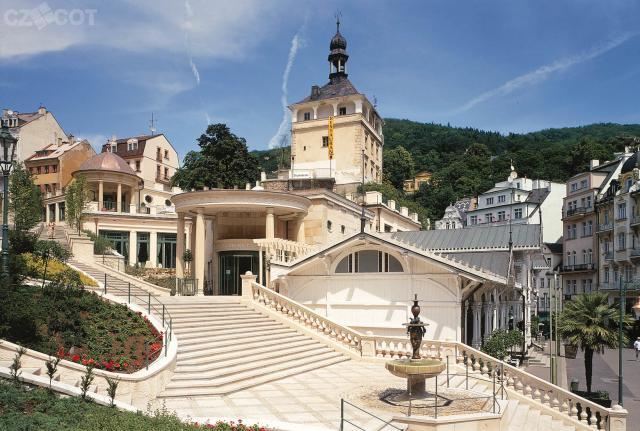

[Entrance to the spa -- it looks a little different in person]

I best combination available to me was the "Classic" three-hour spa treatment. For only 42 euros, I could choose one "major" treatment and two "minor" treatments. I chose the "pearl bath" (literally "bubble" bath in czech), the "electroaerosol inhalation," and the "Kneipp hydrotherapy."

I got into my bathing suit and then wrapped myself in the bathrobe and headed to the pool. They started me off right away with the "electroaerosol inhalation." That's where they put you in a small stone-lined room with these hissing aerosol jets, which are pumping the mineral water into the atmosphere. It feels slightly humid, but isn't damp like a steam room. You're supposed to breathe it in so that it improves your sinuses and lungs.

After that I went swimming in their pool, and then it was time for my "pearl bath." I wasn't sure what to expect (see photo below)


[the "pearl bath" in their brochure]

I basically got into this large, plastic tub, naked, and then the attendent turned on the bubbles. It is a fifteen minute cycle as the bubbles basically stimulate circulation in your outer and inner legs, then your bottom, and finally your back and chest. It all felt a little silly at first, but I was sorry when the fifteen minutes were up. I didn't think it really did anything until I tried to get out of the tub and suddenly felt very, very heavy. I wasn't sure if I was exhausted or just very relaxed, and as I wondered what the difference was, I figured it was the latter, since when I'm exhausted I can't concentrate, but I didn't have any problems doing that then.

After that, I had a nice cup of fruit herbal tea. Around 3pm, they dimmed the lights and did a music and light show over the pool, so I got back in to watch.


[Here's what the pool looks like during the sound and light show]

The final therapy -- the Kneipp bath -- is walking between two very shallow pools, one extremely hot, the other cold. I could've done without that.

After that it was dodging the sudden thunderstorm back to the bus station and the 2 and a half hour bus ride home.

I wanted to have a nice moroccan dinner tonight, but couldn't find the restaurant. My second choice, the Kafka cafe, told me the kitchen was closed, so I ended up at an open-air cafe in the Old Town Square. I ordered the lamb, but it was so overcooked and covered with brown sauce and these tasteless slices of czech dumplings, they could've been serving me horsemeat. I decided to head back to the Municipal House Kaverna for some coffee and cake.


[Inside the Municipal House Kavarna]

I asked for some strudel and a cafe au lait, but the waiter wasn't sure if they had any strudel. After he left, another waiter brought the dessert tray around, so I ordered the black forest cake instead. Bad mistake. Not only was the cake horrible, but a few minutes later my waiter showed up with the strudel. Turns out they have two different dessert services, which are not coordinated. I ate the strudel and left over the cake.

I wanted to read my Hannah Arendt essays in the cafe so I could feel very middle European intellectual, but it was so hot from the overhead lights, I just paid my bill and left.

Thursday, June 14, 2007

Prague Spring

I'm enjoying my trip to Prague much more this year than last's. First, it isn't nearly as crowded now in the middle of June as it was last year towards the middle of July. I've only seen two bands of british stag partiers (though perhaps with the weekend approaching, they may increase). The weather, while still somewhat warm, is not the hot, muggy nightmare of last summer. Finally, the air is perfumed, not with the stench, sweat, and (too often) the vomit of drunken college students on holiday, but with flowering trees. I'm not sure what it's called, but it smells faintly of night-blooming jasmine, only not as strong.

I spent the morning taking pictures of some of the great art nouveau and cubist buildings in Prague. I hoped to upload them, but I couldn't get the computer to read my pictures, but if I find one later that does, I'll upload them then.

On the way to the Cubist museum yesterday I passed by a strange storage container like structure, draped in black fabric, and with a long line of people waiting to get in. It took me a few moments, but I finally figured out it was a "cafe in the dark." I vaguely remembered reading about this fad a few months ago. The idea, as far as I can tell, is you pay a fee for the opportunity to eat and drink in pitch blackness. I'm guessing the waiters have night vision goggles to see the customers. I toyed with the idea of going in (for about 2 seconds) and decided to pass on it. I came back today to take a picture, but they were already disassembling it (it was a one-week special event).

I checked out the Cathedral of Our Lady Before Tyn, but they were having a mass inside. They barely had enough people for a minyan, and the Italian tourists photographing them ("no pictures, no pictures" pleaded the watchman in vain) outnumbered them five to one.

Then I headed down to the Jewish Museum to take a tour of the synagogues. I did this partly to time how long it would take with students, and partly to refresh my recollection of the place. For some reason, they start the tour path with the Pinkas synagogue, which, since it contains the memorial to the Holocaust, should rightfully come towards the end.

Pinkas is a good name for it since it contains the names of all the Czech Jews who died at the hands of the Nazis. I was surprised to notice that in the upper nave there are damaged names from the original installation of 1959. The design of this memorial was set out in the 1950s, but was closed after the "Prague Spring" was crushed in 1968. Only after the fall of communism in 1989 was the original museum restored. In this way, the exhibit parallels the fate of several holocaust monuments in Poland, which also were closed, damaged, or destroyed after 1967. The catalyst there, however, was partly the Six Day War, but also the purge of Jews from Poland.

What they have in common is that both campaigns were the result of new hardline positions within the respective communist parties. In Czechoslovakia, it was a product of the Soviet occupation and the neo-Stalinist government put in place in 1968. In Poland, it was an internal struggle between those who wanted a more liberal approach, and a group known as the Partisans, who combined an ethnic Polish nationalism with rigid communist ideology. But in both cases, the effect was the same regarding the Jews: suspicion and persecution.

Upstairs was the moving collection of children's drawings from Theresienstadt. It is impossible not to be moved to tears by these sketches, which are both childlike in their execution yet so adult in their subjects. The valiant artist-teachers who inspired these drawings did so to help the children cope with the horrors of life in what was a rather elaborate concentration camp. Most heartbreaking to me were the depictions of what the children most hoped for: a return to their homes or a new life in Palestine. The contrast between the dreamlike image of a parade of happy children with banners flying, marching back to Prague, or playing under the blue sky and hills of Erets Yisrael, and the nightmare fate that waited for almost all of them at the end of the deportion train to Auschwitz is unbearable.

From there I walked through the old Jewish cemetery to the house of the burial society. One of the most amazing things in this house is a cycle of paintings, excuted in the late 18th century, depicting the role of the burial society members, from visiting the sick to washing the dead, accompanying them to the grave, and then comforting the mourners. It is a wonderful way of teaching one of the greatest values in Judaism: about caring for the sick, honoring the dead, and consoling the living. Not for the first time, I wished there was some way to purchase a book containing the complete set of paintings (I know exactly who I'd give it to, too), but I can't find it anywhere for sale.

I did, however, find a couple of them on line, so I'm going to post them below.


[Praying with the dying]


[Washing the dead body]


[Consoling the bereaved]

From there I headed out to the other synagogues on the itinerary. At the Alt-Neue Schul, I finally heard the real reason for the odd name. When it was built in 1270, it was the "new synagogue." Over time, though, other new synagogues were built, and it became the old "new synagogue," hence its current name. I had davened here last time and never got to the women's gallery (for obvious reasons), but today I was told, you can only visit it during prayers, so I guess I'll never see it. The barrier between the main sanctuary and the women's gallery looks to be two feet of rock, and I was curious what the women could see from their section.

By the time I got to the Spanish synagogue, I was beginning to fade, and as I walked to the Meisl synagogue I knew I was beat. I had been going from synagogue to synagogue for two and a half hours and I had reached my limit. I've got to find out how logistically I can take students through all this. How do I get all their tickets in advance? Do I need to hire a guide? Oy.

I decided to have lunch at the cafe next to the very art nouveau Municipal Theater. It took a while for them to take my order and I began to get nervous. Only later did I realize that I had sat down by myself at a table for four, rather than at one of the smaller tables for one or two. The cafe was only a quarter full when I arrived, but soon filled up, and I felt bad about hogging a whole large table to myself.

I ordered the grilled chicken and some mineral water (which I downed in two gulps). The chicken was pretty good but I'm pretty sure it was cooked in fat back. The potato was boiled, cut in two, topped with sour cream, and cheese in to which was mixed some bacon, all of which was then browned in a broiler. I ordered a second water and then paid and left.

Although the meal plus tip came to $19, I figured I saved nearly that much today by passing off my faculty card as a student ID to get the discounts on museum entries.

From there I headed to the Mucha Museum, which is a lot of art nouveau. Pronounced "Mukha" (with a gutteral "h"), he was the premiere stylist of art nouveau in Paris and Prague. Tons and tons of ornate, curving posters. During the film of his life, though, I started to fade again. I decided I was museumed out for the day, and walked to a nearby cafe for an ice tea and ice cream sundae (I figured I was good at lunch with ordering relatively low fat entrees -- there was even a salad! -- so I could treat myself to a few calories). I read some of the new International Herald Tribune that I bought (more depressing news out of Iraq) and now I've come back to the hotel to take a nap before dinner.

Wednesday, June 13, 2007

The Wonderful World of Communism

On Wednesday afternoon I headed off to check out two small museums close by each other: the House of the Black Madonna and the Museum of Communism.

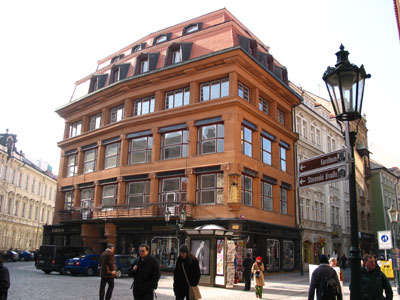
I had tried to visit the first last year, but it was closed because of a its A/C had shut down. It's one of the first Cubist buildings in the world.


[The House of the Black Madonna]

I'm still not sure the A/C was back on, but the building is marvelous. The museum is on three small floors and has sketches, paintings, sculptures, and even furniture all influenced by Cubism. There were photos of other Cubist-inspired buildings and they had a "Cabinet of Dr. Caligari" feel to them. I picked up a book on Cubist architecture and I'm mailing it to myself tomorrow, along with the catalog of the Otto Dix exhibit in Dresden, and Paulo Coehlo's "The Alchemist," which I read on the plane (a very light read and the punch line of the story comes right out of Eastern European Jewish fiction -- really!).

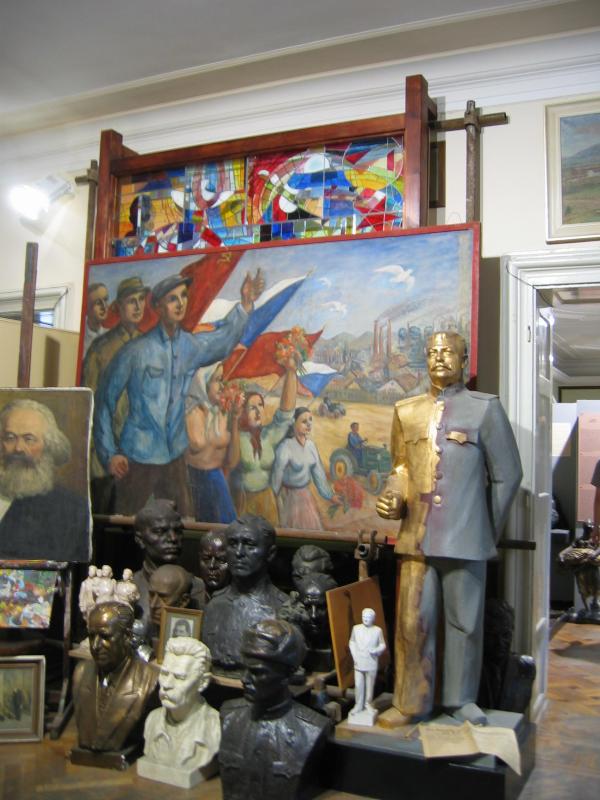
Then it was on to the Museum of Communism. I visited it last year and found it engaging and at the same time moving. What it lacks in nuance it makes up for in dry humor. I didn't take my camera today (sometimes it feels like a ball and chain), but I've downloaded some photos to give you a feel for what it is like.


[The sign for the museum]


[Typical museum exhibit]


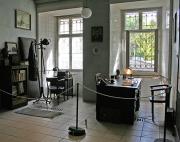
[Recreation of the head of the Czech Secret Police's office]

There isn't a museum catalog per se (it's a private for-profit group), but they did have a cheaply printed text, which I bought to use in my research on post-communist holocaust memorials. While there's nothing about the holocaust in this museum, it fits into the larger question of dealing with the communist past.

I decided to try a vegetarian restaurant near the hotel for dinner. I had the mushroom/green bean "meat" balls in a white wine cream sauce over mashed potatoes, along with a bottle of czech beer. Not exactly low in starches. Instead of a second beer, I had a virgin mojito, which was pretty good (as was the main course, but too large a portion -- not that I had to finish it but, of course, I did).

Afterwards, I took a long walk down to the bottom of Wenceslas Square to enjoy the cool (if slightly humid) evening.

For Future Reference


[This picture was taken during commencment when we graduated our first major (it was just e-mailed to me).]


[This is an amazing piece in the Gruenes Gewoelbe (the Green Vault) that recreates the birthday of the moghul emperor.]


I was pretty tired yesterday afternoon, so I went to a brew-pub restaurant (I think it was called Watzke) in the Neustadt area, not too far from my hotel. I ordered the sauerbraten and a small beer. Too late, I remembered that I wanted to lose weight on this trip and drinking beer is no way to do that. On the other hand, I'm remembering that in Central Europe, beer is always the most affordable thing on the menu.

The sauerbraten was OK (my mom's is better), the potato dumpling mostly inedible, the red cabbage tasty, and the beer was pretty good. The weather started to look threatening (it had rained earlier in the afternooon) so I paid my bill and started to walk back. I was two and a half blocks away when it started to rain. I thought the weather had cleared up so I had left my umbrella in the room. No real damage done, thankfully, and it gave me a chance to work off some of my dinner by running out of the rain.

I stayed at the ANA Hotel because the hotel I stayed in last year had no availability. This one was a little cheaper and felt it. The bed was pretty saggy and I ended up sleeping on the edge against the wall, since no one normally slept there and the bed still had some support there. That being said, I slept about 9 hours last night, so it couldn't have been that bad.

Breakfast at the hotel was passable, nothing too exciting, and after checking out, I headed to the Gruenes Gewoelbe. The museum didn't open until 10am, but I was told to be there by 9 if I wanted to get tickets to the Historic section. There was already a long line, but I stood, and stood, and stood. The only excitement was the older German gentleman who arrived about 30 seconds after me and kept trying to nudge ahead of me in queue. I've shopped too many times at Eilat Market, however, to be caught off guard by a beginner, and I slowly maneuvered my body so as to force him to step back and recognize my priority.

After about an hour and a half of waiting I finally got in, only to find the that all the morning tickets had been sold and that they only had afternoon times still available. At that point, I had no choice but to go to only the New section. Even if I hurried through, I would barely make the later (2:46 pm) train to Prague. Besides, after standing for an hour and a half, I just couldn't face waiting all that extra time, so I limited myself to the New section.

Not that it felt like a compromise. The stuff they have there is stunning. It includes the world's largest green diamond, a mechanical clock of gilded silver and precious stones, which marks the seconds by descending ball of rock crystal, an ornate (and never used) coffee service of silver, gold, and crystal, and an incredibly detailed scale reproduction of the birthday celebration of the moghul emperor, complete with elephants and camels, all made out of gold, silver, and precious stones (it took eight years to complete).

Then I went back to the hotel (having done something I didn't do last year -- which was to master the Dresden tram system) and to the station where I took the train to Prague.

Last time I was in high summer; now it is late spring. The fields which were then brown are still green and the city, though slightly humid, is still comfortable. I had no trouble finding my hotel and I even remembered exactly how to turn out of the metro station. I noticed yesterday that this feels more like an extension of my last trip than a different one, and it's hard to imagine a whole year has passed since I was here last time.

Well, I'm off to the Cubist museum and then the Museum of Communism.

Tuesday, June 12, 2007

Safe and Sound in Dresden


This is the second time I've written this. I completed the entire entry, tried to attach a photo, and crashed the whole thing. I've tried to now add to the start of this entry.

Despite lots of delays (we nearly ran out of fuel after being in a holding pattern for an hour over Newark -- followed by two hours waiting on the tarmac in the second plane) I was finally on my way to Germany. I took an Ambien after dinner and managed to sleep over four hours -- an all-time record for me.

As a result, I didn't get to Dresden til about 3 pm on Tuesday. After checking into my hotel (about two blocks from the 18th century dairy I visited last year, I went in to the Altstadt. The Grünes Gewölbe (what my mother calls the world's biggest and most expensive tchochke collection) is closed on Tuesday, so I went to the Zwinger instead.

I really wanted to check out their small modern collection temporarily housed in the Old Masters Gallery. Until the work on the New Masters Gallery is finished, they have temporary excerpts in it. Right now, they are featuring work by Otto Dix, an important post-WWI German artist. Banned by the Nazis as "degenerate," his most powerful piece was the triptych titled "The War," which I've tried to show at the top of this post.

This just blew me away. It is by no means a pretty or comfortable piece to look at it, but in its raw power, in my opinion, it far exceeds that of Picasso's Guernica, composed 7 or 8 years later. It also anticipate, in its middle panel, the work of Francis Bacon. Worth the price of admission alone.

Well, time to get some dinner. Some of you have posted comments on this blog, which is fine, but I've set up a system where I moderate them. That means they don't get posted until I approve them. That way, I don't find out two months ago that you had something to say about what I wrote. That also means your comments won't appear until I approve them -- something I can only do about once a day or so. So don't panic or repost them several times wondering why you can't see them up yet.

Sunday, June 10, 2007

I'm Leaving, On a Jet Plane

All my bags are packed, I'm ready to go. Well, almost.

I finally finished choosing my clothing. I try to remind myself that I have to live with my choices of shirts for the next thirty days. If I change my mind, my only option is to buy something new.

The last thing was deciding what books I want to read on my trip. I picked up Paul Coehlo's The Alchemist, mostly because I heard him interviewed on NPR yesterday morning. NPR is a pretty good arbiter of middle-brow tastes, and my tastes are about as middle-brow as they come. I happened upon a whole display of his books at Border's and I noticed that all of them had the blurb "by the internationally best-selling author of The Alchemist," so I figured it was his best work (or at least the most popular).

I wanted to balance something serious off against that, so I decided to bite the bullet and finally read Hannah Arendt. Most people assume I've read her work, but I focused much more on nineteenth-century thinkers and never quite got to her. I'm rather embarrassed by this, actually, and just nod when people mention her name, hoping I won't be called on to say anything substantive about her.

Anyway, this trip seemed like a good way to catch up, so I picked up The Portable Hannah Arendt; I'm hoping it lives up to its name.

I've got some crossword puzzles and the new Harper's on how to deal with the multiple failures of the Bush administration to keep me occupied on the flight. Then an Ambien to sleep on the overnight leg so I arrive in Germany fresh and alert.

So that's it. Monday morning my plane leaves for Newark bright and early at 8 am, God-willing with me on it. Next stop, Berlin.

Tuesday, June 05, 2007

Hasidic Trance

Last semester I taught Eastern European Jewish History and in our last class we looked at the afterlife of this culture. We focused on two aspects of this question: the resurgence of interest in Jewish culture in an Eastern Europe almost devoid of Jews, and the attempts to preserve or adapt this culture outside of Eastern Europe.

One of the oddest aspects of the latter is the adoption by a breakaway group of Breslov hasidim of a Moldovan trance song put out by a boy band called O-Zone. Popularly known as the "Numa Numa song," these hasidim have changed the lyrics to "Rebbe Nachman, Nachman may-Uman, Nachman may-Uman, Rebbe Nachman may-Uman" [Rebbe Nachman from Uman].

Now there is a longstanding hasidic tradition of taking secular or profane melodies and elevating and sanctifying them by giving them a religious meaning. In the old days, it was Ukrainian folk tones, now it's Moldovan electronica. What's even odder is that many of these Breslov hasidim aren't Eastern European at all, but mizrachi (Eastern) Jews who have embraced this offshoot.

So basically, we've got here Moroccan Jews dancing to Moldovan electronica in celebration of Ukrainian hasidic rebbe. I can't think of a better example of the dynamism of culture.

I'm posting below three clips of dancing Breslov hasidim.

The first is in Kikar Tziyon (Zion Square) in Jerusalem:


The second is on an Israeli highway after a minor traffic accident:


The third is at the annual Breslov pilgrimage to Rebbe Nachman's grave in Uman for Rosh Hashanah last year (note the mizrachi music and hip hop hasidic kid). It's a modern-day hasidic Woodstock:

Saturday, June 02, 2007

Testing, testing


I'm getting ready for my trip this summer and I would like to experiment a bit with posting some photos. So here's a recent one of me at this year's commencement, all dressed up in my medieval robes.

Tuesday, July 25, 2006

Nearly Home (July 25)

Well, it's the end of a very long day.

Up at 4:40 am this morning to catch my flight, then two security checks at Frankfurt airport (passengers flying to England get an extra second, more intense round of metal detectors), then passport control and another security check in England, followed by customs and yet another security check in New York. At least this time, I was selected for the special chemical analysis check at each stop as I was on my outbound flight.

I'm staying with friends in West Los Angeles, before heading down to San Diego tomorrow to pick up my car. Then I'll head home to check out how my dorm room is doing in the summer heat and make sure my portable air conditioning unit is working after a two month rest.

That being said, the air felt cooler and dryer in LA than in Europe, so I think as a baseline, it's going to be better here.

Monday, July 24, 2006

The Beginning of the End (July 24)

Well, I've begun my trip home.

I managed to achieve my goals this morning, visiting the grave of Leopold Zunz and then making some last-minute purchases at KaDeWe.

No problems at Berlin Hauptbahnhoff getting my ticket, but I had someone help me through all the multiple screens of the automated system. This has to be one of the most complicated ticket-purchasing systems on the planet. After you finally figure out the first machine, you have to take the print out to the second where you actually pay for and receive the ticket.

My hotel in Frankfurt is only one u-bahn station from the hauptbahnhoff. I'm at the airport right now trying to pre-check in for my flight. That way, I'll only have to be at the airport by 6:00 am to go through the two security checks, as opposed to 5:30.

Unfortunately, they won't let me do early check in until after 7pm, so it looks like I'm going to have dinner here while I wait. As long as it isn't McDonald's; so far I've avoided all American chain restaurants during my entire trip to Europe.

Sunday, July 23, 2006

Wannsee (July 23)

Well, out of the frying pan into the fire. We have exchanged high heat for high humidity. It's hard to know precisely which is worst

Still, I slept in til 8 am and after breakfast headed out to Wannsee. This is often described as a suburb of Berlin, but it really is where wealthy Berliners built summer homes at the turn of the century, in order to enjoy the forests and lakes. My goal today was the house where the Wannsee conference was held.

In films, such as "Conspiracy" or even in Lanzmann's "Shoah," I had gotten the impression of a large, isolated mansion. In fact, it is located on a side street of similar summer homes and, while set back from the street, is not any further back than the houses of its neighbors, nor is it significantly larger. The house is in no way remarkable, other than the fact that the implementation of Nazi genocide was planned there.

Not the decision to commit genocide; that was made some (maybe 2-3) months before by Hitler and Himmler. This was where Himmler's assistant, Richard Heydrich, gathered the leading bureaucrats together to agree to his leadership of this project. When he was assisinated a few months later by Czech partisans, the named the major death camps in his honor.

Even though the house has recently undergone extensive renovations, no one bothered to add air conditioning, so we all had the soft drip drip of sweat from the humidity, accentuated by the heat from the display lighting. The display on the origins of racism, the rise of antisemitism, the rise of the Nazis and the increasing persecution of the Jews is all handled quite well, as is the material covering the early years of the war. The exhibit nicely distinguishes between the murderous policies of the Nazis during the first two years of the war and the growing extermination campaign that began with the invasion of the Soviet Union.

At that point, we move into the conference room itself, where the surviving copy of the protocols (and an English translation) is on display in the center of the room, so that one can read for oneself the complete text (it's not very long). On the walls, there are biographies of the participants, with each ending with the individual's fate after the war. Those who didn't die in the fighting, rarely received more than a few year's imprisonment for their actions. It was Stalin who said that the death of one person is a tragedy, the death of a million is a statistic.

I decided not to have lunch next door, but instead walked 10 minutes down the road to Max Liebermann's villa. I had noticed it from the bus, and I thought it would be much more pleasant place to eat. Liebermann was one of the leaders of the Impressionist movement in Germany, and by the 1920s had become the head of the Prussian Arts Academy. At the turn of the century, he built this summer house in Wannsee, and put particular emphasis on the garden, which he incorporated in many of his paintings. The house and gardens have recently been restored, and it was a nice respite from my earlier tour of the Wannsee Conference house.

Not that one can ever really escape awareness of the Holocause anywhere in Europe. Liebermann was Jewish and forced to resign his post by the Nazis in May 1933. At his 87th birthday party in 1935, the Nazis tried to discourage non-Jews from attending. Liebermann died later that year and his daughter and granddaughter escaped to America in 1938, but his widow was forced to give up the house in 1940 when it was "aryanized," and she committed suicide in 1943, when faced with deportation to the Theresienstadt ghetto.

After touring the house and gardens, which are lovely (but not airconditioned), I made my way to my last museum for this trip: the Brücke Museum in Dahlem. This was rather complicated, as I had to first take a bus, then the u-bahn, and then a second bus, but it wasn't that bad. The museum is small, but quite enjoyable. The current exhibition strongly emphasizes the work of Karl Schmidt-Rottluff, with several works showing the strong emphasis of Seurault, Van Gogh, and other French Impressionists and particularly Post-Impressionists on the work of these German artists at the forefront of German Expressionism. A truly delightful museum and well worth the small effort to find it.

My only trouble was not buying the set of 3 large exhibition catalogues on sale for an absurdly low price. I just kept reminding myself that even if I threw out all my clothes so that it would fit, it would still weigh too much to lift repeatedly, as I will have to the next few days.

So now all that's left is to find some souvenirs as gifts for my niece and nephews, and have dinner. Today is really the last full day of being a tourist. Tomorrow morning I'll make a quick stop at the Schönhauser Allee Cemetery, where the man who founded my profession, Dr. Leopold Zunz is buried. Then one quick visit to KaDeWe again before taking the express train to Frankfurt. After that, I'll really be more in transit than on vacation. I have to get up ungodly early on Tuesday for my flight back to the States.

Wannsee (July 23)

Well, out of the frying pan into the fire. We have exchanged high heat for high humidity. It's hard to know precisely which is worst

Still, I slept in til 8 am and after breakfast headed out to Wannsee. This is often described as a suburb of Berlin, but it really is where wealthy Berliners built summer homes at the turn of the century, in order to enjoy the forests and lakes. My goal today was the house where the Wannsee conference was held.

In films, such as "Conspiracy" or even in Lanzmann's "Shoah," I had gotten the impression of a large, isolated mansion. In fact, it is located on a side street of similar summer homes and, while set back from the street, is not any further back than the houses of its neighbors, nor is it significantly larger. The house is in no way remarkable, other than the fact that the implementation of Nazi genocide was planned there.

Not the decision to commit genocide; that was made some (maybe 2-3) months before by Hitler and Himmler. This was where Himmler's assistant, Richard Heydrich, gathered the leading bureaucrats together to agree to his leadership of this project. When he was assisinated a few months later by Czech partisans, the named the major death camps in his honor.

Even though the house has recently undergone extensive renovations, no one bothered to add air conditioning, so we all had the soft drip drip of sweat from the humidity, accentuated by the heat from the display lighting. The display on the origins of racism, the rise of antisemitism, the rise of the Nazis and the increasing persecution of the Jews is all handled quite well, as is the material covering the early years of the war. The exhibit nicely distinguishes between the murderous policies of the Nazis during the first two years of the war and the growing extermination campaign that began with the invasion of the Soviet Union.

At that point, we move into the conference room itself, where the surviving copy of the protocols (and an English translation) is on display in the center of the room, so that one can read for oneself the complete text (it's not very long). On the walls, there are biographies of the participants, with each ending with the individual's fate after the war. Those who didn't die in the fighting, rarely received more than a few year's imprisonment for their actions. It was Stalin who said that the death of one person is a tragedy, the death of a million is a statistic.

I decided not to have lunch next door, but instead walked 10 minutes down the road to Max Liebermann's villa. I had noticed it from the bus, and I thought it would be much more pleasant place to eat. Liebermann was one of the leaders of the Impressionist movement in Germany, and by the 1920s had become the head of the Prussian Arts Academy. At the turn of the century, he built this summer house in Wannsee, and put particular emphasis on the garden, which he incorporated in many of his paintings. The house and gardens have recently been restored, and it was a nice respite from my earlier tour of the Wannsee Conference house.

Not that one can ever really escape awareness of the Holocause anywhere in Europe. Liebermann was Jewish and forced to resign his post by the Nazis in May 1933. At his 87th birthday party in 1935, the Nazis tried to discourage non-Jews from attending. Liebermann died later that year and his daughter and granddaughter escaped to America in 1938, but his widow was forced to give up the house in 1940 when it was "aryanized," and she committed suicide in 1943, when faced with deportation to the Theresienstadt ghetto.

After touring the house and gardens, which are lovely (but not airconditioned), I made my way to my last museum for this trip: the Brücke Museum in Dahlem. This was rather complicated, as I had to first take a bus, then the u-bahn, and then a second bus, but it wasn't that bad. The museum is small, but quite enjoyable. The current exhibition strongly emphasizes the work of Karl Schmidt-Rottluff, with several works showing the strong emphasis of Seurault, Van Gogh, and other French Impressionists and particularly Post-Impressionists on the work of these German artists at the forefront of German Expressionism. A truly delightful museum and well worth the small effort to find it.

My only trouble was not buying the set of 3 large exhibition catalogues on sale for an absurdly low price. I just kept reminding myself that even if I threw out all my clothes so that it would fit, it would still weigh too much to lift repeatedly, as I will have to the next few days.

So now all that's left is to find some souvenirs as gifts for my niece and nephews, and have dinner. Today is really the last full day of being a tourist. Tomorrow morning I'll make a quick stop at the Schönhauser Allee Cemetery, where the man who founded my profession, Dr. Leopold Zunz is buried. Then one quick visit to KaDeWe again before taking the express train to Frankfurt. After that, I'll really be more in transit than on vacation. I have to get up ungodly early on Tuesday for my flight back to the States.

Saturday, July 22, 2006

Pride Day Berlin (July 22)

Well, it's actually called Christopher Street Day Parade here, the Berlin counterpart to Christopher Street West in Los Angeles, all of which take their cue from Stonewall in New York, but by any name it's still Pride Day.

The weather for it is wonderful, by the way; it's the coolest I've been since I left Prague. Temperatures in the mid to upper 80s F.

As the date for my return to the U.S. draws near, I've started to worry about all the work waiting for me back in Long Beach. In fact, I had a brief panic attack at 4 am, but managed to convince myself to fall back asleep. I'm going to try to put off thinking about as long as possible.

After breakfast I mailed my last postcards and headed to the film museum. This is in Potsdamer Platz and traces the history of German cinema from 1895 to the present. Most of the displays are on pre-Nazi cinema, with lots of material on the making of The Cabinet of Dr. Caligari, the films of Murnau and Fritz Lang, but the real heart of the museum is Marlene Dietrich. There's virtually a shrine to her, with dresses, traveling items, diary entries, and a variety of short clips and images.

I grabbed a quick sandwich at Zoo Station, and then headed up to the Bröhan Museum, right across the street from Schoß Charlottenburg. This was a former private collection devoted to art nouveau and jugendstil. At first I thought it wasn't that interesting, but as I went further I was impressed by several of the pieces. Willy Jaeckel, for example, had some interesting works, though none were included in the postcards in the gift shop. (Here's an example of one painting of his: http://www.artfacts.net/artworkpics/2671b.jpg ). One of his more striking paintings, called simply "Paar", showed two naked figures, both apparently male, embracing.

From there I headed to Wittenburg Platz to catch the parade. I followed it all the way from there as it wound its way through Schönberg to the Brandenburg Tor and the Tiergarten, ending at the Siegesäule, Imperial Germany's statue honoring the wars it won (in the 19th century, obviously). All together, this was a loop that took nearly four hours. But with the cooler temperatures, a liter and a half of water, and carefully staying on the shady side of the street, I did alright.

I noticed some differences and similarities with other pride parades I've been to. It was much less political than either DC or New York; there were a few anti-AIDS and anti-defamation groups, and some political parties represented, but there was little in the way of community organizations that really define pride parades in the States. Even LA is more political than Berlin, and LA really isn't that political at all.

As usual, the clubs have the biggest floats which are covered with dancers. The music was all the classics from ABBA to Madonna to the Village People, with some Tarkan thrown in. I was really surprised when I heard "Ma Baker," a song I remember from my summer camp. This was a huge dance hit in Europe and Israel in the 1977, but got virtually no air play in the U.S. (To find out more about this song, check out the wikipedia entry: http://en.wikipedia.org/wiki/Ma_Baker ). I hadn't heard it in years.

One major difference I noticed with American pride parades didn't hit me until the end when I realized I hadn't seen the religious right counterdemonstration. As far as I could tell, there wasn't any. There were, however, a few floats making reference to the recent violence in Poland directed against gay rights groups there, as well as persecution in Central America, Iran, and Russia. Just a few days ago, the paper had an article referring to a speech made by one of the twins governing Poland (the President and the Prime Minister are twin brothers), denouncing EU values -- such as equal rights for gays and lesbians -- that he thinks conflicts with Poland's traditional values. It would seem to me that intolerance, violence, and persecution are not values to be particularly proud of.

By the time I reached the Siegessäule in the Tiergarten, I was pretty tired. I still had a half hour walk to get back to Zoo Station, so I took some rest stops at benches along the walk. In the shade of the trees, the park and city are quite pleasant. I only wish I could have had this weather for my entire stay here, instead of just at the end.

Tomorrow I'm heading to the southwest of the city to visit the mansion in Wannsee where the conference was held in January 1942, and then stop off at the Brücke museum on my way back. Then I need to pick up my train ticket for Frankfurt for Monday.

I can't believe my trip is nearly at an end. Part of me can't wait to get back to air conditioning and really clean clothes (as opposed to clothes that have been washed in the sink for two months). Wearing different clothes would also be nice, as would sleeping in my own bed. On the other hand, it's been so long since I was out of the U.S., part of me fears that it will be another 7 years before I come back (though I'm hoping for next summer).

Friday, July 21, 2006

I'm melting.... (July 21)

Well, it was supposed to be cooler this morning, but it sure didn't feel it.

After breakfast I had to pack up my things as I'm changing rooms in the guesthouse (it has to do with problems I had in booking all six days). Then I headed down to the local Prenzlauerberg museum. It was a small, local affair. The first set of displays were on the history of the highschool where the museum is located, as well as a set of pictures of the neighborhood using postcards. Unlike the museum at Nowy Targ, which also used postcards, this one actually grouped them by theme and provided captions where necessary.

Also unlike the museum in Nowy Targ, this one also included a whole set of displays on Jews in Prenzlauerberg and particularly on the Rykestraße Schul. There were many photos of Jewish schoolchildren on outings, with their teachers, in classes, etc. After Jewish students were expelled from public schools by the Nazis, these Jewish schools became their only source of education. I was particularly moved by the list of the teachers and their ultimate fate.

Although my grandmother grew up in Prenzlauerberg, it was very unlikely that she attended either the Jewish school or the high school. My great-grandparent's apartment was in the southernmost section of Prenzlauerberg, about half a block from Tuetobergerplatz, so she probably went to high school down there.

Last time I was in Berlin, I checked out the block of Templinerstraße where my great-grandparent's apartment was. It was all undergoing gentrification, which now proceeds along adjacent streets. This part of Prenzlauerberg seems to have escaped significant damage by allied bombardment, and a lot of the building facades seem to be pre-war. The building looks quite nice, though I know that it is highly unlikely that my great-grandparents -- one of whom was a mostly unemployed tailor and the other sold herbs at a stand in the open-air market -- could have afforded one of the nice apartments fronting the street. Most likely, their apartment was one of the poorer, smaller apartments facing the back courtyard.

I walked down to my grandparent's last apartment on Linienstraßse in the north end of the Scheunenviertel. The area on what is now Rosa Luxemburg Platz where my grandfather had his first beauty salon is now a small triangular park. Even though it was only 11 am, I was covered from sweat from the heat, and my head was hurting slightly, as if my brain was melting from the heat. I found a cafe around the corner from the Karl Liebknecht Haus (still communist party headquarters in Berlin), and got some soda water.

Then I headed down to find the new DDR Museum. Unfortunately, it turned out to be a half-hour walk, by which time, I was seriously exhausted. I did run across a group of Israeli tourists and we got to chatting. I asked if they were on a heritage tour, but they said no, just for fun. We joked about the heat and how at least in Israel there's air conditioning. One joked, we (meaning me) should head back there now. It's strange, the kind of raport that I feel with the Israelis I've met on this trip. Sort of a landsman experience.

The DDR Museum was a real trip. This is quite different from both the Museum of Terror in Budapest and the Museum of Communism in Prague; it is much more nostalgic than either. The Budapest museum was all about how unremittingly evil the communists were, while the Prague museum poked fun at their foibles, but also went into detail about political and social repression. The museum in Berlin, however, is much more about the social and every day life of Germans in the German Democratic Republic (the DDR auf Deutsch). A lot of the exhibits involved all sorts of clothing, utensils, and products that typified East German life, along with a full-sized Trabant in the entry way.

While the museum also dealt with Stasi surveillance and the wall, it got much lower key treatment than in the other museums I've been to. At the same time, it does make quite clear how limited the options for East Germans was in evading the state. My favorite part was the film clip of an East German fashion show, which was just laughably bad. There was a Spanish-language film crew following a reporter as she toured the exhibit. They stopped for a while in front of the East German answer to American blue jeans. Called boxers, many people complained that while the color in the pants wouldn't fade over time, it would ruin the fabric of any clothing worn with it. The entire exhibit ends with an extended exhibit on the East German penchant for clothing-free holidays, something which has been somewhat restricted since reunification.

After that I headed towards West Berlin to get a new travel pass and some lunch. At Alexanderplatz, the thermometer read 38, two degrees celcius higher than yesterday's record-breaking 36.1. By the time I reached Zoo Station, my head was pounding again. I decided to eat at Mövenpick, even though it's too pricey, just because they have AC. I had a nice assortment of salads, two diet colas, and a cool, tasty dessert of whipped lemon foam and raspberry sauce, all for 17 euros. More importantly, I had an hour of AC to cool off.

When I came out there was a bit of a breeze and some clouds in the sky. Hopefully this bodes well for a cooling front. Tomorrow is the annual Christopher Street Day parade in Berlin, but there's no way I'm going to spend any time in full sun unless the weather breaks.

I headed over to Potsdamer Platz. I saw the designs for this years ago, and the realization of them is a little strange. It's sort of like a stand-alone city, with not much else connected to it yet. There's also an odd urban wetland system they've created, but I wasn't quite sure how it was supposed to purify rainwater or prevent flooding.

My goal was the Neue Nationalgalerie, whose building was one of Mies van der Rohe's last designs. This normally houses the major collection of late 19th and 20th century art, but when I arrived, I saw that it the entire space had been dedicated to a new exhibit on Berlin-Tokyo, Tokyo-Berlin: the cultural and artistic interchanges between the two cities and societies. A little disappointed, I bought a ticket figuring to make the best of it; I mean, other than WWII, what sort of relationship was there?

It turns out I was in for a major and very pleasant surprise. The exhibition opened with several beautiful color prints from Meiji-era Japan, including one of Berlin from a book on capitals around the world, all reflecting the rapid modernization that had taken place in just a few years (though the audio guide gives the false impression that Japan opened up voluntarily). But the next room was even more impressive. It included works by German avante-garde artists, such as Kirschner and Emil Nolde, reflecting their interest in Japanese art. These included several water color and ink sketches done by Nolde on a visit to Japan in 1913.

But this interest didn't just run in one direction. The museum exhibition recreates (as much as possible) an exhibition of German avante-garde works that took place in Japan before WWI. It also includes works by Japanese artists who were strongly influenced by this new art. I was particularly moved by one painting of a running deer, which combines elements of Italian futurism with German expressionism. I couldn't find a print of it online, but here is a similar piece by the same artist: http://www.gallerysugie.com/mtdocs/artlog/archives/images/06.03.Fumon.jpg

The next part of the exhibit dealt with the influence of Dada and the Neue Sachlichkeit on Japanese artists, including one side by side comparison of Georg Grosz with a Japanese counterpart (whose name escapes my memory). There are explorations of German influence on Japanese architecture and Japanese influence on Bauhaus architects, followed by a look at the political and artistic relationships during WWII.

The exhibit also covers the extensive post-war relationship, but I must confess I've never particularly liked most post-war art. I find that in it's effort to shatter the values that led western civilization into the war, artistic aesthetic is often sacrificed for the larger political message. Still, it was interesting to see again how the two special exhibitions I saw in the Vienna modern gallery -- on the Vienna aktionismus and the Neue Realismus -- keep recurring in many of the modern art museums I've visited.

One of themost spectacular works in the exhibition is a quite modern one by the Japanese artists Yayoi Kusama, called "Dots Obsession." To see it, click on the link: http://www.kunstmarkt.de/pagesmag/kunst/_id99967-/marktberichte_grossbildansicht.html?_q=%20

After that I wandered over to the Memorial for the Murdered Jews of Europe, which is located only a few blocks away. From the outside, it appears like a field of charcoal grey tombstones, arranged in rows. As you enter them, however, the ground seems to undulate, and you begin to notice that each pillar is placed individually, not always perpendicular to the ground. As you go deeper into the monument, the pillars grow higher, blocking one's view. To the extent they evoke impressions of Jewish cemetaries, than one finds oneself walled in by ever higher stacks of the dead.

At one end is the museum of the memorial. It is below ground, and in some way the pattern of the stelae on the surface is echoed by the standing information displays below. Each one covers one Jewish family during the Holocaust. In a final room, a voice reads out the biography of one victim, in a process that will take several years to complete. As you leave, there are computer terminals where you can access the Yad Vashem database on victims. As always, I have to remind myself to have my great-grandmother's information entered when I get back.

After that I headed back to my hotel and then to dinner. I tried an Italian restaurant in the neighborhood. By now, the weather had gotten much cooler. Not exactly pleasant, but no longer unbearable. The food was good and the outdoor cafe would be lovely in nicer weather. Lots of young families, small children, and pregnant women, mixed in with a counterculture crowd.

Well, there about to lock up the internet cafe, so I will log off til tomorrow.

Thursday, July 20, 2006

A Hot Day in Berlin (July 20)

All the weather forecasts were for today to be one of the hottest days of the summer (and it has been a very hot summer in Europe), but when I got up this morning, it didn't seem that bad. I decided that I had to put off going to the Pergamon and head to the Jewish community center instead, if I wanted information on Shabbat services.

When I got to West Berlin, much of the area looked familiar from when I stayed here 8 years ago. There's been so much construction in Berlin over the last few years that I don't recognize much of it. The community center was also being renovated, but they told me that services had been moved out of the Rykestraße Schule while that is under reconstruction, and that they are now being held in the Oranienburgerstraße Schul.

After a brief stop at the Jewish bookstore on Joachimsthalerstraße, I decided to check out the City of Berlin museum. This is a rather kitschy, but fun, set of exhibits on the history of Berlin. It was the sort of museum where many of the exhibits present recreations of street or home life of the time. I was particularly pleased to see the history of Jewish Berlin given prominent inclusion from the beginning, not just emerging just before the Holocaust in order to be killed.

My favorite part was the 15-minute set of excerpts from German cinema of the Weimar period, when German films were some of the most creative and innovative in the world. Beneath the museum lies one of Berlin's atomic bomb shelters (still active, by the way). I missed the first english-language tour, so I decided to get lunch and come back for the next one.

I was just three stops away from KaDeWe, one of my favorite department stores. My favorite part is the food court, which has a lot in common with the one in Harrod's in London. Food courts, food halls, and food markets are some of my favorite places to visit. I'm always curious to see how food is marketed and displayed, and I just love wandering around them. Unfortunately, I didn't have as much time as I would have liked, so I decided to sit down at the pasta counter and order their spinach ravioli with cream and mushroom sauce. With mineral water it came to 11 Euros. That's a bit steep for ravioli, but I don't care. Some times you just need to forget the price and just enjoy it.

On my way out, I stopped at my favorite chocolate seller -- Neuhaus -- to buy a few bonbons for the road. Not that they made it to the road, they didn't even make it from the 6th floor to the 2nd. Good thing too, because they would have melted the moment I stepped outside, where the thermometer had really begun to creep up. I made it back to the museum and took the bomb shelter tour. It certainly had a strange form of nostalgia for people like me who can still remember duck and cover drills in elementary school.

I decided to visit the Neue Schul on Oranienburgerstraße to find out what time services would be on Friday night and Saturday. This is the big synagogue with the gold onion domes you see in books about Berlin. They gave me the info sheet on the services, and I took a quick tour. It was only 3:30, so I decided to head over to the Pergamon.

Walking down the street was tiring. The air was so hot, it felt like you had to push it out of the way. I took a shortcut to the Spree and found that they've set up a sort of beach, bringing in sand and chairs, so people can lie out and feel they're at the ocean. 30 minutes and 1 liter of liquid later, I reached the Pergamon.

I figured that I could cool off in the museum, but no such luck. Only one small wing of the museum is air conditioned (I didn't find that section til the very end). The docents all looked flushed and miserable, and every one was fanning themselves to cool off. Still, the Pergamon Altar is amazing; I used the audio commentary to follow the narrative on all the friezes. Then I headed off to the market of Miletus, only to find the 3-story gate is scaffolded for emergency restoration.

A little disappointed I continued on to what is to me the most amazing part of the museum: the recreation of the Ishtar Gate and ceremonial road from Babylon. It's not even the main gate, but one of the smaller ones (the full gate wouldn't fit in the museum). The German colonial empire was too small to allow them to rape and pillage the world the way the French and English did to create their major national museums, so the Germans made up for it by funding archaeological digs and then bringing some extraordinary, and extraordinarily large, pieces back to Berlin. I couldn't help but wonder, as I looked up at this amazing blue gate with its lions and griffins, did my ancestors come through it when Nebuchadnezzar took them into exile from Jerusalem in 587 BCE.

Upstairs is their incredible collection of Islamic art, including the palace facade of an unfinished Umiyad palace from the 8th century, and an incredible paneled room from 18th-century Aleppo. While not as extensive as the holdings at the Louvre, the Pergamon makes up for it with the size and quality of the art they have.

I made my way back to the Pergamon Altar and then went to the north wing. Now I found the (slightly) air conditioned section. By the time I reached the greek and roman sculpture, however, I'm ashamed to admit my energy was seriously flagging. They had a special exhibit on round things, timed to the World Cup, but it didn't do anything for me, and I just sort of skimmed it. After 2 and a half hours I left the museum exhausted.

Another water break on Unter den Linden, and then I made my way to dinner. My guide book mentioned a good French restaurant in Mitte and I decided to try it. Called "Entrecote" and located at Schützenstraße 5, near Checkpoint Charlie, the food and service were quite good. I was very pleased with my steak and frites (and salad). Two small beers later, I tried not to stumble as I made my way back to the U-Bahn.

I just checked the weather, and the temperature is now down to merely 30 C (86 F) from a high of 36 (96), but it doesn't really feel all that cooler, though, it should be noted, I'm in an internet cafe with poor air circulation and lots of hot computers.

Tomorrow I'm praying for a cool front and will try to stand indoors in museums again (hopefully air conditioned).

Wednesday, July 19, 2006

The Jewish Museum (July 19)

Given that my window opens right onto the courtyard where the trashcans are, I didn't expect to sleep particularly well last night, yet I didn't wake up until 7:45 am. Furthermore, the breakfast provided by the hotel was surprisingly good: not just cheese, ham, rolls, butter, and yoghurt, but also a whole variety of tasty mediterranean salads, apple torte, and real juice.

My primary goal today was to visit the Jewish Museum. In many ways the star of the museum is its unusual architecture, designed by Daniel Liebeskind. As you enter the main part of the musuem, the path is angled upwards, but also at a slant, which puts the visitor a little off balance. The way is interesected by paths relating to exile and the holocaust, but I decided to see those on the way out.

But before I reached the main exhibition, I was distracted by the special exhibit in honor of Freud's 150th birthday. In many ways, it was far superior to the exhibit in Freud's home in Vienna, because if focused almost entirely on his work and ideas. The main part of the exhibit was a series of exhibits, each illustrating and explaining key concepts in Freudian thought. It was an excellent primer in Freudian theory, with some amusing touches (the background music at one point included the song "Can't get you out of my head").

I'm sure I'm not discovering anything new if I say that what struck me the most about Freud's theories was how much they reflect the problems of embourgeoisement that the Jewish community was going through. In the third quarter of the 19th century, German (and Austrian) Jewry made a swift and radical shift into the middle class. This was not merely an economic change, but also a powerful social transformation. Jewish homes adopted the values of the 19th-century middle class and all that came with it. In many cases, this led to a radical shift in family dynamics. In her memoirs, Pauline Wengeroff described how this was often a double loss for Jewish women, as they were forced to give up their control over the home and forbidden from being involved in business. So many of the problems Freud was examining seem to have their roots in the difficulties families faced in instituting and enforcing middle class rules of decorum and parental expectations.

After visiting the Freud exhibit on continued on upstairs to the main Jewish exhibition. There's an interesting set of short film at the beginning on Jewish history in the Diaspora up to the Crusades, followed by another short 3-D film on the Worms Jewish community of 1000 years ago.

The exhibit follows a roughly linear pattern, but the flow is often interrupted by walls, side passage ways, and blind alleys. At one point, in fact, on the next floor, the exhibt actually double backs on itself. While the flow is roughly chronological, there is an interesting digression on Glikl of Hameln, which involves bringing in Bertha Pappenheim (who lived two centuries later).

By the time I reached the second floor, focusing on Jewish life from the 19th century to the present, I'd been in the museum 2 hours and needed a tea break. Rested, I continued on through the discussion of Jewish identity and Germanness, through to the Holocaust and afterwards. They also have a special exhibit right now on German-Jewish athletics in the 20th century, and I looked to see if there were any photos of my grandfather in the set on the Maccabi Berlin Jewish Boxing Club, but sadly no.

Going back down, I explored the two side aisles: the way of the Holocaust and the way of exile. The way of the Holocaust is illustrated with items originally owned by German Jews, most of whom perished in the gas chambers. At the end of the path is a heavy black door. Pushing it open, one enters into a tall, relatively narrow, concrete tower. I found myself moving towards a side wall and lookiing up at the one narrow ray of sunlight visible.

I watched as other people entered, and many, though not all, moved to the walls out of the middle. I couldn't help but think of a Kafka (very) short story:

"When I first came into the world," said the mouse, "it was so large and wide that I was frightened and I began to run, and I was glad when I finally saw walls appearing on my left and right. But now the walls have come closer and closer and I am in the final room where the trap lies in the corner into which I must run." "You must change your direction," says the cat, who ate it.

The path to exile, leads up to the garden of exile, which consists of 49 nine pillars, all at an angle, with willow trees growing out of their tops. 48 have the soil of Israel in them, the last from Berlin. The pillars are meant to disorient the visitor, so he or she feels the disorientation of exile, but what I noticed was the way the floor is slanted at a diagonal from the paths, so one is never on level ground and one is always off balance.

After a quick sandwich in the cafeteria, I went for a walk through Kreuzberg. I'd been in the museum nearly 4 hours, and I got to wondering how I would bring students through it. I would like to take them through quicker, but I was also wondering if it wouldn't be better just to let them go through at their own pace.

I also got to thinking about my blog on vengeance yesterday. Perhaps the reason I feel anger is that the discussion of the bombing of Dresden is a criticism of "my side" during the war, and my discomfort at such criticism in turn generates anger at the criticizer: how dare you complain about what the Allies did, you did much worse. Yet most individual Germans didn't do much worse. Most did nothing at all. And was their nothing worse than the nothing that Americans did when given the opportunity to rescue in the years before the Holocaust when 100,000s could have been saved?

After that I went to the Schwules Museum, which I had tried to visit in 1998, but had come on the only day it was closed. This time I checked its hours to make sure it was open. I talked to one of the people who worked there about donating a photo of my great-aunt and her girlfriend (if I can find it, my grandfather destroyed almost all his photo collection in the year prior to his death).

I spent almost all of today inside, as the weather continues to warm. All of Western Europe is in the grip of a terrible heat wave and the hot air is due to reach here tomorrow with temperatures in the high 30s (that's high 90s F). Tomorrow, I'm going to try to stay inside again with visits to the Pergamon Museum, and maybe one of the new art museums in the Tiergarten.

Tuesday, July 18, 2006

Vengeance (July 18)

I don't know where this anger in me is coming from, but I have been surprised in the last few days by how vengeful I can feel.

Some of it is coming out the current crisis in the Middle East, where I keep having to remind myself that most of the people in Lebanon and Gaza are not responsible for the rockets and attacks being launched from their territory.

But the vengeance I'm thinking of has been coming up in relation to events in German history. First in Wroclaw then in Dresden, I found myself withholding pity when reading about enormous German civilian casualties during the Second World War.

In Wroclaw, which used to be Breslau, I read how Hitler laid the foundations for the destruction of the city by demanding it be turned into a fortress against the Soviets. In January 1945, the civilian population was evacuated in the deep cold of winter, leading to about 100,000 civilians to die. All I kept thinking about, though, was the death marches leading out from Auschwitz at exactly the same time and all the Jewish prisoners dying in the same snow, only having to march in rags and wooden clogs, and being shot if they fell behind.

In Dresden, I read, of course, of the horrific Allied fire bombardment of February 1945, which utterly destroyed the historic inner city, as well as about 100,000 civilians. Last night, after a nice dinner in an italian restaurant off Theaterplatz that my mother recommended to me, I found the memorial to the central Dresden synagogue. A faded memorial barely visible on a small hill under a tree told of how the synagogue had been built around 1840, by the same architect who designed the Semperoper. The chief rabbi had been R. Zacharias Frankel, the same man who later led the first modern Jewish seminary, and who had hired Heinrich Graetz (on whom I wrote my dissertation) as its first professor. The synagogue was not destroyed in the firestorm of 1945, because it had already been put to the torch on Kristallnacht, 1938.

Just across the street, by the way, is the current Jewish community building and the new synagogue, built in 2000. The new synagogue looks like a stone square that has been twisted slightly, so the walls spiral outward counterclockwise. There are no windows.

I was thinking last night, again surprised at my initial reaction to the fire bombing -- served them right -- and my lack of sympathy for the tens of thousands of civilians burned to death as a result of deliberate Allied policy. Part of why I'm so surprised at my reaction is that I've never been one to be angry at Germans. I don't mentally ask myself when I meet a German, what his or her father or grandfather was doing during the war. So why this sudden thirst for vengeance?

The best I can think of is that while I don't hold the present generation guilty for their ancestors' crimes, I'm not willing (or able) to show sympathy for that same generation who suffered so much for allowing Hitler to come to power. On the one hand, I know that this suffering was not accidental, that Hitler intended to turn all of Germany into one vast personal funeral pyre in his own private Götterdamerung, but at the same time, part of me wants to hold the victims personally accountable for at least part of their suffering. I don't think this is particularly rational on my part, but perhaps it's just human.

So today I spent the morning at the Zwinger museum in the Old Masters Gallery. I think I need to revise my earlier posts about my distaste for the baroque by conceding that there was more than one baroque, and that the northern baroque included many fine pieces of art and excellent artists, such as Rubens, Rembrandt, etc. I spent an enjoyable hour and a half wandering through the galleries of 17th and 18th century painting. Then I went downstairs and found that while the New Masters Gallery is closed until 2009 for complete remodeling, their collection of paintings by Die Brücke, the formative group of German Expressionist art, was on display in a special exhibition. There were paintings by Nolde, Pechstein, Kokoschka ´-- it was great!

I didn't have much time left before I needed to head to the train station, but I did want to see some of the porcelain collection. I think I saw about 80% before I had to run out. I figured I had plenty of time to get back to my hotel, get my suitcases, and head to the trainstation. I reached the station a half hour before my train; more than enough time, I thought, to get my ticket and buy the paper. As it was, I barely made my train.

For reasons I cannot explain, it took nearly 30 minutes to buy my train ticket. I tried to use the automated machines, but they kept asking for my bahnkart information, and I had no idea what one was (I since learned this refers to a promotional program for rail users). So I was stuck in the slow moving line. There were four tellers open, but unlike all other train stations in Europe, where there are separate lines for information and for sales, here they are combined. That meant that two of the tellers were fully occupied with extended questions from just a few customers, while the rest of us prayed we would make our trains. I remember thinking that it was quicker and simpler in Poland!

I made it to a teller with five minutes to go. I made it to the platform just after the train arrived, and while I was still taking off my backpack in the compartment, the train pulled away. That's the closest I've come to missing a train. I thought perhaps the problem was a result of the construction at the station, but one of the people in the compartment said no, that this was a problem throughout Germany. I will need to plan ahead for next week.

I'm all settled in my hotel. No air conditioning, but it's a low floor on the interior, so I'm hoping it will be cool. Tomorrow the temperature is set to hit 36, so that will be the real test.

Monday, July 17, 2006

Dresden (July 17)

No problem at all getting to Dresden. In fact, it was a pleasant surprise to re-discover how fast trains can go. I realized that for the last 5 weeks, I had gone back some 40 years in time, transportation-wise.

My hotel in Dresden is one of the uglier ones I've stayed at, but, besides having air conditioning and a working thermostat, it is very conveniently located: just a 10 minute walk from Dresden Hauptbanhoff.

After checking in and changing, I took a stroll down to the historic center of the city. It turns out that Dresden is celebrating its 800th year, mostly by forcing locals to dress up in medieval costume to sell tourist items at small wooden booths. Think Renaissance Faire.

I headed over to the Zwinger museum complex only to discover to my horror that it and almost every other museum in Dresden in closed on Mondays. Great, I thought, another bone-headed itinerary decision (in my defense, I should explain that I used a guidebook that now appears to be have become quite out of date).

There was, however, one museum open to the public: the Grüne Gewölbe. This is a huge collection of oddities and artistic craftsmanship accumulated by the Elector of Saxony, including the time the family provided kings to Poland. Some really wild stuff. After an hour and a half of being amazed I was exhausted and needed a break, though they saved the best, the garniture collection for last. This is the collection of medals, swords, and staffs all covered in rubies, emeralds, topazes, and diamonds. The full collection is said to be the best outside of the Topkapi in Istanbul.

After a welcome cup of tea and strawberry torte, I went back up to tour the special photography exhibit, and then went back outside to wander a bit more. My general plan was to find this baroque dairy I sent my parents to last year. It took a while, but I finally found it. The interior is covered in porcelain tiles on a dairy theme. They have a restaurant upstairs, while downstairs they sell cheese. You can also buy glasses of fresh whole milk or fresh buttermilk (I chose the former). To see a picture of the interior, go to: http://www.pfunds.de/

I'm still trying to decide whether to try to visit the Zwinger collection tomorrow morning and just take the noon train to Berlin. I think I'll sleep on it.

Sunday, July 16, 2006

Theresienstadt (July 16)

After sleeping in again, I had breakfast and headed to the bus station to catch a bus to Terezin.

I hoped to catch the 9 am bus, but by 9:05 there was no sign of it, so I went in a bought a ticket to the 9:30 bus. Good thing, too, because it sold out a few minutes later.

Not that it arrived a few minutes later. There was no sign of it by 9:30, when I started chatting with an Israeli family who I saw in schul yesterday. I glanced at my watch and was shocked that it was 9:45 and still no sign of the bus. Finally, at 9:55, the bus arrived.

A huge crowd gathered around and an argument broke out between the driver and a woman who was part of a group of about 5 women, standing between me and the bus door. While I still don't know what they were arguing about, since I don't speak Czech, it seems that the bus was oversold, and there was much gnashing of teeth. After 3-4 minutes of blocking everyone's entrance, she stepped back, now only blocking my (and everyone behind me) entrance. When it became clear that she was just going to stand there talking and not let any of us on, I began to push the women in front of me until they realized they would have to move. A minute later and I was on the bus and in my assigned seat.

Thankfully, this was one of the newer buses with air conditioning (while the weather remains dry, it's also rather warm). The Israelis and I did a little comparison between the humid Prague weather of a few days ago and Tel-Aviv. Tel-Aviv gets very humid in the summer, but there, everyone has air conditioning. If you are overcome by the heat and humidity, you can step on any bus, in any store, in any hotel or movie theater, and you can cool and dry off. Here, there's no escape. It's like being wrapped in a large fuzzy, ugly pink, wet, heavy blanket and then forced to stand in the sauna. I don't care how beautiful Prague is, but after a while it becomes unbearable.

It's only an hour-long trip to Terezin and the bus let us off between the small fortress prison run by the SS and the walled ghetto. Terezin was originally established as a garrison town and fortress by the Hapsburg emperor Joseph II and named Theresienstadt after his mother, Maria Theresa. During the war, the Nazis decided to transform it into a ghetto for Bohemia and Moravian Jews, and later for elderly German and Austrian Jews, as well as the so-called "prominents." The original population of 5000 people were evicted, and tens of thousands of Jews were brought in. At its height the ghetto held 58,000 people in a space designed to house a tenth that number.

The ghetto museum is spread out across several buildings. I began at the main museum, which was a children's home for boys under 15. The exhibits on the ground floor are illustrated with the art work created by children in Theresienstadt. Several important artists were imprisoned in the ghetto, and they worked with the children doing innovative art therapy. Because the ghetto was not completely liquidated and was eventually liberated, much of the children's art survived. Sadly, of the 10,500 children imprisoned in the ghetto, 8,000 died either of starvation or disease within the ghetto or in the death camps to which most of the ghetto population was sent.

The most famous of these artist-teachers was Friedl Dicker-Brandeis, who later died in Auschwitz in 1944. To see an example of her art, go to http://nyartsmagazine.com/Files/Documents/phpk28smN_85_friedl.jpg

Downstairs was a documentary film on the history of Theresienstadt and the Small Fortress (which was a prison even before WWII and it's where the Bosnian Serb assassin of Archduke Ferdinand died), and of the awful conditions within Thereseinstadt during the war. By 1943, reports of Nazi atrocities and the holocaust had begun to appear in western newspapers, and so the Nazis decided to use Theresienstadt as a "model ghetto" to counter this. In 1944, the International Red Cross was brought in and bought the cover story hook, line, and sinker.

Many of the artists working in the ghetto had created secret pictures documenting the actual horrors of the ghetto, but when they tried to smuggle these pictures to the Red Cross, they were arrested and all sent to the Small Fortress, where most were killed or later died in Auschwitz. Only one or two survived to liberation.

Upstairs was a history of the camp, its creation, operation, and the fate of its inmates. That was a lot to take, so I took a break for lunch and chatted with a group of American study-abroad students and asked details about the logistics of their trip to get a better idea of how to arrange my class next summer.

After that I walked over the the Madgeburg barracks for the next part of the museum. In one of the rooms, a typical living area for dozens of women is recreated, using, I think, actual clothing and furnishings of the victims. The rest of the floor is given over to art created in the ghetto. First is music, including the children's opera Brundibar, which was performed over fifty times within the ghetto. Then paintings, drawings, and sketches by various individuals, followed by literary works created in the ghetto, such as poetry, and underground journals. Finally, there is a room devoted to the various theatrical productions staged within the ghetto.

It is hard not to be struck by how much art and literature created at Theresienstadt survived, particularly since almost all its creators perished. It is even harder not to wonder at the intense human need to create and enjoy art, even in the most tortured of circumstances. Art here was no luxury item or frivolous elective; it was essential for survival. It seems to me that in Theresienstadt one really sees the true power and role of art, stripped of its various fads and affectations. Art was about expressing loss, and grief, and longing. It was both an escape from hell and a reflection of it. It raised people's spirits and it was a political cry of protest. In a very real way, it was a form of resistance.

Of course, Theresienstadt was not the only ghetto to produce art and literature. I saw a very moving poem written by Mordechai Geburtig in the Krakow ghetto just a week or two before he and his family were murdered during the ghetto's final liquidation. It begins:

"It's burning, brothers, it's burning!
Oy, our poor shtetl is burning,
Raging winds are fanning the wild flames
And furiously tearing,
Destroying and scattering everything.

"All around, all is burning,
And you stand and look just so, you
With folded hands....
And you stand and look just so,
While our shtetl burns."

In Warsaw, it was the archives of the Oneg Shabbat, organized by Jewish historians, who sought to document the evil being perpetrated by the Nazis as their resistance. Here, I think, it was the artists who took the lead.

After I left the building, I headed over to the columbarium, where the ashes of 20-30,000 who died in the ghetto were originally stored before the Nazis decided in November 1944 to dump them all in the river to conceal the scope. The first 20,000 who died were buried in the cemetery, but as the death toll rose from starvation and disease, it overwhelmed the cemetery, so the Nazis began to cremate the bodies. Across from it is a new memorial in the morturary where the bodies were washed and prepared for burial.

The next stop was the cemetery and the crematorium. It's getting a little easier, but I still choke up when I see the large ovens. There's just something so horrifying about the whole thing that's very difficult to take.

I didn't have much time left before the bus back to Prague, so I hurried over to the Small Fortress. Those killed in the fortress were buried in a cemetery before its gates, and the memorial there is clearly a work in progress. In the center of the cemetery is a tall wooden cross, bearing a crown of thorns. There are marble plaques at its base, but someone has recently removed all the letters, so it looks as if the memorial is undergoing some ideological renovation.

In the meantime, someone finally figured out that placing a giant wooden cross in the middle of a cemetery whose graves are overwhelmingly those of Jews probably wasn't the smartest idea, and a large star of David has been added at one end of the graveyard.

I managed to catch the 4:30 bus home, but that too had its moments of drama, as it was already mostly full when it arrived in Terezin and two people were turned away. This was an older, pre-air conditioning bus, and, of course, I ended up with a window seat on the sunny side, but thankfully, this was a mercifully short ride. I picked up my train ticket to Dresden for tomorrow and then had dinner at the restaurant in Mala Stranka that I like so much.

Now its time to do one more set of laundry and then start packing.

Saturday, July 15, 2006

Shabbat in Prague (July 15)

Today has been a truly delightful day.

I slept in until almost 8 am! The cool, dry air from yesterday evening continues to grace Prague, making a stroll through the city a wonderful experience.

After breakfast I headed to the Altneuschul for Shabbat services. According to the schedule, they were supposed to be held in the High Schul, but for reasons no one knew, they switched them to the Altneu, the oldest synagogue in Europe.

The main schul, built in the early 13th century, is gothic in style, with an extra decorative rib added to the vaulted roof to prevent it from forming a cross. The stone bimah is in the middle, with straightback wooden benches lining the wall and the exterior of the bimah. The aron ha-kodesh is also stone, and the walls are plain, except for abbreviations, such as the one that read "dalet, lamed, mem, aleph, ayin" -- i.e. "da lifneh me atah omed" (know before Whom you are standing).

Almost all the seats were taken when I arrived 25 minutes in (as I said, I slept late), but I found one on the far wall that no one wanted because its view was obstructed by one of the stone central pillars. I would guess that there were about a 100 men in the minyan, with an unknown number of woman (but I would guess substantial), in the women's section next door (there were windows in the 2' thick walls, allowing them to hear what was happening in the men's section). Needless to say, the service was stricly orthodox and all in Hebrew.

Given the limited ventilation (one open door), it got stuffy and warm pretty quick, but the service was over by 11. It was nice and cool as soon as I left (though, it was an unpleasant surprise to walk out into three separate tour groups standing outside discussing the synagogue). I wandered to the main old town square and noticed an exhibition of Mucha. I had wanted to go to the Mucha Museum (I know, doesn't it sound like the name of a lounge-lizard latin band?), and figured this was it.

Actually, it was a private gallery, but it was interesting anyway. The first floor exhibit was on Czech bad-boy photographer Jan Saudek, whose controversial work would probably get him arrested if shown in the United States (it focuses on the human body, including children). Much of his work is disturbing and meant to be so.

Afterwards, I went upstairs to the Mucha exhibit, which is mostly some posters and postcards of this most prolific of Czech art nouveau artistis. (To see an example, go to http://vovo2000.com/who/master6/09.jpg )

In fact, I would say that the most characteristic style of Prague architecture is art nouveau. Oh, there are the occasional baroque or beaux art style building, but in the center of town, it is art nouveau that predominates.

After lunch, I went looking for the House of the Black Madonna, which was a cubist-inspired building in Stare Mesto. Unfortunately, it is closed for the time being since its air conditioning disasterously failed two weeks ago, but it turns out I had already seen much of their collection of cubist furniture, as it was transferred to the National Gallery, which I visited yesterday. Cubism had an enormous impact on Czech artists and architects, and the building has a variety of cubist-elements, including oddly angled windows and pediments.

From there I decided to see if I could find the Frank Gehry designed building offically called "the dancing building," but more colloquially known as "Fred and Ginger." Part of the building is straight and erect (that's Fred), the other part is angled and sinched at the waist (Ginger). It really is an interesting building and it doesn't clash at all with its surroundings.

I decided to head to the Petrin Park to enjoy the nice weather, but they've decided to renovate their funicular during the height of the tourist season. No problem. I'll just walk up the hill. At least that meant there were a lot fewer tourists. At the top of the hill I found the "Mirror Maze" -- mostly designed for children, but also for children of all ages. There's also the Petrin Tower. It seems that the Czechs were so impressed by the Eifel Tower that they built one of their own using disused railroad ties. Hitler hated it so much he ordered it torn down, but no one ever got around to destroying it. I decided to trudge up the 300 steps to see the fantastic view of the whole city from the top (where I discovered, there was a small elevator, but given the way the tower swayed in the wind, I think I was better off schlepping).

From there a nice walk back down, a tram ride to Mala Strana, and a very nice salmon dinner at the grill restaurant I ate at two nights ago. The salmon came with a shrimp cocktail appetizers, in which the little shrimps were drowned in thousand island dressing, but it was still pretty good.

All in all, a very delightful day.

Friday, July 14, 2006

The Museum of Communism (July 14)

It is really surprising to me, how much my feelings towards Prague have been affected by the weather.

The last three days have been miserable: very hot, very muggy, with occasional warm, muggy showers. Then, last night, I had a hint of what Prague might be like when things are nicer.

I had a rather good dinner at a restaurant called Grill U Seminaristy (it's on U Luzickeho seminaire 13, just half a block to the north of the Malostranska end of the Charles Bridge. In fact, it was the first memorable meal (in a good way) since my very expensive duck in Rzeszow over a week and a half ago.

I ordered one of the menus: an apertif of Becherovka, an appetizer of lox, a nicely-cooked medium rare steak with green peppercorn and garlic sauce, and an three fruit-flavored ice cream scoops for dessert. All for a grand total of 480 kronen (including tip) or $21.65. Not bad at all.

When I left the restaurant I noticed that it had become noticeably cooler and dryer. Not cool and dry, mind you, but still, cooler and dryer. I decided to amble home through the Staromestka, where I found they're having a summer jazz festival (though the band on the stage sounded much more hard rock to me).

The only damper on the night were the crowds of drunks wandering the streets with large cups of beer or cocktails, but at least they were better than the ones passed out on the benches in Wenceslas Square.

My hotel has central air and thermostats in all the rooms, but I think they're for decorative purposes only. No matter how cold I set mine, it still cuts out in the early morning and this morning when the humidity spike to 88% (according to CNN's weather website), I woke up at 6 am in a tepid sweat.

Since it was supposed to rain for much of today, I decided it was a good day for going to museums. I started with the Museum of the City of Prague. The centerpiece of its collection is a handmade paper model of the city, created in the first half of the 19th century by a minor government official with a lot of time on his hands. There were two other exhibits: one on the history of the Prague Boroughs up until the 19th century, the other on the Jewish ghetto.

The history of the Prague Boroughs was fine and interesting, but it bothered me that the presentation completely ignored the presence of Jews in the city (one etching depicts a progrom in the 18th century, explaining why the ghetto was attacked, but since no mention was made previously of the existence of a ghetto, the casual viewer might wonder, where did this come from).

The fact that they have an entire exhibit devoted to the Prague ghetto doesn't change the fact that, as in Poland, Jewish history is segregated from the general history of the city. There's the story of the Czech city, and oh, in case you're wondering, there were some Jews here too, so here's a separate exhibit on them.

The exhibit on the Jewish ghetto was not so much a history of the ghetto, but rather a collection of artistic depictions of the ghetto and its residents done by artists in the 19th century. There were some very interesting paintings and portraits, particularly for me, the portrait of Rabbi Shlomo Rappoport, but about half of them were of the old Jewish cemetery. They have two of the cycle of paintings done for the Jewish burial society depicting Jewish burial practices in the late 18th century, but of course, none are available as postcards, and no photos are permitted.

After that I headed off to the National Gallery, which turned out to be a rather nice museum. The top floor is 19th-century Czech and German art. Mostly neo-classical and romantic pieces. On the same floor, howver, was a wonderful exhibit on art nouveau designs for buildings and building decorations in Prague.

The next floor down is where things really got interesting. The third floor is devoted to Czech art from 1900 to 1930, along with their collection of 19th and 20th-centuries French art. The Czech pieces included a whole set of pieces by Kupka, allowing one to trace his artistic development, along with several other important Czech cubist painters. Cubism had a huge impact in the Czech lands, and they had an amazing collection of cubist-inspired furniture! There's a cubist building that's an art gallery in Prague, and I hope to visit it tomorrow afternoon.

The French collection is small, but they have a nice selection of pieces by the most important French artists of the late 19th and early 20th centuries, works which were influential on Czech artists.

The main exhibit on the first floor, to Czech art post 1930, is closed for restoration work right now, but they had an amazing exhibit on the work of Pavel Brazda, a post-war painter suppressed and persecuted by the communist authorities. His work sort of resembles the work of the American artist Robert Crumb.

In the afternoon, I decided to visit a rather different sort of museum: the Museum of Communism. Unlike the Museum of Terror in Budapest, which also sought to document the oppression of people under Soviet domination, this museum is much more accessible. I think that's because it's a private museum, partly run by an expat American bar owner, whereas the museum in Budapest was built by the conservative-led government who hoped that its anti-communist message would aid it in the subsequent elections against its leftist opponents.

The museum is opposite a McDonald's and shares the floor with a casino, and the tone for the museum is set by the numerous posters featuring actual communist-era progaganda posters, with new snarky texts. Also unlike the Hungarian museum, this one is mulit-lingual, with displays in Czech, German, English, Italian, and French.

While the summaries of Marx and Lenin's theories were more than a little tendentious and superficial, they're not meant to be more than stage dressing. The high light of the museum are all the vintage artifacts from the communist period: food, posters, statues, class room displays, etc. But in some ways, the light touch at the beginning gives greater impact to the punch that comes from the documentary film on the suppression of freedoms in Czechoslovakia between 1968 and 1989. You come into the museum mildly amused but you leave genuinely moved.

By dinner time, the heat and the humidity had passed and Prague felt liveable. It was delightful to be on the street, though I could still do without the bands of mostly British stag partiers. I had dinner at the Franz Kafka Cafe (not particulary memorable as far as the food went) and a group of about 8-10 Brits came in, all wearing matching shirts, each one bearing a particular nickname. It was some sort of bachelor party, as one of the shirts had the words "best man" scrawled across it in marker. They kept trying to get the girls at one of the outside tables to sign the shirts. I left before they were past their first half liter of beer each.

My guide book mentioned a walk through a series of passages that cut through many of the buildings on either side of Wenceslas Square. There's an incredible art deco lobby for one cinema that has a life-size statue of a horse hanging upside down, with the rider seated on its stomach.

The most amazing thing about these passage ways, however, is that they were almost entirely free of tourists (after all I was there, so there was at least one tourist). It was a real treat to get to see what Prague is like without all the hordes on every street and corner.

So today, at long lost, I got to experience Prague free from heat, free from humidity, and free from tourist crowds, and found it magical and lovely.

Tomorrow I'm off to synagogue in the morning and then a few more museums in the afternoon.