I had a tremendous shock this morning. I woke up and looked at clock and saw that it was a quarter of. I assumed that it was a quarter of seven and that I had managed to sleep about 45 minutes later than usual. I watched the BBC news at the top of the hour, took a shower, got dressed, went downstairs to check my e-mail, when suddenly I noticed that it wasn't 7:45, but in fact, 8:45! Somehow I managed to sleep in nearly two hours later than usual.
I rushed to breakfast thinking it closed at 9, though I quickly realized, it stays open til 10. There was no way I was going to catch the 9 am bus to Karlovy Vary, so I tried for the 10, but they gave me a ticket for the 10:45. The bus was hot, humid, and all I could see where fields of wheat turning brown. I checked my guide book and it said that the public spa in Karlovy Vary is open from 7:30 to 3:00, which meant I wouldn't have much time at it. Well, I would do the best I could.
Arriving in town, the driver said "Centrum," so I made the decision to get off there (I also noticed a large public map posted in the park a block away). This turned out to be the right choice, saving me a 10 minute walk through hot, dull streets. After some confusion figuring out where I was and wanted to go, I set off for the spa.
Karlovy Vary is a very pretty restort town. It is built in a narrow valley with a stream flowing through the middle. On either side is the promenade with 4-story fin-de-siecle buildings, all with nice, fresh paint. The one exception is the communist-era Hotel Thermal, which defies all the bourgeois capitalist excess with its grey, concrete, socialist-realist lines.
Finally I reached the State Spa (Lazne 3). I entered up a short flight of steps into a lobby. Ahead of rose the grand staircase (to the restaurant); to the right and the left were double doors leading to corridors. I went to the information desk on the left and she told me to go down one corridor to room 21.
The corridor vaguely resembled what I imagine a 19th-century sanitarium might have looked like. Tall, 12 foot ceilings, doors bearing ominous cards, such as "Inhalation," in Czech, German, English, and Russian. Finally, I reached #21, which looked no different from the other doors, except for the small sign saying "kassa" (box office). I went in, and asked the woman if she spoke English. Not so much, she mumbled. German? I asked. Yes, German is better she replied.
We went over my options. This was quite different from the spas in Budapest, much more medicinal and controlled. I could have one bath option and one massage option, but not two bath options. My choices were: oxygenated mineral bath (20 minutes), mud bath (10 minutes), or swimming pool (1 hour). I chose the mineral bath and the classic massage.
The woman then led me back through the lobby to the other corridor to find the woman who would arrange the bath. I was wondering whether I should put on my bathing suit, but she said, no, included in price. They led me to another door off the corridor where there was a small room with 12-foot ceilings that had a very large, metal tub, and an inclined bed. Two large spigots filled the tub in two minutes; then she lowered some metal pipes and railings into the tub and it began to fill with bubbles.
She told me to get undressed and into the tub and set the timer. When the timer went off, I was to pull on the cord on the wall, and she would come to arrange the massage. After she left I got. The water was warm, but not hot at all (she came in a minute later and asked if the temperature was all right, and I said yes). The bubbles of oxygen gave the air a strange, pleasant smell. I tried not to think about electrocution in a metal tub filled with pipes or what might happen if someone lit a match in a room full of oxygen bubbles and instead tried to relax. The air coming out of the pipes was a little cold, so I tried not to sit on them. The water was only very slightly oily, quite different from the mineral pools at Ein Gedi.
The 20 minutes passed by in no time at all. The alarm went off so I got out of the tub, grabbed the towel I brought with me to maintain modesty, and pulled the cord. 30 seconds later, the attendent came in, motioned for me to put my towel away, wrapped a sheet around me, grabbed my clothes and told me to follow her. We walked down another corridor, where she put my clothes in a changing room, locked it, and gave me the key. Then she passed me off to the woman who would give me the massage.
We walked through various shower and hot tub rooms until we reached the massage room. She put a sheet on the table and motioned for me to lie down. Then she covered me with the sheet I brought, and then uncovered the section she was going to work on. I've always been reluctant to get massages because I have a low threshold for pain, and I've had neck massages that have been quite uncomfortable, but this was quite relaxing. No pain at all.
She began by working on my feet and calves. I knew she was reaching the end of whatever section she was working on when she did the karate chop maneuver, followed by the open hand slapping maneuver (I have no idea what benefit comes from either move). After 30 minutes she was done and told me to take a shower. I found the open shower room, but there were no knobs to turn. "It's automatic," she told me. I finally go the water to start and it was quite cold, but eventually it warmed up. After that, I found my way back to my clothes, changed, and left.
The whole session took about an hour, so I had nothing to fear about my limited time. The sky was rather overcast and thundery when I came out, but the air was slightly cooler and more pleasant, so I strolled along the promenade and found a cafe where I could sit outside under an umbrella. I had a very nice strawberry sundae, with some very good ice cream (particularly welcome after the very poor ice cream I had had in Poland) and fresh strawberries, accompanied by a nice glass of Becherovka, a distilled liquour flavored with herbs and made in Karlovy Vary. After that, I made my way back to the bus station and bought a ticket back to Prague.
All in all, it was a rather nice outing. Very different from what I was expecting, much more medicine and cure and monitored than the spas in Budapest. Still, I can see why my cousin goes back to these spas every year (though she goes to Mariansky Lazne, not Karlovy Vary).
Time to go get dinner. Tomorrow I'm going to the National Gallery, which I read, has a lot more of the paintings by Kupka that I like so much.
Thursday, July 13, 2006


Wednesday, July 12, 2006
Frantisek Kupka (July 12)
Let me start off by listing the things I like about Prague, the things I don't like, and the things that have surprised me.
First off, I worried whether Prague would live up to the billing that I had heard. It certainly has. It is an amazingly beautiful city. All the old fin-de-siecle, art deco, and secessionst buildings have been restored, and ever their decorative trims glisten with new gold leaf. Where Budapest exuded faded glory struggling to bloom again, Prague has been thoroughly refurbished.
What isn't so nice are all the tourists who financed this reconstruction. The city is by far the most touristed place I've been on my trip, including Paris (though granted I was in Paris at the very end of May and now we're in high season). The same crowds that fill the Louvre fill every major street in Prague. It's hard sometimes to see the ancient preserved city behind the mobs on every corner.
Another thing that comes with that is the predatory tourist pricing. After a month in Poland, Prague prices came as quite a shock, being on a par with Vienna. In Poland, I knew that whether I bought my water in a kiosk in the main rynek or in a convenience store, I was going to pay basically the same price (plus or minus a few groschen). Here, fast food stands on Wenceslas square sell a 0.5 liter of water for 60 kronen (about $2.75), while the convenience store sells a 1.5 liter bottle of the same water for 11 kronen (about $0.50).
Under things that surprised me, I should first off list how many cognates with Polish I've noticed in Czech. It certainly has made understanding signs much easier. Also, the subway system seems to be modeled on Budapest's, down to the same tilted ads on the subway escalator (perpendicular to the railing, not the floor) and the same system of validating tickets along with ticket inspectors.
Last night after dinner, I basically just walked around the city. I wandered through the Old City and Josefov, and then across the Charles Bridge. I went to sleep a little early, but still woke up earlier than I hoped, around 6:30 am, because the hotel turns the AC off for a few hours while the guests are sleeping. The increased humidity woke me up. I stayed in bed watching BBC world and then had a nice buffet breakfast in the hotel.
I decided to start off this morning with Prague Castle. I took the tram up the castle hill, but, as is so typical for me, I got off one stop too soon, fearful I'm might miss my stop. But also typically, this meant I saw things I would otherwise have missed: the Royal Gardens. The path wound gently up past the Ball Court, where the sgraffito on the side, depicting the various elements, sciences, and virtues, was "updated" under the communists to include a hammer and sickle.
I bought the "combined ticket," which allowed me to see "everything." I later decided that some things were definitely worth it and others I could have done without, but then you only realize these things afterwards. The cathedral of St. Vitus was rather nicely restrained in its interior decorations, but I particularly liked the 20th-century stained glass, much of it art nouveau/seccesionist in style.
My ticket allowed me to climb to the top of the south tower and so I did so. Along the way, I found myself giving moral support to one tourist unprepared for the 287 steps. I thought she was going to have a heart attack, the way she panted and collapsed on the bench at the top. The view, however, was quite lovely. I could see the entire city and river. The only drawback from the climb and the descent is it left my legs a little winded, and I found myself taking more frequent rest breaks.
The next stop was the Old Royal Palace, from whose windows the Catholic ambassadors were "defenestrated" (i.e. thrown out) in 1618, starting the Thirty Years War (they survived the fall, by the way). I sat and watched the film on the castle. It was in Czech but it gave me a few moments to rest my legs.
Then I walked across to the Basilica of St. George. This was recently restored to reveal its original Romanesque design, but was not particularly interesting. Next to it is one of the wings of the National Gallery. This part specializes in baroque and mannerist art. Since I had bought the ticket, I felt compelled to enter, despite the fact I don't really care for baroque art. This museum, with its tortured, grotesque crucifixes; its nuns, priests, and saints twisting in ecstasy; and its dark, shadowy portraits did nothing to change my opinion of baroque art. I think the yiddish phrase for it is "goyim naches."
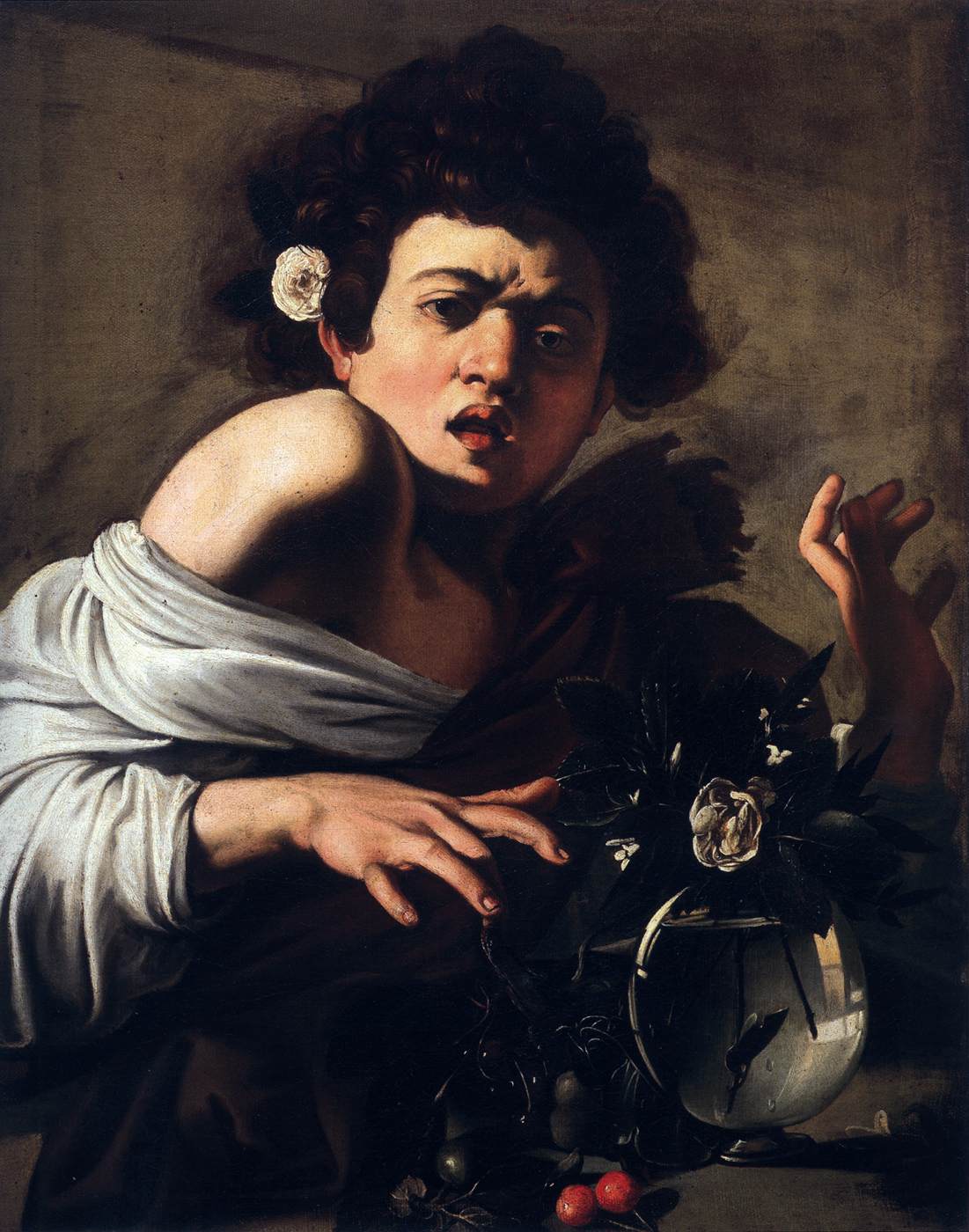
There is one exception for my distaste for this art and that's Caravaggio. A recent article in the Guardian on a new exhibit on Galileo and the Inquisition argued that the counter-reformation essentially killed the Italian renaissance. This is far outside my area of expertise, so I will entirely defer to others on whether this idea holds any water. What I found interesting was the author's argument that Caravaggio represents the last painter who expressed the renaissance interest in the sciences. Using the painting of a boy bitten by a lizard -- http://www.wga.hu/art/c/caravagg/01/042boy.jpg -- the author argued that the boy represents the western (read catholic) world's reaction of shock to the discovery that the natural world can disturb us. As I say, I don't vouch for the historical accuracy of the analysis, but I found it interesting.
After that, I wandered over to the Powder Tower, now transformed into an exhibition on 17th and 18th century military weapons and techniques. Moving quickly on, I joined the mobs in the Golden Lane, a ancient narrow passageway that has been redone into tourist traps for which you have to buy a ticket even to have the opportunity to enter. That being said, the little shops were scenic, but had a Disneyland feel to them.
I hoped to see the changing of the guard at noon, but by 12:05, I realized that the gate in question was at the opposite end of the castle complex, so I decided to get lunch instead. Afterwards, I wanted something completely different, so I went to the Museum Kampa, located on the Vltava River. This was the private collection of a wealthy Prague woman who was interested in 20th century Czech art. The main collection was full of interesting and playful works, and the political art of the 1970s and 80s was far more daring than any contemporaneous works I saw in Hungary or Poland.
But what I really, really, really, really liked was the exhibition of the painting of Frantisek Kupka. The museum described him as a cubist, but he combined elements of cubism (particularly Mondrian) with the colors of expressions artists like Kirchner, and the interest in light of rayonist painters like Larionov. In fact, for the first time in my life, I actually thought about stealing a painting, since they wouldn't let me photograph it, and I knew there wouldn't be a postcard of it for sale (there never is, you know).
While that picture, called "Cosmic Spring," is not on the web, I have found some others that are similar, if you would like to get an idea of what his art is like:
http://www.pori.fi/art/satakunta/pori/eng/EXHIB/n10/newton.jpg
http://blogsimages.skynet.be/images/000/070/050_kupka.jpg
And this one is probably most similar to the one I really liked:
http://www.thecityreview.com/fauv8.gif
But the one I liked had more reds and oranges, and looked like some one had peeled a bright, sun-filled orange, and left the peels around the middle.
In the late afternoon, I decided to visit the synagogues, but had to race a bit to see them all before they closed (I bought a combined ticket). Most have quite restrained interior decorations, but I couldn't tell if that was because they were built like that or if the Nazis had destroyed them and the restorers chose not to bring them back. The only exception was the more liberal Spanish Synagogue, which closely resembles the Tempel Synagogue in Prague and the main synagogue in Budapest with its use of arabesques and orientalist gilded themes.
I had originally thought I might visit Mariansky Lazne tomorrow (my cousin spends a month there every year), but I just came back from the bus station and its a 3-hour bus ride and the bus doesn't leave until 11:30. The bus to Karlovy Vary, on the other hand, leaves every hour on the hour and only takes 2:12 hours. I think that's where I'm going tomorrow.
First off, I worried whether Prague would live up to the billing that I had heard. It certainly has. It is an amazingly beautiful city. All the old fin-de-siecle, art deco, and secessionst buildings have been restored, and ever their decorative trims glisten with new gold leaf. Where Budapest exuded faded glory struggling to bloom again, Prague has been thoroughly refurbished.
What isn't so nice are all the tourists who financed this reconstruction. The city is by far the most touristed place I've been on my trip, including Paris (though granted I was in Paris at the very end of May and now we're in high season). The same crowds that fill the Louvre fill every major street in Prague. It's hard sometimes to see the ancient preserved city behind the mobs on every corner.
Another thing that comes with that is the predatory tourist pricing. After a month in Poland, Prague prices came as quite a shock, being on a par with Vienna. In Poland, I knew that whether I bought my water in a kiosk in the main rynek or in a convenience store, I was going to pay basically the same price (plus or minus a few groschen). Here, fast food stands on Wenceslas square sell a 0.5 liter of water for 60 kronen (about $2.75), while the convenience store sells a 1.5 liter bottle of the same water for 11 kronen (about $0.50).
Under things that surprised me, I should first off list how many cognates with Polish I've noticed in Czech. It certainly has made understanding signs much easier. Also, the subway system seems to be modeled on Budapest's, down to the same tilted ads on the subway escalator (perpendicular to the railing, not the floor) and the same system of validating tickets along with ticket inspectors.
Last night after dinner, I basically just walked around the city. I wandered through the Old City and Josefov, and then across the Charles Bridge. I went to sleep a little early, but still woke up earlier than I hoped, around 6:30 am, because the hotel turns the AC off for a few hours while the guests are sleeping. The increased humidity woke me up. I stayed in bed watching BBC world and then had a nice buffet breakfast in the hotel.
I decided to start off this morning with Prague Castle. I took the tram up the castle hill, but, as is so typical for me, I got off one stop too soon, fearful I'm might miss my stop. But also typically, this meant I saw things I would otherwise have missed: the Royal Gardens. The path wound gently up past the Ball Court, where the sgraffito on the side, depicting the various elements, sciences, and virtues, was "updated" under the communists to include a hammer and sickle.
I bought the "combined ticket," which allowed me to see "everything." I later decided that some things were definitely worth it and others I could have done without, but then you only realize these things afterwards. The cathedral of St. Vitus was rather nicely restrained in its interior decorations, but I particularly liked the 20th-century stained glass, much of it art nouveau/seccesionist in style.
My ticket allowed me to climb to the top of the south tower and so I did so. Along the way, I found myself giving moral support to one tourist unprepared for the 287 steps. I thought she was going to have a heart attack, the way she panted and collapsed on the bench at the top. The view, however, was quite lovely. I could see the entire city and river. The only drawback from the climb and the descent is it left my legs a little winded, and I found myself taking more frequent rest breaks.
The next stop was the Old Royal Palace, from whose windows the Catholic ambassadors were "defenestrated" (i.e. thrown out) in 1618, starting the Thirty Years War (they survived the fall, by the way). I sat and watched the film on the castle. It was in Czech but it gave me a few moments to rest my legs.
Then I walked across to the Basilica of St. George. This was recently restored to reveal its original Romanesque design, but was not particularly interesting. Next to it is one of the wings of the National Gallery. This part specializes in baroque and mannerist art. Since I had bought the ticket, I felt compelled to enter, despite the fact I don't really care for baroque art. This museum, with its tortured, grotesque crucifixes; its nuns, priests, and saints twisting in ecstasy; and its dark, shadowy portraits did nothing to change my opinion of baroque art. I think the yiddish phrase for it is "goyim naches."
There is one exception for my distaste for this art and that's Caravaggio. A recent article in the Guardian on a new exhibit on Galileo and the Inquisition argued that the counter-reformation essentially killed the Italian renaissance. This is far outside my area of expertise, so I will entirely defer to others on whether this idea holds any water. What I found interesting was the author's argument that Caravaggio represents the last painter who expressed the renaissance interest in the sciences. Using the painting of a boy bitten by a lizard -- http://www.wga.hu/art/c/caravagg/01/042boy.jpg -- the author argued that the boy represents the western (read catholic) world's reaction of shock to the discovery that the natural world can disturb us. As I say, I don't vouch for the historical accuracy of the analysis, but I found it interesting.
After that, I wandered over to the Powder Tower, now transformed into an exhibition on 17th and 18th century military weapons and techniques. Moving quickly on, I joined the mobs in the Golden Lane, a ancient narrow passageway that has been redone into tourist traps for which you have to buy a ticket even to have the opportunity to enter. That being said, the little shops were scenic, but had a Disneyland feel to them.
I hoped to see the changing of the guard at noon, but by 12:05, I realized that the gate in question was at the opposite end of the castle complex, so I decided to get lunch instead. Afterwards, I wanted something completely different, so I went to the Museum Kampa, located on the Vltava River. This was the private collection of a wealthy Prague woman who was interested in 20th century Czech art. The main collection was full of interesting and playful works, and the political art of the 1970s and 80s was far more daring than any contemporaneous works I saw in Hungary or Poland.
But what I really, really, really, really liked was the exhibition of the painting of Frantisek Kupka. The museum described him as a cubist, but he combined elements of cubism (particularly Mondrian) with the colors of expressions artists like Kirchner, and the interest in light of rayonist painters like Larionov. In fact, for the first time in my life, I actually thought about stealing a painting, since they wouldn't let me photograph it, and I knew there wouldn't be a postcard of it for sale (there never is, you know).
While that picture, called "Cosmic Spring," is not on the web, I have found some others that are similar, if you would like to get an idea of what his art is like:
http://www.pori.fi/art/satakunta/pori/eng/EXHIB/n10/newton.jpg
http://blogsimages.skynet.be/images/000/070/050_kupka.jpg
And this one is probably most similar to the one I really liked:
http://www.thecityreview.com/fauv8.gif
But the one I liked had more reds and oranges, and looked like some one had peeled a bright, sun-filled orange, and left the peels around the middle.
In the late afternoon, I decided to visit the synagogues, but had to race a bit to see them all before they closed (I bought a combined ticket). Most have quite restrained interior decorations, but I couldn't tell if that was because they were built like that or if the Nazis had destroyed them and the restorers chose not to bring them back. The only exception was the more liberal Spanish Synagogue, which closely resembles the Tempel Synagogue in Prague and the main synagogue in Budapest with its use of arabesques and orientalist gilded themes.
I had originally thought I might visit Mariansky Lazne tomorrow (my cousin spends a month there every year), but I just came back from the bus station and its a 3-hour bus ride and the bus doesn't leave until 11:30. The bus to Karlovy Vary, on the other hand, leaves every hour on the hour and only takes 2:12 hours. I think that's where I'm going tomorrow.
Tuesday, July 11, 2006
Safe and Sound in Prague (July 11)
Well, after a long, dull, and very hot train ride, I have arrived safe and sound in Prague.
There was a little delay at the border when they couldn't find my Polish arrival stamp (the border guard hadn't bothered to make sure there was ink on the stamp when he marked it). I was able to show my Hungarian exit stamp for that date, and after a brief consultation, they filled out some paperwork and let me leave.
The air had cooled and dried a bit when we went up into the hills towards the border, but as we descended to the rolling plains, the temperature shot up. At one station, I saw the temperature posted as 37 C (about 99 F).
One odd thing about the train: on the way to the border, we passed through two tunnels, during which time the train was completely, pitch black. I felt like I was in one of those murder mysteries where the actor says "I know who did it, wait, let me tell you. I was standing at my window, looking out, when all of a sudden...." Just then the train enters the tunnel and a scream is heard. 5 seconds later, the train emerges and the actor is now dead with a knife in his chest.
The odd thing was on the Czech side, just as we were approaching Prague, we passed through a similar tunnel, only this time, the lights came on. Apparently they only work on Czech side.
There were the typical learning curve issues on arriving in Prague, but without too much difficulty I found out about and bought a three-day tram/metro pass, managed to get to my hotel and check in. Later, I found an ATM that took my card and bought a guide book to Prague.
But the really good news is my hotel. This is the most expensive hotel of my trip (well, tied actually with Dresden) at about $75/night. I had originally intended to book a cheaper one, but when I read the reviews that mentioned pickpockets working the tram that stopped at the hotel, I upgraded. I figured at the time (rightly) that I might need a little bit more luxury after Poland. And luxury is what I got.
First and foremost: CENTRAL AIRCONDITIONING. The thermostat was set on maximum cool (15 C -- 58 F). I showered and did accumulated laundry in a large, capacious sink, that easily accomodated 4 pairs of socks and 2 pieces of underwear. Instead of just the two (or sometimes one) towel, this hotel offered six. They even have a bidet, but I've never got the hang of using those; I'm always trying to get the water temperature right. I also have both Sky TV and the BBC. The bed also feels comfortable. I have a north facing room and it looks like also dark curtains, so I'm hoping to sleep in til maybe 7 am tomorrow (which will be over an hour later than usual for me).
So now I'm going to check my book and find a nice place for dinner.
There was a little delay at the border when they couldn't find my Polish arrival stamp (the border guard hadn't bothered to make sure there was ink on the stamp when he marked it). I was able to show my Hungarian exit stamp for that date, and after a brief consultation, they filled out some paperwork and let me leave.
The air had cooled and dried a bit when we went up into the hills towards the border, but as we descended to the rolling plains, the temperature shot up. At one station, I saw the temperature posted as 37 C (about 99 F).
One odd thing about the train: on the way to the border, we passed through two tunnels, during which time the train was completely, pitch black. I felt like I was in one of those murder mysteries where the actor says "I know who did it, wait, let me tell you. I was standing at my window, looking out, when all of a sudden...." Just then the train enters the tunnel and a scream is heard. 5 seconds later, the train emerges and the actor is now dead with a knife in his chest.
The odd thing was on the Czech side, just as we were approaching Prague, we passed through a similar tunnel, only this time, the lights came on. Apparently they only work on Czech side.
There were the typical learning curve issues on arriving in Prague, but without too much difficulty I found out about and bought a three-day tram/metro pass, managed to get to my hotel and check in. Later, I found an ATM that took my card and bought a guide book to Prague.
But the really good news is my hotel. This is the most expensive hotel of my trip (well, tied actually with Dresden) at about $75/night. I had originally intended to book a cheaper one, but when I read the reviews that mentioned pickpockets working the tram that stopped at the hotel, I upgraded. I figured at the time (rightly) that I might need a little bit more luxury after Poland. And luxury is what I got.
First and foremost: CENTRAL AIRCONDITIONING. The thermostat was set on maximum cool (15 C -- 58 F). I showered and did accumulated laundry in a large, capacious sink, that easily accomodated 4 pairs of socks and 2 pieces of underwear. Instead of just the two (or sometimes one) towel, this hotel offered six. They even have a bidet, but I've never got the hang of using those; I'm always trying to get the water temperature right. I also have both Sky TV and the BBC. The bed also feels comfortable. I have a north facing room and it looks like also dark curtains, so I'm hoping to sleep in til maybe 7 am tomorrow (which will be over an hour later than usual for me).
So now I'm going to check my book and find a nice place for dinner.
Monday, July 10, 2006
My Ur-doktor vater (July 10)
Well, this will be my last blog from Poland (at least for this trip) as tomorrow I leave for Prague and the Czech Republic (a 6:44 hour train ride).
After posting last night's entry, I went out and watched the last half of the final of the Mundial. The city put up a large plasma screen tv in the Rynek Glowny and with the speakers you could basically here and watch it a block away (which is about the length of the Rynek). There were many supporters of Italy (including someone waiving an Italian flag), but I think there were probably more French supporters, based on the cheers or groans. The game was 1-1 going into the half and 1-1 at the end of the second half, and at the end of the first overtime. At that point, I decided to walk back to my hotel and watch the finale there while I packed up. The game continued tied through the second overtime, and ended (the way many of the games at this World's Cup have done) with a shoot out.
This morning I came to Wroclaw (formerly known as Breslau). It was very hot when I got off the train (certainly low 30s C -- which means low 90s F), and I searched for the tram/bus line that would run to my hotel. No luck. So I started walking, figuring I would find it eventually. In the end I found out that there are no trams or buses because they have entirely torn up the street leading to the hotel for about a block. It's only a 15-20 minute walk, but in this heat my shirt was soaked and I was dripping on to the counter as I filled out the forms. I took a quick shower and changed, but was sweating before I even left my hotel room.
I made my way to the Rynek. This is another one of those large public squares around which medieval Polish cities were built, though this one still has three blocks of buildings in the middle, so you don't get the full scope of the size of the square the way you do in Krakow. Another thing that has surprised me about Poland is how brightly colored many of the renaissance buildings are. Perhaps because so much of the films I see are in black and white, it's a bit of a shock to see so many yellow, green, red, and gold building surfaces.
I had lunch in a vegetarian restaurant on the Rynek (mushroom crepes with mushroom sauce -- not bad, actually), and then I went in search of the synagogue. Today being Monday, all the museums in town are closed, so there was little else to see (part of the reason for stopping here was to see the synagogue and cemetery, the other reason was to break up what would otherwise be a 10-hour train ride). I walked past it the first time because it is tucked away in a courtyard. This is the only synagogue building to survive the Nazis and it is undergoing extensive external restoration.
I walked inside, and found that none of the interior decorations have survived. There were a series of posters on the side about the history of the Jewish community of Wroclaw, prepared in 2003, but these had been moved out of the way to make room for the festival of asian culture performances that are being held there.
I went looking for the Jewish community offices, which are in the building adjacent to the synagogue. The wooden staircases looked like they are in urgent need of repair (they looked as if they might give way), and when I made it up to the floor in which the office is located, it was locked with no sign of when it's open (except for a phone number).
Now you might be wondering, why don't I just call them, but, in fact, I have a phobia about calling people in non-English languages. It is a little stressful, but manageable, to call people in Hebrew or German, but my Polish is virtually non-existent, and there's no way for me to communicate over the phone. I would much prefer to send e-mail.
From there I made my way to the Jewish cemetery. This in itself was a bit of an undertaking in order to find the right tram. I ended up walking a fair way but eventually I found it. Like other Jewish cemeteries, it was damaged during the war, but since Breslau was part of Germany, it didn't undergo the same violence of conquest that Polish cemeteries experienced. Instead, much of the damage came in 1945, when the cemetery was the scene of significant fighting between the Soviets and the Nazis.
I bought my ticket and a guide book and went in. Thankfully, there are many trees, so much of the cemetery is shaded. I ignored the suggested walking tour and went right to the grave of my ur-doktor vater, Heinrich Graetz. In Germany, the chair of your dissertation committee is known as your doktor vater -- the father of your doctoral degree. Well, my doktor vater is Prof. David Myers, and his doktor vater was Prof. Yosef Yerushalmi, who holds the Salo Baron chair in Jewish history at Columbia, and Prof. Salo Baron studied at the Jewish Theological Seminary in Breslau, whose first professor was Heinrich Graetz, making him my urdoktor vater.
Graetz popularized the study of Jewish history. When he began to write his History of the Jews in 1853, just a few hundred people read Jewish history. When he died in 1891, the number had grown to hundreds of thousands, in great part due to his writings. I wrote my dissertation on the reception of his history, and I wanted to visit his grave here in Breslau (Wroclaw) where he taught.
I had no trouble finding it. The marker had been restored in 1991 based on earlier photos of the grave. I saw a long line of stones that previous visitors had placed, and I put my own up there and then said kaddish. I felt it was the least I could do. Then I walked around and looked at the various types of funereal ornamentation used in the cemetery. In many ways, it reminded me of a much smaller version of the Weisensee cemetery in Berlin.
After about an hour I left and made my way back to the center of town. In a little bit I'm going for dinner in the hotel restaurant. A local guide describes the restaurant (and my hotel) as a quaint unrestored treasure, built in the 19th century. I'm hoping it lives up to the billing. Then a quick trip to the train station to get my ticket for tomorrow. And then, I hope, it will be cool enough to sleep.
After posting last night's entry, I went out and watched the last half of the final of the Mundial. The city put up a large plasma screen tv in the Rynek Glowny and with the speakers you could basically here and watch it a block away (which is about the length of the Rynek). There were many supporters of Italy (including someone waiving an Italian flag), but I think there were probably more French supporters, based on the cheers or groans. The game was 1-1 going into the half and 1-1 at the end of the second half, and at the end of the first overtime. At that point, I decided to walk back to my hotel and watch the finale there while I packed up. The game continued tied through the second overtime, and ended (the way many of the games at this World's Cup have done) with a shoot out.
This morning I came to Wroclaw (formerly known as Breslau). It was very hot when I got off the train (certainly low 30s C -- which means low 90s F), and I searched for the tram/bus line that would run to my hotel. No luck. So I started walking, figuring I would find it eventually. In the end I found out that there are no trams or buses because they have entirely torn up the street leading to the hotel for about a block. It's only a 15-20 minute walk, but in this heat my shirt was soaked and I was dripping on to the counter as I filled out the forms. I took a quick shower and changed, but was sweating before I even left my hotel room.
I made my way to the Rynek. This is another one of those large public squares around which medieval Polish cities were built, though this one still has three blocks of buildings in the middle, so you don't get the full scope of the size of the square the way you do in Krakow. Another thing that has surprised me about Poland is how brightly colored many of the renaissance buildings are. Perhaps because so much of the films I see are in black and white, it's a bit of a shock to see so many yellow, green, red, and gold building surfaces.
I had lunch in a vegetarian restaurant on the Rynek (mushroom crepes with mushroom sauce -- not bad, actually), and then I went in search of the synagogue. Today being Monday, all the museums in town are closed, so there was little else to see (part of the reason for stopping here was to see the synagogue and cemetery, the other reason was to break up what would otherwise be a 10-hour train ride). I walked past it the first time because it is tucked away in a courtyard. This is the only synagogue building to survive the Nazis and it is undergoing extensive external restoration.
I walked inside, and found that none of the interior decorations have survived. There were a series of posters on the side about the history of the Jewish community of Wroclaw, prepared in 2003, but these had been moved out of the way to make room for the festival of asian culture performances that are being held there.
I went looking for the Jewish community offices, which are in the building adjacent to the synagogue. The wooden staircases looked like they are in urgent need of repair (they looked as if they might give way), and when I made it up to the floor in which the office is located, it was locked with no sign of when it's open (except for a phone number).
Now you might be wondering, why don't I just call them, but, in fact, I have a phobia about calling people in non-English languages. It is a little stressful, but manageable, to call people in Hebrew or German, but my Polish is virtually non-existent, and there's no way for me to communicate over the phone. I would much prefer to send e-mail.
From there I made my way to the Jewish cemetery. This in itself was a bit of an undertaking in order to find the right tram. I ended up walking a fair way but eventually I found it. Like other Jewish cemeteries, it was damaged during the war, but since Breslau was part of Germany, it didn't undergo the same violence of conquest that Polish cemeteries experienced. Instead, much of the damage came in 1945, when the cemetery was the scene of significant fighting between the Soviets and the Nazis.
I bought my ticket and a guide book and went in. Thankfully, there are many trees, so much of the cemetery is shaded. I ignored the suggested walking tour and went right to the grave of my ur-doktor vater, Heinrich Graetz. In Germany, the chair of your dissertation committee is known as your doktor vater -- the father of your doctoral degree. Well, my doktor vater is Prof. David Myers, and his doktor vater was Prof. Yosef Yerushalmi, who holds the Salo Baron chair in Jewish history at Columbia, and Prof. Salo Baron studied at the Jewish Theological Seminary in Breslau, whose first professor was Heinrich Graetz, making him my urdoktor vater.
Graetz popularized the study of Jewish history. When he began to write his History of the Jews in 1853, just a few hundred people read Jewish history. When he died in 1891, the number had grown to hundreds of thousands, in great part due to his writings. I wrote my dissertation on the reception of his history, and I wanted to visit his grave here in Breslau (Wroclaw) where he taught.
I had no trouble finding it. The marker had been restored in 1991 based on earlier photos of the grave. I saw a long line of stones that previous visitors had placed, and I put my own up there and then said kaddish. I felt it was the least I could do. Then I walked around and looked at the various types of funereal ornamentation used in the cemetery. In many ways, it reminded me of a much smaller version of the Weisensee cemetery in Berlin.
After about an hour I left and made my way back to the center of town. In a little bit I'm going for dinner in the hotel restaurant. A local guide describes the restaurant (and my hotel) as a quaint unrestored treasure, built in the 19th century. I'm hoping it lives up to the billing. Then a quick trip to the train station to get my ticket for tomorrow. And then, I hope, it will be cool enough to sleep.
Sunday, July 09, 2006
LIfe and Death (July 9)
This blog will be a study in contrasts.
The concluding concert for the 16th annual Jewish cultural festival in Krakow was extremely interesting. I got to the square around 7pm and it was about half full and half partly full. Poland's TV2 had cameras out in force to record everything. The first group I heard was a Russian, I think (they kept yelling "spacebo" to the crowd), followed by an American klezmer group, Chevrisa.
The event was part cultural festival, part concert, and part block party. There were grills set up selling pork kielbasa (which I tried and found to be quite tasty), and lots of people walking around with half-liter glasses of beer. If anything, there was a remarkable dearth of trash cans, but I didn't notice much litter.
By the back I ran into the Dutch women I had met my first day here. We traded stories about concerts and I chatted with two other people at their table: an Austrailian English teacher who had lived in Krakow for three years and a grandmotherly woman from Mannheim, who kept singing Yiddish songs she had learned in one of the workshops. This became my base; after making a circuit of the concert and listening for an hour, I would return and rest at their table and chat.
At one breather, the Dutch women -- Anne and Adrianne -- gave me some of their Zubrovka vodka (flavored with bison grass -- every bottle has a stalk), which I rather like (though the Poles prefer to drink it with apple juice). I told them that felt strange for me to be at this concert, sort of like being at someone else's wedding. They were playing klezmer music, but the audience, who really got into it, reacted differently to it, I thought, than a Jewish audience would have.
Later, I met two other aquaintances of theirs: Jan from Prague and his companion Dinah, the Central European correspondent for the Jewish Telegraph Agency. She was there on behalf of Deutsche Welle, conducting interviews of the audience. We got to talking and she asked if she could do a brief interview of me. I was reluctant, mostly because I felt I was still trying to form my own opinions about the event.
She asked me to state my name and where I was from, and then say why I was at the concert. I told her that I wanted to see 20,000 Polish Christians listening to klezmer music. And now that I had seen 20,000 Polish Christians listening to klezmer music, she asked, what did I think now? I told her what I had said earlier, that it felt strange to me to watch the way people listened and moved to the music. Did I think it was kitsch? she asked. No, I emphatically responded. The restaurants are kitsch, but I think the audience is genuinely interested in the music. Did I think it was exploititive to hold this event in a place where so many Jews had been exterminated? Absolutely not, I responded. In all my travels in Poland, I told her, I have been struck by how dynamic the situation is here right now, how in many places Jewish sites are being identified, preserved, and restored. And no place more so than Krakow, where they are trying to preserve not just a single synagogue, but an entire neighborhood. And that's probably why it hurts more here, because you can feel more how much was lost.
She thanked me and turned off the recorder. Then we all got into a very intense discussion about the concert. She responded to my comment about the audience's reaction by saying that she sees teenage Jewish girls in America doing exactly the same breast shaking and hand moves that I was noticing here. It got me wondering how much my seeing the audience as "other" was really my projecting my knowledge of their "otherness" on to them, therefore seeing what I expected, or perhaps wanted to see. She pointed out that many of the Poles she's interviewed are genuinely interested in Jewish culture.
She's absolutely right about that, by the way. I went to a discussion of the Kielce pogrom and when I came in, a workshop on introduction to Judaism was letting out. Since the talk was by an American rabbi, most of the (large) Polish audience needed headsets for simultaneous translation, and there was a long line to return them. There were not only workshops in Jewish arts, crafts, and music, but also sessions on introduction to Jewish textual study. The festival was a lot more than just "fiddler on the roof."
I've been thinking about her comments about the audience, and while she may certainly be right about the women were reacting, I still think there were differences. My comments now should be taken with the caveat that I haven't been to a klezmer concert in the U.S. in over a decade, so my impressions may well be out of date. I was struck by how many men were doing the same sinuous "belly-dancer" hand gestures as the women. Couples were swing dancing. There wasn't the sort of haimish dancing one sees in synagogues. Years ago I was at a simchas torah party in a hasidic shul in Jerusalem, and it was just a see of black hats and coats, with everyone closely packed in while doing line dances. There was a lot of bumping shoulders and back thumping, and it was difficult to move in the tightly packed crowd.
The orthodox sociologist, Samuel Heilman, described this in his book "Defenders of the Faith," when he went to a Ger (I think) celebration in Jerusalem. The bumping and the pushing, which can so often be read as aggressive, was really a physical statement of tribal solidarity, he wrote. It was much more about intimacy than aggression, about being part of a single extended family. It was that sort of experience that I felt missing at last night's concert.
This morning, I took the slow train to Oswiecim (there are only slow trains). From there, it was a short bus ride to Auschwitz I camp and the museum. I chose not to see it with a guide (though I was offered a place with the Israeli group I had met at shabbat services -- their guide for their entire trip in Poland is a second-generation survivor whose mother was in Auschwitz), but rather move at my own pace.
The entrance began with a 15-minute film shot by Soviet troops in January 1945 when they liberated the camp. I had seen brief excerpts before but not the entire film and of course, it left me in tears. I sat outside for a few minutes to regain my composure and then entered the camp.
It felt very odd watching all the people pose for pictures under the "Arbeit Macht Frei" gate. It was even odder and more uncomfortable seeing how many people brought their young children (including toddler age!) into the camp with them. This place should be off limits to anyone under the age of 14; they don't have the emotional maturity to deal with the subject (and, apparently, neither do these parents).
I found myself close to tears through much of the early exhibits of the museum on the extermination process, though seeing the 2 tons of human hair cut from the corpses of Jewish women was very, very difficult. Ditto the mounds of suitcases and the collection of shoes, which rose up like dark, heavy waves on either side of the hall.
There was a very, very long line to see the "Death Block," where prisoners to be executed were held and then killed. Partly because it is very narrow so people can only visit single file, partly because all the tour groups have to go through, partly because of this sick fascination people have with the murder sites, to get a cheap, almost pornographic thrill by visiting them, it is very very crowded. I decided to give it a pass.
I ran into a USY group by the entrance to the exhibit on the extermination of the Jews. I chatted with the guide, who told me they had taken a night bus from Prague to Warsaw (12 hours) and the students had slept on the bus (tried to sleep, one girl piped in). I went into the exhibit and it is very dated. Originally put up in the 1960s and then modified in the late 70s, it is a very bare bones description of the Holocaust. The original exhibit was in Polish and Yiddish(!), but English text was added later. It really pales in comparison to what was done at Belzec.
Then there are a series of "national exhibits" on the extermination of Jews from Slovakia, Hungary, the Czech Republic, and of the extermination of the Gypsies. Finally, the directed path goes through the small gas chamber, where again I watched in amazement and horror as people posed for pictures.
Then I took the bus to Birkenau. As I arrived, I could see a line of thunderstorms building to the west. I went through the main gate and made my way past the rail lines built by prisoners in 1944 so that Hungarian Jews could be brought directly into the camp for execution. I went through a few of the barracks in the women's camp but it started to thunder and so I hurried on to the ruins of gas/crematoria II and III. I said a brief kaddish at the pool where the ashes were dumped, but I kept seeing lightening strikes disturbingly close, so I wrapped it up quick and made my way to the memorial.
It was another of those abstract monuments the Polish communist government put up into the 1960s. I was so distracted by the immanent storm that I forgot to look at the original text and only read the updated one beneath it mentioning the more accurate number of 1.5 million dead (though it was still probably less, around 1.2-3 million) and describing the majority of victims as Jews. I then quickly made my way back to the entrance.
The storm passed to the north, though the humidity did not decrease, so I went into the wooden quarantine barracks, the few wooden structures to survive. Then I left the camp and went back to the center of town (passing the controversial church built by nuns outside the camp walls), and caught a train back to Krakow. Tomorrow it's on to Wroclaw.
The concluding concert for the 16th annual Jewish cultural festival in Krakow was extremely interesting. I got to the square around 7pm and it was about half full and half partly full. Poland's TV2 had cameras out in force to record everything. The first group I heard was a Russian, I think (they kept yelling "spacebo" to the crowd), followed by an American klezmer group, Chevrisa.
The event was part cultural festival, part concert, and part block party. There were grills set up selling pork kielbasa (which I tried and found to be quite tasty), and lots of people walking around with half-liter glasses of beer. If anything, there was a remarkable dearth of trash cans, but I didn't notice much litter.
By the back I ran into the Dutch women I had met my first day here. We traded stories about concerts and I chatted with two other people at their table: an Austrailian English teacher who had lived in Krakow for three years and a grandmotherly woman from Mannheim, who kept singing Yiddish songs she had learned in one of the workshops. This became my base; after making a circuit of the concert and listening for an hour, I would return and rest at their table and chat.
At one breather, the Dutch women -- Anne and Adrianne -- gave me some of their Zubrovka vodka (flavored with bison grass -- every bottle has a stalk), which I rather like (though the Poles prefer to drink it with apple juice). I told them that felt strange for me to be at this concert, sort of like being at someone else's wedding. They were playing klezmer music, but the audience, who really got into it, reacted differently to it, I thought, than a Jewish audience would have.
Later, I met two other aquaintances of theirs: Jan from Prague and his companion Dinah, the Central European correspondent for the Jewish Telegraph Agency. She was there on behalf of Deutsche Welle, conducting interviews of the audience. We got to talking and she asked if she could do a brief interview of me. I was reluctant, mostly because I felt I was still trying to form my own opinions about the event.
She asked me to state my name and where I was from, and then say why I was at the concert. I told her that I wanted to see 20,000 Polish Christians listening to klezmer music. And now that I had seen 20,000 Polish Christians listening to klezmer music, she asked, what did I think now? I told her what I had said earlier, that it felt strange to me to watch the way people listened and moved to the music. Did I think it was kitsch? she asked. No, I emphatically responded. The restaurants are kitsch, but I think the audience is genuinely interested in the music. Did I think it was exploititive to hold this event in a place where so many Jews had been exterminated? Absolutely not, I responded. In all my travels in Poland, I told her, I have been struck by how dynamic the situation is here right now, how in many places Jewish sites are being identified, preserved, and restored. And no place more so than Krakow, where they are trying to preserve not just a single synagogue, but an entire neighborhood. And that's probably why it hurts more here, because you can feel more how much was lost.
She thanked me and turned off the recorder. Then we all got into a very intense discussion about the concert. She responded to my comment about the audience's reaction by saying that she sees teenage Jewish girls in America doing exactly the same breast shaking and hand moves that I was noticing here. It got me wondering how much my seeing the audience as "other" was really my projecting my knowledge of their "otherness" on to them, therefore seeing what I expected, or perhaps wanted to see. She pointed out that many of the Poles she's interviewed are genuinely interested in Jewish culture.
She's absolutely right about that, by the way. I went to a discussion of the Kielce pogrom and when I came in, a workshop on introduction to Judaism was letting out. Since the talk was by an American rabbi, most of the (large) Polish audience needed headsets for simultaneous translation, and there was a long line to return them. There were not only workshops in Jewish arts, crafts, and music, but also sessions on introduction to Jewish textual study. The festival was a lot more than just "fiddler on the roof."
I've been thinking about her comments about the audience, and while she may certainly be right about the women were reacting, I still think there were differences. My comments now should be taken with the caveat that I haven't been to a klezmer concert in the U.S. in over a decade, so my impressions may well be out of date. I was struck by how many men were doing the same sinuous "belly-dancer" hand gestures as the women. Couples were swing dancing. There wasn't the sort of haimish dancing one sees in synagogues. Years ago I was at a simchas torah party in a hasidic shul in Jerusalem, and it was just a see of black hats and coats, with everyone closely packed in while doing line dances. There was a lot of bumping shoulders and back thumping, and it was difficult to move in the tightly packed crowd.
The orthodox sociologist, Samuel Heilman, described this in his book "Defenders of the Faith," when he went to a Ger (I think) celebration in Jerusalem. The bumping and the pushing, which can so often be read as aggressive, was really a physical statement of tribal solidarity, he wrote. It was much more about intimacy than aggression, about being part of a single extended family. It was that sort of experience that I felt missing at last night's concert.
This morning, I took the slow train to Oswiecim (there are only slow trains). From there, it was a short bus ride to Auschwitz I camp and the museum. I chose not to see it with a guide (though I was offered a place with the Israeli group I had met at shabbat services -- their guide for their entire trip in Poland is a second-generation survivor whose mother was in Auschwitz), but rather move at my own pace.
The entrance began with a 15-minute film shot by Soviet troops in January 1945 when they liberated the camp. I had seen brief excerpts before but not the entire film and of course, it left me in tears. I sat outside for a few minutes to regain my composure and then entered the camp.
It felt very odd watching all the people pose for pictures under the "Arbeit Macht Frei" gate. It was even odder and more uncomfortable seeing how many people brought their young children (including toddler age!) into the camp with them. This place should be off limits to anyone under the age of 14; they don't have the emotional maturity to deal with the subject (and, apparently, neither do these parents).
I found myself close to tears through much of the early exhibits of the museum on the extermination process, though seeing the 2 tons of human hair cut from the corpses of Jewish women was very, very difficult. Ditto the mounds of suitcases and the collection of shoes, which rose up like dark, heavy waves on either side of the hall.
There was a very, very long line to see the "Death Block," where prisoners to be executed were held and then killed. Partly because it is very narrow so people can only visit single file, partly because all the tour groups have to go through, partly because of this sick fascination people have with the murder sites, to get a cheap, almost pornographic thrill by visiting them, it is very very crowded. I decided to give it a pass.
I ran into a USY group by the entrance to the exhibit on the extermination of the Jews. I chatted with the guide, who told me they had taken a night bus from Prague to Warsaw (12 hours) and the students had slept on the bus (tried to sleep, one girl piped in). I went into the exhibit and it is very dated. Originally put up in the 1960s and then modified in the late 70s, it is a very bare bones description of the Holocaust. The original exhibit was in Polish and Yiddish(!), but English text was added later. It really pales in comparison to what was done at Belzec.
Then there are a series of "national exhibits" on the extermination of Jews from Slovakia, Hungary, the Czech Republic, and of the extermination of the Gypsies. Finally, the directed path goes through the small gas chamber, where again I watched in amazement and horror as people posed for pictures.
Then I took the bus to Birkenau. As I arrived, I could see a line of thunderstorms building to the west. I went through the main gate and made my way past the rail lines built by prisoners in 1944 so that Hungarian Jews could be brought directly into the camp for execution. I went through a few of the barracks in the women's camp but it started to thunder and so I hurried on to the ruins of gas/crematoria II and III. I said a brief kaddish at the pool where the ashes were dumped, but I kept seeing lightening strikes disturbingly close, so I wrapped it up quick and made my way to the memorial.
It was another of those abstract monuments the Polish communist government put up into the 1960s. I was so distracted by the immanent storm that I forgot to look at the original text and only read the updated one beneath it mentioning the more accurate number of 1.5 million dead (though it was still probably less, around 1.2-3 million) and describing the majority of victims as Jews. I then quickly made my way back to the entrance.
The storm passed to the north, though the humidity did not decrease, so I went into the wooden quarantine barracks, the few wooden structures to survive. Then I left the camp and went back to the center of town (passing the controversial church built by nuns outside the camp walls), and caught a train back to Krakow. Tomorrow it's on to Wroclaw.
Saturday, July 08, 2006
Shabbat in Krakow (July 8)
Last evening's concert by habreera hateeveet was fantastic. They started it early -- around 6 pm -- so they could finish before shabbat started. In attendence was the Chief Rabbi of Poland and the Israeli ambassador to Poland. Because I arrived late (one of the drawbacks in changing hotels is that while I am in a nicer neighborhood, it is significantly farther away from Kazimierz), I could only find a seat in the back right corner with a view obstructed by a pillar. In the end, however, it turned out I had one of the better seats in the house. Not because my view improved (I could just make out the head of Shlomo Bar, until one of the many people standing chose the pillar for supportÖ, but because they opened the door right behind me to let in cool air to a building packed to the rafters with people.
The concert was a blast, though it took them a while to warm up. Shlomo kept trying to get them to sing along -- just la, la, las, nothing too complicated -- but many people would not do it at the beginning. In the end, he got everyone on their feet. It was terrific.
On my way out, I grabbed some new brochures from Polish-Jewish organizations. One took severe issue with the March of the Living for concentrating only on five years of death in Poland, while ignoring nine hundred years of life. Many people with whom I have spoken in Poland -- both Jews and non-Jews -- have criticized the March of the Living to me for traveling through Poland in a bubble while ignoring the living people around them. I also have a lot of problem with the politics and theology around the trip, which ties the gas chambers in Poland to the formation of the State of Israel, creating a narrative of death and resurrection. As the brochure notes, there already is a religion that emphasizes death and resurrection and it isn't Judaism.
The other brochure was from Czulent, a Jewish organization in Krakow, describing their various activities and seeking financial support. I'm holding on to both and will try to use them when I put together a course to take students to Eastern Europe next summer.
This morning I managed to sleep until 6:25. After breakfast I headed to the Tempel Synagogue where I heard there were going to be Shabbat services this morning. Although this was a progressive synagogue, it still has a women's gallery. Today it was used by two groups of orthodox Jews -- the first to arrive was an Israeli group made up mostly of Jews of Polish ancestry -- they were later joined by members of a Young Israel synagogue group from Oceanside, New York. When we went in, they had already set up a mechitza in the lower area, even though there was a gallery upstairs (both were used). Altogether, I counted about 51 men in the mens section, and I would guess an equal number of women.
During the services, at least two separate tour groups arrived, watched, and left. This was a little awkward since it is a violation of Jewish rules of the Sabbath to photograph or record, and many in the mixed group ignored the separate seating arrangements for men and women. Not that I'm particularly religious, but I think one should respect the beliefs of the people you are visiting. The second group was particularly intrusive, and one looked like he was carrying a professional video camera with sound equipment. Suddenly we all heard a loud, shattering crash. Everyone turned around to see what had broken. A man with a camera standing nearby the professional had dropped his camera and the lens had shattered and the batteries had popped out. That's about the time that group left.
Afterwards, one of the Young Israel leaders came over to chat with some people behind me who had been sitting right in front of the whole incident. "It was the hand of God," he said. Just at the moment he had intended to take the picture and violate the sabbath, God had struck the camera down (which would also violate the Sabbath, I think, but no one was in a mood to quibble). One of the younger guys joked that soon it would be circulated as a Krakow miracle, and then we would have the real story and the legend.
Afterwards I said goodbye and went back to my hotel to change and get some lunch. I chose a small little back courtyard restaurant off the main square and had some nice wild mushroom soup and peirogies. Three people looked in and asked in English if the food was good. I told them that I really liked the soup (that was the only course that had arrived). They sat down across from me and unburdened themselves.
They were two men and one woman, all in their early sixties from Ireland by way of Birmingham. They were also the worst sort of travelers -- loud, demanding, and unsatisfiable. Their water spoke only a few words of English, and even I don't know the proper way to respond to the question "how much garlic is in the garlic soup? Is it too garlicky?" One of her companions hoped that the onion soup would be the French Onion soup he liked. I told the woman that I really liked the mushroom soup, so she changed her order to that.
When the soup came, however, she announced it was cold and called the water over. "Cold," she said, "this soup is cold." When it became clear that he did not understand, she pointed at the water bottle, and kept repeated "cold, cold." The waiter left and I told her that I think she just ordered a bottle of cold water. She ran to the waiter who was just getting a bottle out of the refrigerator for her, and they managed to find a waitress who spoke a little more English. A few minutes later her soup arrived hot, but her companion was unhappy to find something like an egg at the bottom of his onion soup. "What's that doing in there," she asked, "it just ruins the whole thing." I don't think it ever occured to them that people in Poland might like the soup that way. Thankfully, I left before their main course arrived, so I was spared that.
After lunch I went to tour the Krakow ghetto. Not Kazimierz, but the ghetto established across the river in 1941 by the Nazis. I had seen footage of the forced relocation of the remaining sixteen thousand Jews (over two-thirds had already been deported to other parts of Poland) into this small area of only 321 houses. Two small sections of the ghetto wall survived. The wall was shaped with half domes arcs running the length of the way, designed to resemble tombstones. Many of the ghetto structures survived and, as in Lodz, it remains a rather poor area of town to this day.
While I was walking I ran into the Israeli group. They were in the main ghetto square, which has an unusual memorial in it. Dispersed throughout the square are a series of slightly, larger-than-life chairs. At one end stands a small metal structure, the interior of which vaguely resembled a cattle car. On the outside were the dates 1941 and 1943, the years in which the ghetto stood there. At the other end of the square was the pharmacy. This structure was the only non-Jewish building in the ghetto. The pharmacist refused German entreaties to leave the ghetto and finally won permission to stay and provide free medical aid to the ghetto residents to prevent plague. He and his assistants also hid Jews during the periodic liquidations of part of the ghetto, and smuggled in food and supplies. After the war, the communist authorities seized the building from him but allowed him to work in it. In the sixties, they closed the building and made it into a bar, but in the eighties it was turned into a museum.
From there I took the tram to Plaszow, where the remaining Jews from the Krakow ghetto were marched in 1943, when the entire ghetto was finally liquidated. Two of my grandmother's cousins were sent to camps, one of them to Plaszow. When it was liquidated, he found his brother in Auschwitz and the two of them survived to liberation.
Plaszow was built on top of a Jewish cemetery, and there's supposed to be one tombstone that survived but I could not find it. After wandering about through the unmarked paths, I found a large cross, which was an execution site, and then the main memorial for the camp, put up by the communist authorities in 1964. On one side it consists of 6 abstracted human forms, standing up, but their heads weighed down with suffering and exhaustion. On the other is a brief text in Polish referencing the victims of Hitlerism.
Nearby, however, were two newer monuments. One is a small plaque, put up by the Hungarian Jewish community six years ago referring to Hungarian Jewish women who were transferred to the camp in 1944 before being sent to Auschwitz to be gassed. The other is a newer, but undated memorial, put up by the Jewish community of Krakow. It is a very angry text, with as much anger directed against the generic communist monument as against the Germans. The side you first see is in Polish, with a Hebrew version on the reverse. Here is a translation: "Here on this site, several thousand Jews were brought from Poland and Hungary, and were tortured, murdered and burnt, between 1943 and 1945. We do not know their names. We shall name them with one word: JEWS. The human tongue lacks the words to describe the depth of this atrocity. Its incredible bestiality, ruthlessness, and cruelty. We shall name it with one word: HITLERISM. To commemorate the murdered, whoe last cry of despair is the silence of this Plaszow cemetery -- we pay homage, we, the survivors of this fascist pogrom -- the Jews."
After that I walked back to the main road where I found the house of camp commandant Amnon Goeth still standing, though with only a small degree of renovation. It is currently occupied, though I can't imagine living in the house of someone who used to use prisoners for target practice from the balcony.
In a few minutes I'm going to head off to the final concert of the Jewish Cultural Festival. Tonight is the big deal, where some twenty thousand people show up, so I'm looking forward to seeing it. Then tomorrow I head to Auschwitz-Birkenau.
The concert was a blast, though it took them a while to warm up. Shlomo kept trying to get them to sing along -- just la, la, las, nothing too complicated -- but many people would not do it at the beginning. In the end, he got everyone on their feet. It was terrific.
On my way out, I grabbed some new brochures from Polish-Jewish organizations. One took severe issue with the March of the Living for concentrating only on five years of death in Poland, while ignoring nine hundred years of life. Many people with whom I have spoken in Poland -- both Jews and non-Jews -- have criticized the March of the Living to me for traveling through Poland in a bubble while ignoring the living people around them. I also have a lot of problem with the politics and theology around the trip, which ties the gas chambers in Poland to the formation of the State of Israel, creating a narrative of death and resurrection. As the brochure notes, there already is a religion that emphasizes death and resurrection and it isn't Judaism.
The other brochure was from Czulent, a Jewish organization in Krakow, describing their various activities and seeking financial support. I'm holding on to both and will try to use them when I put together a course to take students to Eastern Europe next summer.
This morning I managed to sleep until 6:25. After breakfast I headed to the Tempel Synagogue where I heard there were going to be Shabbat services this morning. Although this was a progressive synagogue, it still has a women's gallery. Today it was used by two groups of orthodox Jews -- the first to arrive was an Israeli group made up mostly of Jews of Polish ancestry -- they were later joined by members of a Young Israel synagogue group from Oceanside, New York. When we went in, they had already set up a mechitza in the lower area, even though there was a gallery upstairs (both were used). Altogether, I counted about 51 men in the mens section, and I would guess an equal number of women.
During the services, at least two separate tour groups arrived, watched, and left. This was a little awkward since it is a violation of Jewish rules of the Sabbath to photograph or record, and many in the mixed group ignored the separate seating arrangements for men and women. Not that I'm particularly religious, but I think one should respect the beliefs of the people you are visiting. The second group was particularly intrusive, and one looked like he was carrying a professional video camera with sound equipment. Suddenly we all heard a loud, shattering crash. Everyone turned around to see what had broken. A man with a camera standing nearby the professional had dropped his camera and the lens had shattered and the batteries had popped out. That's about the time that group left.
Afterwards, one of the Young Israel leaders came over to chat with some people behind me who had been sitting right in front of the whole incident. "It was the hand of God," he said. Just at the moment he had intended to take the picture and violate the sabbath, God had struck the camera down (which would also violate the Sabbath, I think, but no one was in a mood to quibble). One of the younger guys joked that soon it would be circulated as a Krakow miracle, and then we would have the real story and the legend.
Afterwards I said goodbye and went back to my hotel to change and get some lunch. I chose a small little back courtyard restaurant off the main square and had some nice wild mushroom soup and peirogies. Three people looked in and asked in English if the food was good. I told them that I really liked the soup (that was the only course that had arrived). They sat down across from me and unburdened themselves.
They were two men and one woman, all in their early sixties from Ireland by way of Birmingham. They were also the worst sort of travelers -- loud, demanding, and unsatisfiable. Their water spoke only a few words of English, and even I don't know the proper way to respond to the question "how much garlic is in the garlic soup? Is it too garlicky?" One of her companions hoped that the onion soup would be the French Onion soup he liked. I told the woman that I really liked the mushroom soup, so she changed her order to that.
When the soup came, however, she announced it was cold and called the water over. "Cold," she said, "this soup is cold." When it became clear that he did not understand, she pointed at the water bottle, and kept repeated "cold, cold." The waiter left and I told her that I think she just ordered a bottle of cold water. She ran to the waiter who was just getting a bottle out of the refrigerator for her, and they managed to find a waitress who spoke a little more English. A few minutes later her soup arrived hot, but her companion was unhappy to find something like an egg at the bottom of his onion soup. "What's that doing in there," she asked, "it just ruins the whole thing." I don't think it ever occured to them that people in Poland might like the soup that way. Thankfully, I left before their main course arrived, so I was spared that.
After lunch I went to tour the Krakow ghetto. Not Kazimierz, but the ghetto established across the river in 1941 by the Nazis. I had seen footage of the forced relocation of the remaining sixteen thousand Jews (over two-thirds had already been deported to other parts of Poland) into this small area of only 321 houses. Two small sections of the ghetto wall survived. The wall was shaped with half domes arcs running the length of the way, designed to resemble tombstones. Many of the ghetto structures survived and, as in Lodz, it remains a rather poor area of town to this day.
While I was walking I ran into the Israeli group. They were in the main ghetto square, which has an unusual memorial in it. Dispersed throughout the square are a series of slightly, larger-than-life chairs. At one end stands a small metal structure, the interior of which vaguely resembled a cattle car. On the outside were the dates 1941 and 1943, the years in which the ghetto stood there. At the other end of the square was the pharmacy. This structure was the only non-Jewish building in the ghetto. The pharmacist refused German entreaties to leave the ghetto and finally won permission to stay and provide free medical aid to the ghetto residents to prevent plague. He and his assistants also hid Jews during the periodic liquidations of part of the ghetto, and smuggled in food and supplies. After the war, the communist authorities seized the building from him but allowed him to work in it. In the sixties, they closed the building and made it into a bar, but in the eighties it was turned into a museum.
From there I took the tram to Plaszow, where the remaining Jews from the Krakow ghetto were marched in 1943, when the entire ghetto was finally liquidated. Two of my grandmother's cousins were sent to camps, one of them to Plaszow. When it was liquidated, he found his brother in Auschwitz and the two of them survived to liberation.
Plaszow was built on top of a Jewish cemetery, and there's supposed to be one tombstone that survived but I could not find it. After wandering about through the unmarked paths, I found a large cross, which was an execution site, and then the main memorial for the camp, put up by the communist authorities in 1964. On one side it consists of 6 abstracted human forms, standing up, but their heads weighed down with suffering and exhaustion. On the other is a brief text in Polish referencing the victims of Hitlerism.
Nearby, however, were two newer monuments. One is a small plaque, put up by the Hungarian Jewish community six years ago referring to Hungarian Jewish women who were transferred to the camp in 1944 before being sent to Auschwitz to be gassed. The other is a newer, but undated memorial, put up by the Jewish community of Krakow. It is a very angry text, with as much anger directed against the generic communist monument as against the Germans. The side you first see is in Polish, with a Hebrew version on the reverse. Here is a translation: "Here on this site, several thousand Jews were brought from Poland and Hungary, and were tortured, murdered and burnt, between 1943 and 1945. We do not know their names. We shall name them with one word: JEWS. The human tongue lacks the words to describe the depth of this atrocity. Its incredible bestiality, ruthlessness, and cruelty. We shall name it with one word: HITLERISM. To commemorate the murdered, whoe last cry of despair is the silence of this Plaszow cemetery -- we pay homage, we, the survivors of this fascist pogrom -- the Jews."
After that I walked back to the main road where I found the house of camp commandant Amnon Goeth still standing, though with only a small degree of renovation. It is currently occupied, though I can't imagine living in the house of someone who used to use prisoners for target practice from the balcony.
In a few minutes I'm going to head off to the final concert of the Jewish Cultural Festival. Tonight is the big deal, where some twenty thousand people show up, so I'm looking forward to seeing it. Then tomorrow I head to Auschwitz-Birkenau.
Friday, July 07, 2006
E Unum, Pluribus (July 7)
I discovered today that part of my problem in getting a handle on Krakow is that it really is several quite distinct cities, rather than one large one. That's not all that unusual really -- most cities have different neighborhoods -- but in this case, I really needed to step back and see the mosaic.
First off is the Stare Miasto, the old city of Krakow. This is the area around the gigantic central square and represents the medieval heart of the city. Surrounding it is the "Planty," a large public park that forms a green belt where the defensive walls of the city used to stand. Inside this area, the streets are often pedestrianized, the houses are 3-4 stories tall, and most of the buildings have a 17th-18th century exterior.
Kazimierz, on the other hand, is the former Jewish neighborhood of Krakow. Established outside the walls, it became the primary neighborhood after Jews were expelled from the city of Krakow during the Renaissance (in other words, I'm not sure of the exact date). The Nazis expelled the Jews from Kazimierz in 1941, forcing them to relocated across the river to the ghetto at Podgorze. When the ghetto was liquidated in March 1943, those not slated for extermination were marched to Plaszow Labor Camp, built a short distance away on top of a Jewish cemetery.
Kazimierz has been the center of efforts to identify, preserve, and restore Jewish sites in Krakow. Virtually all of the surviving synagogues have been restored, some quite beautifully. Some now serve as museums for the history of Jews in Krakow. Yiddish signs and displays (very few survived) have been preserved. Jewish-themed restaurants have opened (though I find them a tad kitsch) and this is also the center for the annual Jewish cultural festival, which will have its climactic conclusion tomorrow night with a marathon free concert in the plaza on Ulica Szeroka, opposite the Stara Synagogue. Other than the synagogues, most of the buildings in this area are 19th century, and many have peeling walls, and show the impact of decades of air pollution.
My old hotel was between these two neighborhoods, about a block to the southeast of the Planty in the direction of Kazimierz. Its sidewalks were narrow, there were few trees, and the buildings rose 5-6 stories above the pavement. I very much enjoyed getting out of this neighborhood and heading to the open, green countryside.
Today, however, I changed hotels. My new hotel is not as nice as the old one, in terms of what it provides: no airconditioning, a sink big enough only to wash one shirt or two socks but not all three at once, no English or German-language stations on the tv. But what it does have is a much more comfortable neighborhood. Like my old hotel, I'm just half a block from the Planty, but now I'm on the west side, adjacent to Jagellonian University (the hotel is a guest house that normally serves faculty visiting the university). The sidewalks are wider, there are trees, the houses are not as tall, and many are set back a bit from the street with some trees and grass. It just feels more airy and light.
As a result, for the first time I really enjoyed being in the Stare Miasto. I walked to the Planty and this time felt like strolling through it. It wasn't as crowded as the other side and it just felt more comfortable and inviting. I spent the afternoon visiting museums in the old city. I started off with the upstairs in the Cloth Hall in the center of the Rynek. This is a museum dedicated to 19th century Polish art and there were some fun pieces there. Many of them are more noteworthy for their political significance that their artistic merit (e.g., The Homage of Prussia -- http://www.krakow-info.com/images/hold1.jpg -- depicted the scene when Albert of Hohenzollern, the last master of the Teutonic knights and later founder of the kingdom of Prussia, swore vassal homage to the Polish crown (a pointed reference to Prussia's violation of that oath in the 18th century by the partion of Poland). Another painting, by Chemonski, puts the viewer in the position of being about to be run over by a cart driven by four galloping horses: http://www.pilsudski.org/images/Pictures/Chelmonski-Czworka.jpg (but much more intense in person).
After that I walked across the square to see the high alter in the Kosciol Mariacki. Carved in the 15th century, the panels are only opened once a day. If you want to see a picture, go to http://chall.ifj.edu.pl/~cieslik/week/pic/Stwosz.jpg
I couldn't help but be struck by the radical difference in decorations between the cathedral and the various Polish synagogues that I've visited over the last two weeks. Its not that the synagogues didn't have decorations, or even elaborate carvings and images. It's that the general style of Polish synagogues was to decorate them to look like illuminated manuscripts. The walls were covered in texts, adorned with plants, animals, zodiac signs, leviathans, landscapes, etc., but it was the texts that were central. By contrast, there's very little writing in the cathedrals, instead you have an unending series of religious stories told through images and tableaux.
After lunch I went to he Wyspianski Museum. Stanislaw Wyspianski was one of the leading figures in the "young Poland" are movement during the fin-de-siecle. Bearing some similarities in motivation to art nouveau and the arts and crafts movement, Wyspianski did drawings, stained glass, furniture, and ornamentation. Quite interesting, actually. Then I went to the Czartoryski Museum a few blocks away. This contains the private collection of a Polish aristocratic family, and their prize possession is Leonoard da Vinci's Lady With an Ermine. It occupies a room by itself (except for a photo of the other prize possession, Raphael's Portrait of a Young Man, which was stolen by the Nazis and never recovered). Had this painting been in the Louvre, I would have had to fight crowds of people struggling to see it; here, I stood in the room all by myself and could look at it to my hearts content with no one to bother me or snap flash shots in violation of the museum rules. To see what it looks like, go to: http://www.ibiblio.org/wm/paint/auth/vinci/ermine.jpg
After that, I strolled back down to the Rynek and finally saw the "klezmer cruise" -- a free half hour concert as part of the Jewish Cultural Festival. A French klezmer group performed some numbers, while most of us watching hid under an arch in the shade to listen. Then I had a nice ice cream sundae, with fresh strawberries and strawberry and raspberry ice creams (and jello!). Tonight I'm going to see Ha-breera ha-teeveet in concert. I last saw them at the Jerusalem Theater for their Israeli Independence Day concert in 1999. They combine musical influences from North Africa, Iran, India, Spain and Eastern Europe. I really like them and this is the concert I've most looked forward to.
First off is the Stare Miasto, the old city of Krakow. This is the area around the gigantic central square and represents the medieval heart of the city. Surrounding it is the "Planty," a large public park that forms a green belt where the defensive walls of the city used to stand. Inside this area, the streets are often pedestrianized, the houses are 3-4 stories tall, and most of the buildings have a 17th-18th century exterior.
Kazimierz, on the other hand, is the former Jewish neighborhood of Krakow. Established outside the walls, it became the primary neighborhood after Jews were expelled from the city of Krakow during the Renaissance (in other words, I'm not sure of the exact date). The Nazis expelled the Jews from Kazimierz in 1941, forcing them to relocated across the river to the ghetto at Podgorze. When the ghetto was liquidated in March 1943, those not slated for extermination were marched to Plaszow Labor Camp, built a short distance away on top of a Jewish cemetery.
Kazimierz has been the center of efforts to identify, preserve, and restore Jewish sites in Krakow. Virtually all of the surviving synagogues have been restored, some quite beautifully. Some now serve as museums for the history of Jews in Krakow. Yiddish signs and displays (very few survived) have been preserved. Jewish-themed restaurants have opened (though I find them a tad kitsch) and this is also the center for the annual Jewish cultural festival, which will have its climactic conclusion tomorrow night with a marathon free concert in the plaza on Ulica Szeroka, opposite the Stara Synagogue. Other than the synagogues, most of the buildings in this area are 19th century, and many have peeling walls, and show the impact of decades of air pollution.
My old hotel was between these two neighborhoods, about a block to the southeast of the Planty in the direction of Kazimierz. Its sidewalks were narrow, there were few trees, and the buildings rose 5-6 stories above the pavement. I very much enjoyed getting out of this neighborhood and heading to the open, green countryside.
Today, however, I changed hotels. My new hotel is not as nice as the old one, in terms of what it provides: no airconditioning, a sink big enough only to wash one shirt or two socks but not all three at once, no English or German-language stations on the tv. But what it does have is a much more comfortable neighborhood. Like my old hotel, I'm just half a block from the Planty, but now I'm on the west side, adjacent to Jagellonian University (the hotel is a guest house that normally serves faculty visiting the university). The sidewalks are wider, there are trees, the houses are not as tall, and many are set back a bit from the street with some trees and grass. It just feels more airy and light.
As a result, for the first time I really enjoyed being in the Stare Miasto. I walked to the Planty and this time felt like strolling through it. It wasn't as crowded as the other side and it just felt more comfortable and inviting. I spent the afternoon visiting museums in the old city. I started off with the upstairs in the Cloth Hall in the center of the Rynek. This is a museum dedicated to 19th century Polish art and there were some fun pieces there. Many of them are more noteworthy for their political significance that their artistic merit (e.g., The Homage of Prussia -- http://www.krakow-info.com/images/hold1.jpg -- depicted the scene when Albert of Hohenzollern, the last master of the Teutonic knights and later founder of the kingdom of Prussia, swore vassal homage to the Polish crown (a pointed reference to Prussia's violation of that oath in the 18th century by the partion of Poland). Another painting, by Chemonski, puts the viewer in the position of being about to be run over by a cart driven by four galloping horses: http://www.pilsudski.org/images/Pictures/Chelmonski-Czworka.jpg (but much more intense in person).
After that I walked across the square to see the high alter in the Kosciol Mariacki. Carved in the 15th century, the panels are only opened once a day. If you want to see a picture, go to http://chall.ifj.edu.pl/~cieslik/week/pic/Stwosz.jpg
I couldn't help but be struck by the radical difference in decorations between the cathedral and the various Polish synagogues that I've visited over the last two weeks. Its not that the synagogues didn't have decorations, or even elaborate carvings and images. It's that the general style of Polish synagogues was to decorate them to look like illuminated manuscripts. The walls were covered in texts, adorned with plants, animals, zodiac signs, leviathans, landscapes, etc., but it was the texts that were central. By contrast, there's very little writing in the cathedrals, instead you have an unending series of religious stories told through images and tableaux.
After lunch I went to he Wyspianski Museum. Stanislaw Wyspianski was one of the leading figures in the "young Poland" are movement during the fin-de-siecle. Bearing some similarities in motivation to art nouveau and the arts and crafts movement, Wyspianski did drawings, stained glass, furniture, and ornamentation. Quite interesting, actually. Then I went to the Czartoryski Museum a few blocks away. This contains the private collection of a Polish aristocratic family, and their prize possession is Leonoard da Vinci's Lady With an Ermine. It occupies a room by itself (except for a photo of the other prize possession, Raphael's Portrait of a Young Man, which was stolen by the Nazis and never recovered). Had this painting been in the Louvre, I would have had to fight crowds of people struggling to see it; here, I stood in the room all by myself and could look at it to my hearts content with no one to bother me or snap flash shots in violation of the museum rules. To see what it looks like, go to: http://www.ibiblio.org/wm/paint/auth/vinci/ermine.jpg
After that, I strolled back down to the Rynek and finally saw the "klezmer cruise" -- a free half hour concert as part of the Jewish Cultural Festival. A French klezmer group performed some numbers, while most of us watching hid under an arch in the shade to listen. Then I had a nice ice cream sundae, with fresh strawberries and strawberry and raspberry ice creams (and jello!). Tonight I'm going to see Ha-breera ha-teeveet in concert. I last saw them at the Jerusalem Theater for their Israeli Independence Day concert in 1999. They combine musical influences from North Africa, Iran, India, Spain and Eastern Europe. I really like them and this is the concert I've most looked forward to.
Thursday, July 06, 2006
Lopuszna (July 6)
Today was my day for visiting some Jewish and family-related sites in the mountains south of Krakow. After another very nice breakfast (with some tasty fresh strawberries on my cereal), I caught an express bus for the two-hour drive south to Nowy Targ.
Nowy Targ is the regional capital of the area known as Podhale, which encompasses the hills and mountain area of southern Poland. The views from the town are beautiful: the High Tatras hazily visible to the south, with the sunlight glistening off the view remaining spots of snow; and the Gorce, a range of wooded hills, running immediately to the north. Nowy Targ itself, however, is utterly forgettable and really does not have much to see. I came today because Thursday has been the market day in Nowy Targ for hundreds of years. Back when there were 1000 Jews living in town, this was a major day for Jewish traders to buy and sell goods from peasant farmers, who would bring in their goods in horse-drawn carts. Today the market area is a vast expanse of tin-roofed stalls, where the sellers show up with pick-up trucks.
In some ways, it reminded me a bit of the Polish-Ukrainian market in Przemysl, but this was at least twice as large. There was a lot less farm-related merchandise than I expected, much more finished goods. The first area I came to was the pet market. Sellers stood in the intersection of two large lanes with cardboard boxes full of mostly puppies (though I saw one woman selling kittens). I can only hope that these were not the products of the sort of pupply mills that dominate the U.S. pet market.
From there I passed people selling everything from cheese, candy, dried wild mushrooms on strings, shoes, music (the Polish version of shuk music). Eventually I did reach the stock section where there were a very few horse traders, and one or two cows. I took a picture of the only horse-drawn cart I saw and a 10 year-old boy started yelling at me. God, flashback to Bialystok. I don't know what he was saying, but I just high-tailed it out of there and lost myself in the crowds. I circled around and found the pig market, where there were three pick-up trucks with young pigs in the back. I asked a farmer if I could snap a shot and he let me.
From there I decided to make my way to the Jewish cemetery in Nowy Targ. It was a 15 minute walk (though I took a break is a small roadside cafe for some water). The cemetery was fenced in and the gate padlocked, but the fence was quite low and I had no problem jumping over it. Right in front was a monument to the murdered Jews of Nowy Targ and the surrounding region, erected in 1990 by the Israeli survivors of the Podhale region (the Nazis established a ghetto in Nowy Targ, where 2-3000 Jews from the town and surrounding villages were crammed into a few square blocks). Behind it was a large raised concrete square with a Jewish star pattern on top and a commemorative plaque. I believe this is where the Germans shot several hundred elderly Jews along with the head of the Jewish council when they liquidated the ghetto in 1942. Those like my great-grandmother, who were not shot in the cemetery, were put on trains to Belzec.
I looked around for tombstones of family members, but only a handful survived. Those have been set up right (except for one Mendel, whose headstone is on its side next to the gate). It looks as if the cemetery has been cleaned and weeded, and I noticed relatively fresh flowers and a memorial candle by the mass grave. I put a stone on it and said kaddish. Then I leapt over the wall and walked back to town.
On my way, I tried to keep an eye out for Nowy Targ's synagogue. I knew there was one that had survived the war, but didn't know the address. About a block from the Rynek, I noticed a three-story building with arched, bricked-in windows. The front, the building was surrounded on all sides by a new structure that formed the Kino Tatry (the Tatry cinema). Just across and down away from the cinema, I found the town's memorial to the Second World War. It contained a meter-wide brick wall, and a Polish text identifying it as a memorial to the victims of Hitler's terror during the years 1939-1945.
There was a city museum in the Rynek, so I went in hoping to find out more information on Nowy Targ, and maybe ask if anyone knew where the synagogue was. The museum, however, turned out to be postcards pictures of Nowy Targ from the 19th and 20th centuries. Although a few were sold by Jewish-owned stores (I recognized two names from the remaining tombstones in the cemetery), there was nothing on the history of the town or of the town's Jews. I asked the people who worked there if any of them spoke English or German. One man spoke a little German so I asked him about the synagogue. He translated and the woman showed me that one of the postcards, you could just make out the top of the synagogue in the background. I asked if it was now the cinema, and she said yes (the arched windows were on the East wall where presumably the ark was located).
She then told me that there was another building a few blocks away. I never could figure out what sort of building it was, she used the term "dom budnik" or "dom budynik" but I don't know what that means, and my German translator didn't know how to translate it. I walked down to it, but it didn't look like anything. I suspect it's one of the two batei midrash that survived the war.
By that point, I was pretty much done with Nowy Targ. I headed back to the bus station to catch the noon bus to Lopuszna. The "L" in the city's name is one of those Polish "L"s with a line crossing the middle, meaning it's sort of pronounced like an English "W." That means the name of this small town is pronounced "woh-PUSH-na." When I asked the bus driver for a ticket to there, he gave me a funny look, like "why are you going there?"
After the bus passed the market and crossed the bridge over the Czarny Dunajec river, we were quickly back in the Polish countryside. As we passed small rural village after small rural village, I began (not for the first time on this trip) to question my hubris is thinking that just because I can read some lines someone drew on a map, some numbers on a bus schedule posted last year, and a dim memory of seeing an article posted on the internet 4 years ago about a museum in Lopuszna, I could just go there, equipped with nothing more than some colored pieces of paper that people treated as currency, and a guide book that said nothing about the place.
The bus dropped me off at the entrance to the village and I started walking through the fields. After a few minutes, I made out the museum. This is part of a series of museums throughout Podhale designed to preserve and teach about the unique culture and history of this region. This museum was the 18th-19th century manor house of the town. I had another reason, however, that explained my visit: my great-grandmother's grandfather lived and worked in Lopuszna in the middle of the 19th century. While the story passed down to his children was that he managed forests in the region for the Austro-Hungariarn emperor (not empire, mind you, but the emperor himself), I've always felt this was more than a tad exaggerated. Most likely he worked for the owner of the local manor (who, in turn, owed his title and position in part to the empire)
The museum has restored the manor house, though the main rooms are used as an art gallery, but you can also see the original kitchen. More interesting for me, however, was the 19th-century cottage near by. This cottage (not owned by my great-great-great grandfather either, by the way), was much more like the kind of place he would have lived in. In had three rooms: a short entry way, a basic kitchen, and then a large dining room/bedroom. The cottage was restored in period furnishings and was really interesting. After checking with the docent, I completely ignored the signs saying no photographs.
There were three other people there with me and as we were leaving, one of them asked how I had heard about the museum. It turns out they were tour guides from Krakow doing some background research and were extremely surprised that I as an American had ever even heard of the museum, let alone decided to visit it. I explained about my family connection and how I had read about it on the internet. Actually, Lopuszna played a rather significant role in my grandmother's life, since it was her parent's decision in 1909 to take her back to Poland to meet the grandparents that led to their decision not to return to America.
After that short visit, I decided to catch the 1pm bus back to Nowy Targ. Unfortunately it didn't show up, leaving me wondering how out of date the old, faded schedule was. Thankfully, another bus showed up 15 minutes later and I was able to get back to Nowy Targ and from catch a bus back to Krakow. I wanted to get back by 5pm, because they were having a public reception for the new museum of the history of Polish Jews, planned for Warsaw. The reception included a computer animated video on what the museum will look like, and the speakers included the leading historical advisor, the architect, and the principle donor.
The museum is bisected by a curving, jagged line, that to me looked like a break, a cataclysmic split, similar to the large crack that forms the gateway to the cemetery at Kazimierz Dolny. I asked the historian Michael Berkowicz about it and he said that the architect, who is Finnish, had seen it as a parting of the Red Sea, as a rupture. I replied that to me, the parting of the Red Sea implies a path to salvation, not rupture, and asked him if he intended to refer to the Jewish legend of how Poland got its name (a group of wandering Jews found a piece paper that had fallen from heaven reading "po lin" -- rest here). He said that the architect was outside the Jewish tradition and therefore really unaware of many of these associations, but that this was the beauty of architecture in that it is the audience who projects meaning onto the building, rather than the other way around.
We chatted for a bit and he mentioned that he was raised in Wroclaw after the war, was taught yiddish, attended Jewish schools, and Jewish summer camps, all in Poland up to the 1960s. This was a Poland, he said, that no one ever talks about. I told him that I very much agreed with him, and didn't like the March of the Living, which isolates its participants from contemporary Poland, and instead seems to be more interesting in protesting (though I'm not sure who the target audience is). Berkowicz completely agreed with me and said that it's all about politics. I said that I really disliked the theology, which presents the holocaust as the sacrifice and the state of Israel as the redemption. He nodded strenously.
I mentioned that I would like to bring students to Poland next summer and that it was important for me that they meet with Polish Jews and Christians, not travel around in a bubble. He said, well, there's someone here you should really meet then. He brought me to Andrzej Folwarczny who runs a program called "Forum for Dialogue Among Nations." This group brings together American students with Polish students as a way of opening up discussion. We all exchanged cards and I said I would get in touch when I got back to the States.
After that I rushed over to the Tempel Synagogue for the first of this evening's concerts. It was Midnight Minyan, featuring Paul Shapiro. Like the Andy Stetman Trio, this wasn't really a klezmer concert but rather a jazz concert using Jewish melodic riffs. Shapiro's music was much more energetic and active, however. Many of his melodies began as traditional Jewish tunes, e.g., the Kiddish, Lecha Dodi, etc., but were given contemporary jazz arrangements. His final number was a roaring 1930s swing tune. It was a lot of fun.
Tomorrow night I'm going to see another non-klezmer group: ha-breera ha-teeveet. Originally I planned to go to Auschwitz during the day, but I have to change hotels in the morning and I don't want to have to rush back to make the 6 pm concert. I think I'm going to hit the art museums in the morning and go to Auschwitz on Sunday (I'm also hoping the weather on Sunday will be a bit cooler).
Nowy Targ is the regional capital of the area known as Podhale, which encompasses the hills and mountain area of southern Poland. The views from the town are beautiful: the High Tatras hazily visible to the south, with the sunlight glistening off the view remaining spots of snow; and the Gorce, a range of wooded hills, running immediately to the north. Nowy Targ itself, however, is utterly forgettable and really does not have much to see. I came today because Thursday has been the market day in Nowy Targ for hundreds of years. Back when there were 1000 Jews living in town, this was a major day for Jewish traders to buy and sell goods from peasant farmers, who would bring in their goods in horse-drawn carts. Today the market area is a vast expanse of tin-roofed stalls, where the sellers show up with pick-up trucks.
In some ways, it reminded me a bit of the Polish-Ukrainian market in Przemysl, but this was at least twice as large. There was a lot less farm-related merchandise than I expected, much more finished goods. The first area I came to was the pet market. Sellers stood in the intersection of two large lanes with cardboard boxes full of mostly puppies (though I saw one woman selling kittens). I can only hope that these were not the products of the sort of pupply mills that dominate the U.S. pet market.
From there I passed people selling everything from cheese, candy, dried wild mushrooms on strings, shoes, music (the Polish version of shuk music). Eventually I did reach the stock section where there were a very few horse traders, and one or two cows. I took a picture of the only horse-drawn cart I saw and a 10 year-old boy started yelling at me. God, flashback to Bialystok. I don't know what he was saying, but I just high-tailed it out of there and lost myself in the crowds. I circled around and found the pig market, where there were three pick-up trucks with young pigs in the back. I asked a farmer if I could snap a shot and he let me.
From there I decided to make my way to the Jewish cemetery in Nowy Targ. It was a 15 minute walk (though I took a break is a small roadside cafe for some water). The cemetery was fenced in and the gate padlocked, but the fence was quite low and I had no problem jumping over it. Right in front was a monument to the murdered Jews of Nowy Targ and the surrounding region, erected in 1990 by the Israeli survivors of the Podhale region (the Nazis established a ghetto in Nowy Targ, where 2-3000 Jews from the town and surrounding villages were crammed into a few square blocks). Behind it was a large raised concrete square with a Jewish star pattern on top and a commemorative plaque. I believe this is where the Germans shot several hundred elderly Jews along with the head of the Jewish council when they liquidated the ghetto in 1942. Those like my great-grandmother, who were not shot in the cemetery, were put on trains to Belzec.
I looked around for tombstones of family members, but only a handful survived. Those have been set up right (except for one Mendel, whose headstone is on its side next to the gate). It looks as if the cemetery has been cleaned and weeded, and I noticed relatively fresh flowers and a memorial candle by the mass grave. I put a stone on it and said kaddish. Then I leapt over the wall and walked back to town.
On my way, I tried to keep an eye out for Nowy Targ's synagogue. I knew there was one that had survived the war, but didn't know the address. About a block from the Rynek, I noticed a three-story building with arched, bricked-in windows. The front, the building was surrounded on all sides by a new structure that formed the Kino Tatry (the Tatry cinema). Just across and down away from the cinema, I found the town's memorial to the Second World War. It contained a meter-wide brick wall, and a Polish text identifying it as a memorial to the victims of Hitler's terror during the years 1939-1945.
There was a city museum in the Rynek, so I went in hoping to find out more information on Nowy Targ, and maybe ask if anyone knew where the synagogue was. The museum, however, turned out to be postcards pictures of Nowy Targ from the 19th and 20th centuries. Although a few were sold by Jewish-owned stores (I recognized two names from the remaining tombstones in the cemetery), there was nothing on the history of the town or of the town's Jews. I asked the people who worked there if any of them spoke English or German. One man spoke a little German so I asked him about the synagogue. He translated and the woman showed me that one of the postcards, you could just make out the top of the synagogue in the background. I asked if it was now the cinema, and she said yes (the arched windows were on the East wall where presumably the ark was located).
She then told me that there was another building a few blocks away. I never could figure out what sort of building it was, she used the term "dom budnik" or "dom budynik" but I don't know what that means, and my German translator didn't know how to translate it. I walked down to it, but it didn't look like anything. I suspect it's one of the two batei midrash that survived the war.
By that point, I was pretty much done with Nowy Targ. I headed back to the bus station to catch the noon bus to Lopuszna. The "L" in the city's name is one of those Polish "L"s with a line crossing the middle, meaning it's sort of pronounced like an English "W." That means the name of this small town is pronounced "woh-PUSH-na." When I asked the bus driver for a ticket to there, he gave me a funny look, like "why are you going there?"
After the bus passed the market and crossed the bridge over the Czarny Dunajec river, we were quickly back in the Polish countryside. As we passed small rural village after small rural village, I began (not for the first time on this trip) to question my hubris is thinking that just because I can read some lines someone drew on a map, some numbers on a bus schedule posted last year, and a dim memory of seeing an article posted on the internet 4 years ago about a museum in Lopuszna, I could just go there, equipped with nothing more than some colored pieces of paper that people treated as currency, and a guide book that said nothing about the place.
The bus dropped me off at the entrance to the village and I started walking through the fields. After a few minutes, I made out the museum. This is part of a series of museums throughout Podhale designed to preserve and teach about the unique culture and history of this region. This museum was the 18th-19th century manor house of the town. I had another reason, however, that explained my visit: my great-grandmother's grandfather lived and worked in Lopuszna in the middle of the 19th century. While the story passed down to his children was that he managed forests in the region for the Austro-Hungariarn emperor (not empire, mind you, but the emperor himself), I've always felt this was more than a tad exaggerated. Most likely he worked for the owner of the local manor (who, in turn, owed his title and position in part to the empire)
The museum has restored the manor house, though the main rooms are used as an art gallery, but you can also see the original kitchen. More interesting for me, however, was the 19th-century cottage near by. This cottage (not owned by my great-great-great grandfather either, by the way), was much more like the kind of place he would have lived in. In had three rooms: a short entry way, a basic kitchen, and then a large dining room/bedroom. The cottage was restored in period furnishings and was really interesting. After checking with the docent, I completely ignored the signs saying no photographs.
There were three other people there with me and as we were leaving, one of them asked how I had heard about the museum. It turns out they were tour guides from Krakow doing some background research and were extremely surprised that I as an American had ever even heard of the museum, let alone decided to visit it. I explained about my family connection and how I had read about it on the internet. Actually, Lopuszna played a rather significant role in my grandmother's life, since it was her parent's decision in 1909 to take her back to Poland to meet the grandparents that led to their decision not to return to America.
After that short visit, I decided to catch the 1pm bus back to Nowy Targ. Unfortunately it didn't show up, leaving me wondering how out of date the old, faded schedule was. Thankfully, another bus showed up 15 minutes later and I was able to get back to Nowy Targ and from catch a bus back to Krakow. I wanted to get back by 5pm, because they were having a public reception for the new museum of the history of Polish Jews, planned for Warsaw. The reception included a computer animated video on what the museum will look like, and the speakers included the leading historical advisor, the architect, and the principle donor.
The museum is bisected by a curving, jagged line, that to me looked like a break, a cataclysmic split, similar to the large crack that forms the gateway to the cemetery at Kazimierz Dolny. I asked the historian Michael Berkowicz about it and he said that the architect, who is Finnish, had seen it as a parting of the Red Sea, as a rupture. I replied that to me, the parting of the Red Sea implies a path to salvation, not rupture, and asked him if he intended to refer to the Jewish legend of how Poland got its name (a group of wandering Jews found a piece paper that had fallen from heaven reading "po lin" -- rest here). He said that the architect was outside the Jewish tradition and therefore really unaware of many of these associations, but that this was the beauty of architecture in that it is the audience who projects meaning onto the building, rather than the other way around.
We chatted for a bit and he mentioned that he was raised in Wroclaw after the war, was taught yiddish, attended Jewish schools, and Jewish summer camps, all in Poland up to the 1960s. This was a Poland, he said, that no one ever talks about. I told him that I very much agreed with him, and didn't like the March of the Living, which isolates its participants from contemporary Poland, and instead seems to be more interesting in protesting (though I'm not sure who the target audience is). Berkowicz completely agreed with me and said that it's all about politics. I said that I really disliked the theology, which presents the holocaust as the sacrifice and the state of Israel as the redemption. He nodded strenously.
I mentioned that I would like to bring students to Poland next summer and that it was important for me that they meet with Polish Jews and Christians, not travel around in a bubble. He said, well, there's someone here you should really meet then. He brought me to Andrzej Folwarczny who runs a program called "Forum for Dialogue Among Nations." This group brings together American students with Polish students as a way of opening up discussion. We all exchanged cards and I said I would get in touch when I got back to the States.
After that I rushed over to the Tempel Synagogue for the first of this evening's concerts. It was Midnight Minyan, featuring Paul Shapiro. Like the Andy Stetman Trio, this wasn't really a klezmer concert but rather a jazz concert using Jewish melodic riffs. Shapiro's music was much more energetic and active, however. Many of his melodies began as traditional Jewish tunes, e.g., the Kiddish, Lecha Dodi, etc., but were given contemporary jazz arrangements. His final number was a roaring 1930s swing tune. It was a lot of fun.
Tomorrow night I'm going to see another non-klezmer group: ha-breera ha-teeveet. Originally I planned to go to Auschwitz during the day, but I have to change hotels in the morning and I don't want to have to rush back to make the 6 pm concert. I think I'm going to hit the art museums in the morning and go to Auschwitz on Sunday (I'm also hoping the weather on Sunday will be a bit cooler).
Wednesday, July 05, 2006
Not Jumping to Conclusions (July 5)
I'm having a hard time figuring out how I feel about Krakow. I think I need to avoid jumping to conclusions and just absorb experiences until I have enough time to sort things out.
Last night I bumped into two of my board members, Gerda and Harold, here in Krakow (actually, we had talked ahead of time, so I knew they were going to be here). Gerda has a little mobile scooter that she uses to get around the Polish streets, so I still don't know how she deals with all the ubiquitous stairs. We talked briefly last night about Przemysl, and they told me that the cemetery has been partially restored there, but entirely through the activities of Jews outside Poland.
Afterwards, I went to a klezmer concert that was part of the festival. It was held in the Tempel Synagogue, which has just been beautifully restored, in part with money from the Ronald Lauder foundation. It reminded me, in its golden arabesques and domed aron-hakodeh, of the much larger and grander synagogue in Budapest. It's one of the central locations for the concerts, which caused me a little difficulty when I went back today to photograph the interior, but was told that it was closed for sound checks for tonight's concerts.
I heard the Andy Stetman Trio. He's a hasid from Brooklyn, who combines both klezmer and blue grass with jazz. Unlike the earlier concert (the tail end of which I could hear from outside), they didn't have the people dancing in the aisles. It was more contemplative. I really enjoyed it.
The only problem is that the 10 pm concerts let out at midnight (after the trams stop). While it's only a 15 minute walk back to the hotel, give the sheer curtains, I was up at 6 am this morning, with less than 6 hours of sleep. That's left me feeling a bit "punchy" today.
Nonetheless, I had a very nice breakfast at the hotel. They have a nice spread, designed to appeal to various demographic groups: they have the frankfurters, meats, and cheeses that Poles and Germans like; they had the cereal, milk, and yoghurt Americans like; they had the bread, butter and jam the French like; and they had cucumbers, tomatoes, onion, and bell peppers that Israelis like. I had a little of each.
Afterwards, I went back to the central bus station to plan out my trip tomorrow to Nowy Targ and then I headed to Wawel Castle. This is original capital of Poland, and the place where Polish kings were crowned, and for many years, lived. To visit parts of the castle, you must be individual separate tickets. Having read that the treasury was repeatedly robbed by Austrian, Russian, and German forces, I decided to skip it. Instead, I bought tickets to the Royal State Apartments, the Private Royal Apartments, the Gallery of Asian Art, and the so-called "Lost" Wawel. The private apartments were beautiful, with many of the 16th century Belgian tapestries preserved. A very nice collection of renaissance paintings was donated to the castle to replace pieces stolen by the Nazis and never recovered.
I then toured the State Apartments, which were also quite interesting, particularly, the audience room with thirty carved wooden heads of individual renaissance Krakovians portruding from the ceiling (there used to be 200 but the rest did not survive). On my way down, I saw the entry way to the Oriental Art wing and went in. It turned out to be three small rooms. The first just had some paintings depicting the great Polish victory over the Turks in 1683, when King Jan Sobienski III saved Vienna (I think the Poles would have been better off to let the Turks take the city). The next long room is of flags, carpets, and weapons the Poles captured from the Turks during the battle. The final room is a collection of Japanese ceramics. I began to feel that the tourist board was taking advantage of me by making me buy a separate ticket just for this short exhibit.
I grabbed a tuna sandwich and some water for lunch, and overheard two tour guides swapping horror stories, and I had to laugh. One told me how he was guiding a tour group of American students and teachers when a teacher came to his room at 10pm with a student in agony. "She only has one kidney," the teacher said, "and it's failing. We need to go to the hospital." In the hospital the student complained of pain on both sides, despite only having one kidney. By the morning, the teacher told him she hoped the hospital maxxed out the student's credit card, as she had Baron Munchhausen syndrome. The doctor proclaimed a miracle: she had arrived at the hospital with only one failing kidney, but she was leaving with two healthy ones.
After the snack I went to the "lost" Wawel exhibition, which turned out to be a short walk through some excavations of medieval structures, with none of it signed in English, followed by a short computer animated film in Polish, showing the medieval structure. I left again feeling a bit ripped off.
I left the castle and strolled to the main square. The rynek in Krakow has to be the largest public square I've ever seen. Bisected by the renaissance cloth house, it looks like two large public squares. I bought yesterday's International Herald Tribune and had an ice cream sundae in a cafe on the square under an umbrella. Very nice.
Then I headed to the Museum of the City of Krakow. Very similar in its structure to the corresponding museum in Warsaw. The history of the city is presented as the history of the politicians and wars that shaped it. When prominent cultural figures appear, they are figures from high status institutions, such as the church or Jagellonian University. It goes without saying, therefore, that Jews were barely present. In a painting of a funeral in Kazimierz, three Jews can be seen in the background off to the side. Later, I saw three Jews as members of the 19th century town council.
But the problem is that while Krakow housed some of the most important figures in European Jewish history, they are not seen as "high" culture or as part of Krakow's history. The museum exhibit only goes up until the 1920s, which I found odd, so there are no discussions of the Holocaust or the aftermath in Krakow. I'm certain this exhibit was put together decades ago, and the city has certainly tried to include Jews and Jewish history in other exhibitions (the books of which were for sale in the shop), but I would be happier if they were directly integrated into the city's official history.
After walking downstairs, I noticed what was a continuation of the museum. I entered and a woman asked for my ticket. I got out my ticket, but she said, no, that's for the museum upstairs, you have to buy a separate museum for the downstairs. I had had enough of that and left.
I headed back to Kazimierz and to the New Cemetery. Usually I don't look for relatives names in the graveyard since the only tombstones that tend to be visible are the large tombs of the rich and famous. Since my family has never been either, I know that there's almost no chance of finding something, but I found myself scanning the wall of reconstructed tombstones nonetheless. The cemetery is being restored, and there are workmen removing weeds, repairing walkways, and steam cleaning the grime off tombstones. I looked for "Herman"s (my mother's mother's family came from Krakow), but no luck. Then I headed to the Isaac Synagogue, which has recently been restored.
They have several movies, filmed in Krakow in the 1930s and 40s playing continuously. I watched one film from 1937 on the work of T.O.Z. (a Jewish health organization). It was sort of like those infomercials that often play at night urging viewers to donate a quarter a day to provide fresh water to an urchin, only here they were ghetto children getting fresh food, excercise, and nursing. It was heartbreaking, actually, knowing that in a few years all these children (and nurses) would most certainly be dead.
After that I went to hear a debate over the Kielce pogrom and then have dinner with Gerda, Harold, and some friends of theirs, two of whom, like Gerda, survived the war on false papers.
I've got to end it here as again I'm out of time.
Last night I bumped into two of my board members, Gerda and Harold, here in Krakow (actually, we had talked ahead of time, so I knew they were going to be here). Gerda has a little mobile scooter that she uses to get around the Polish streets, so I still don't know how she deals with all the ubiquitous stairs. We talked briefly last night about Przemysl, and they told me that the cemetery has been partially restored there, but entirely through the activities of Jews outside Poland.
Afterwards, I went to a klezmer concert that was part of the festival. It was held in the Tempel Synagogue, which has just been beautifully restored, in part with money from the Ronald Lauder foundation. It reminded me, in its golden arabesques and domed aron-hakodeh, of the much larger and grander synagogue in Budapest. It's one of the central locations for the concerts, which caused me a little difficulty when I went back today to photograph the interior, but was told that it was closed for sound checks for tonight's concerts.
I heard the Andy Stetman Trio. He's a hasid from Brooklyn, who combines both klezmer and blue grass with jazz. Unlike the earlier concert (the tail end of which I could hear from outside), they didn't have the people dancing in the aisles. It was more contemplative. I really enjoyed it.
The only problem is that the 10 pm concerts let out at midnight (after the trams stop). While it's only a 15 minute walk back to the hotel, give the sheer curtains, I was up at 6 am this morning, with less than 6 hours of sleep. That's left me feeling a bit "punchy" today.
Nonetheless, I had a very nice breakfast at the hotel. They have a nice spread, designed to appeal to various demographic groups: they have the frankfurters, meats, and cheeses that Poles and Germans like; they had the cereal, milk, and yoghurt Americans like; they had the bread, butter and jam the French like; and they had cucumbers, tomatoes, onion, and bell peppers that Israelis like. I had a little of each.
Afterwards, I went back to the central bus station to plan out my trip tomorrow to Nowy Targ and then I headed to Wawel Castle. This is original capital of Poland, and the place where Polish kings were crowned, and for many years, lived. To visit parts of the castle, you must be individual separate tickets. Having read that the treasury was repeatedly robbed by Austrian, Russian, and German forces, I decided to skip it. Instead, I bought tickets to the Royal State Apartments, the Private Royal Apartments, the Gallery of Asian Art, and the so-called "Lost" Wawel. The private apartments were beautiful, with many of the 16th century Belgian tapestries preserved. A very nice collection of renaissance paintings was donated to the castle to replace pieces stolen by the Nazis and never recovered.
I then toured the State Apartments, which were also quite interesting, particularly, the audience room with thirty carved wooden heads of individual renaissance Krakovians portruding from the ceiling (there used to be 200 but the rest did not survive). On my way down, I saw the entry way to the Oriental Art wing and went in. It turned out to be three small rooms. The first just had some paintings depicting the great Polish victory over the Turks in 1683, when King Jan Sobienski III saved Vienna (I think the Poles would have been better off to let the Turks take the city). The next long room is of flags, carpets, and weapons the Poles captured from the Turks during the battle. The final room is a collection of Japanese ceramics. I began to feel that the tourist board was taking advantage of me by making me buy a separate ticket just for this short exhibit.
I grabbed a tuna sandwich and some water for lunch, and overheard two tour guides swapping horror stories, and I had to laugh. One told me how he was guiding a tour group of American students and teachers when a teacher came to his room at 10pm with a student in agony. "She only has one kidney," the teacher said, "and it's failing. We need to go to the hospital." In the hospital the student complained of pain on both sides, despite only having one kidney. By the morning, the teacher told him she hoped the hospital maxxed out the student's credit card, as she had Baron Munchhausen syndrome. The doctor proclaimed a miracle: she had arrived at the hospital with only one failing kidney, but she was leaving with two healthy ones.
After the snack I went to the "lost" Wawel exhibition, which turned out to be a short walk through some excavations of medieval structures, with none of it signed in English, followed by a short computer animated film in Polish, showing the medieval structure. I left again feeling a bit ripped off.
I left the castle and strolled to the main square. The rynek in Krakow has to be the largest public square I've ever seen. Bisected by the renaissance cloth house, it looks like two large public squares. I bought yesterday's International Herald Tribune and had an ice cream sundae in a cafe on the square under an umbrella. Very nice.
Then I headed to the Museum of the City of Krakow. Very similar in its structure to the corresponding museum in Warsaw. The history of the city is presented as the history of the politicians and wars that shaped it. When prominent cultural figures appear, they are figures from high status institutions, such as the church or Jagellonian University. It goes without saying, therefore, that Jews were barely present. In a painting of a funeral in Kazimierz, three Jews can be seen in the background off to the side. Later, I saw three Jews as members of the 19th century town council.
But the problem is that while Krakow housed some of the most important figures in European Jewish history, they are not seen as "high" culture or as part of Krakow's history. The museum exhibit only goes up until the 1920s, which I found odd, so there are no discussions of the Holocaust or the aftermath in Krakow. I'm certain this exhibit was put together decades ago, and the city has certainly tried to include Jews and Jewish history in other exhibitions (the books of which were for sale in the shop), but I would be happier if they were directly integrated into the city's official history.
After walking downstairs, I noticed what was a continuation of the museum. I entered and a woman asked for my ticket. I got out my ticket, but she said, no, that's for the museum upstairs, you have to buy a separate museum for the downstairs. I had had enough of that and left.
I headed back to Kazimierz and to the New Cemetery. Usually I don't look for relatives names in the graveyard since the only tombstones that tend to be visible are the large tombs of the rich and famous. Since my family has never been either, I know that there's almost no chance of finding something, but I found myself scanning the wall of reconstructed tombstones nonetheless. The cemetery is being restored, and there are workmen removing weeds, repairing walkways, and steam cleaning the grime off tombstones. I looked for "Herman"s (my mother's mother's family came from Krakow), but no luck. Then I headed to the Isaac Synagogue, which has recently been restored.
They have several movies, filmed in Krakow in the 1930s and 40s playing continuously. I watched one film from 1937 on the work of T.O.Z. (a Jewish health organization). It was sort of like those infomercials that often play at night urging viewers to donate a quarter a day to provide fresh water to an urchin, only here they were ghetto children getting fresh food, excercise, and nursing. It was heartbreaking, actually, knowing that in a few years all these children (and nurses) would most certainly be dead.
After that I went to hear a debate over the Kielce pogrom and then have dinner with Gerda, Harold, and some friends of theirs, two of whom, like Gerda, survived the war on false papers.
I've got to end it here as again I'm out of time.
Tuesday, July 04, 2006
Jew-ish City (July 4)
Despite the best efforts by the mattress, I managed to get nearly 8 hours of sleep last night.
I was packed, paid, and out the door by 7:10. Bought another poppyseed sweet roll for breakfast and found my bus to Krakow. When we reached Nowy Targ, the bus filled up and I had to keep my suitcase in the aisle. Arriving in Krakow station was a bit confusing, as arriving in a Polish city always is, not made any easier by the extensive construction going on both around as well as within the rail and bus terminals. They are building a large new mall right opposite the stations, and in the meantime, the whole situation is confusing.
Nonetheless, I made my way to my hotel, and what a hotel it's turned out to be. The Wielepole Guest House is by far the nicest hotel I've stayed at anywhere on my trip. Not only do I have the BBC on the tv, but I have AIR CONDITIONING. I nearly fainted. The only negative: the typical sheer Polish curtains designed only to mask your body from viewers, but still allow full sunlight to enter.
The first thing I did, after getting my 3-day bus pass (which I do whenever I can in Polish cities since it frees me up from having to buy bus ticket after ticket) is head down to Kazimierz, the former Jewish neighborhood in Krakow (pronounced "ka-zee-MEE-ezh" by the way). I got a copy of the program for the festival and bought a ticket for Shlomo Bar and Habrira Hativit's concert Friday night. All concerts are 45 zloty, which is a steal, but they don't take credit cards, so I need to go back to my hotel before dinner and get some more cash. As Poland becomes more integrated into capitalism, credit cards will no doubt become more ubiquitous, and you can use them already in many places here, but many small cafes and shops don't like them, so I use much more cash here than anywhere else I've travelled.
I visited the REMA synagogue as well as the Old Synagogue. The latter is now the museum for the Jewish experience in Krakow. They have a nice exhibit right now on famous Jewish Krakovians. I picked up a guidebook on Jewish sights in Kazimierz, and saw some of them today. I went to the new cemetery, but they want you to wear a kippah and I stupidly left mine in my hotel (and I hate the cheap, generic ones they give you, which never stay put). I ended up going to a "Jewish"-style cafe on the main square for a snack. I saw down in the courtyard in the shade and ordered a Cola Light (i.e., Diet Coke) and one of the two women to my right asked if I was as American. Yes, I said, why do you ask. Because only Americans order Cola Light to go with a meal. They were drinking half liters of beer.
I asked where they were from and they said Holland. This is the third straight year they've come to the festival, and they gave me some helpful advice. I had been disappointed to learn that the drumming workshop with Shlomo Bar required you to bring your own instrument, but they said it was still worthwhile to listen (and only 12 zloty). The cooking workshop that I had thought of attending is in Polish, and last year all she taught them was how to make hummus (something that only requires a can opener, a blender, a can of chickpeas, some tehina, some garlic, and some lemon juice -- my father and I disagree how much of the latter).
They were going to a workshop in the afternoon and two concerts tonight. I think I'll just go to one concert tonight: the Andy Statman Trio (though there's also a free concert in the square earlier I might attend too). After the snack (a nice ice cream sundae with fresh fruit and whipped cream), I went to the Galicia Jewish Musuem. They have some interesting exhibits just up on Poles who rescued Jews during the Holocaust. From reading Nechama Tec's study of Polish rescuers I was not surprised to see how many (all but one that I saw) had had close personal contacts with Jews before the war. Most rescuers tended to be non-conformists, who saw beyond the cultural barriers.
The other exhibit was a series of recent photographs of Jewish sites in Galicia. It really confirmed my own impressions of the wide variation in ways Jewish sites are preserved or ignored. One photo, of an exhibit on Jewish communities in Galicia, showed that pre-war Przemysl -- where nothing was identified -- had over 12,000 Jews. It's important to remember, though, that the situation in Poland is quite dynamic. The excellent memorial at Belzec was only opened two years ago. In Warsaw, I was struck by the way Jewish contributions to Warsaw history prior to WWI, were virtually absent from the city museum. Even then, the only Yiddish-language materials were those that were bilingual with Polish. Nothing on the rich Yiddish and Hebrew literary culture in Warsaw in the period before or after WWI. Yet I also saw in this museum that the City of Warsaw is one of the sponsors for the planned new museum on the history and culture of Polish Jews, which will hopefully go a long way to rectifying this absence. (At the same time, I would be happier if the official museum of Warsaw's history also included Jews and Jewish culture in its treatment of the pre-WWI past).
After the museum, I headed over to the Kupa Synagogue for a lecture by Jan Tomasz Gross (author of Neighbors -- an account of a Polish massacre of Jews carried out in 1941 in Jedwabne) on the 60th anniversary of the Kielce pogrom. I had figured it would be a pretty small group, but was shocked to find numerous camera crews and a packed hall. I found a seat way in the back and watched as Gross entered, surrounded by a phalanx of flash photographers. I was seated behind Polish TV, and saw representatives from various Polish media and Polish radio. Then he started talking in Polish. Oh God, I thought, the whole lecture is going to be in Polish. What should I do? Then I saw some people wearing headphones and I thought, maybe they have simultaneous translation. I made my way to the front a picked up a headset, and was thus able to listen to his lecture.
60 years ago todays, rioters in Kielce attacked a building housing some 100 Holocaust survivors. Gross set out the context of the time, in which many Catholic bishops firmly believed that Jews used Christian blood to make matzot. The pogrom began because a drunken man accused the Jews of having kidnapped his missing son (who had gone to a neighboring village to visit a friend who had a cherry orchard). As rumors spread, the police made it much worse by sending 9-12 police officers to the community building, even though they knew that this would cause a mob to form. Later investigation showed that the police chief allowed as many men who volunteered to go, to go. The crisis really started when soldiers arrived and then began to drag Jews out of the building and shoot them. Those who weren't shot by the soldiers or the police were then stoned or stabbed by the mob.
Individuals also sought out Jews known to be staying in private homes, and in one instance, dragged a presumably Jewish passenger out of a train that happened to be passing through Kielce at the time of the pogrom. Gross described in detail one set of murders that was particularly well documented (one of the victims escaped and gave testimony immediately afterwards) where four people who were essentially strangers to each other, agreed quite quickly to kill some Jews. They needed a way of transporting their intended victims to the forest and so did a quick negotiation with a passing peasant with a truck. Gross wanted to emphasize the ordinariness that people viewed the decision to kill Jews.
Gross ended by looking at the various explanations that have been proposed for why the Kielce pogrom took place. Against the accusation that it was motivated by anti-Communism (that the Jews were seen as representatives of Communism), Gross notes that the communist party took virtually no notice of the pogrom and never saw it as a threat to itself. Against the accusation that the Soviets instigated the pogrom in order to smear the Poles, Gross noted that documents show that the Soviets refrained from stopping it out of fear of being seen as supporting the Jews (as well as because the local communist officials were anti-Semitic).
In the end, Gross concluded that this pogrom, as well as the ones that took place in Krakow and other Polish cities after the war, were not primarily motivated by Christian anti-Jewish beliefs or by anti-Communism, but rather by simple greed. Jews may have made up 10% of the Polish population, but they were between 30-50% of city dwellers. They were the primary commercial class in Poland. Many young, poor Poles had benefitted from the Germans rounding up and extermination of the Jews, since it created economic opportunities (not to mention, many individual Poles were personally enriched -- though, I think, much less than the Germans themselves). When Jewish survivors returned to Poland after the war, many Poles who had benefitted by their absence feared their return, and some may have feared that the Jews would seek to recover lost property). The massacres of Jews after the war, therefore, was designed to prevent any return to the economic situation that had existed in Poland ante bellum.
After he finished there was a short kaddish service.
Well, I'm almost out of time, so I will sign off for today.
I was packed, paid, and out the door by 7:10. Bought another poppyseed sweet roll for breakfast and found my bus to Krakow. When we reached Nowy Targ, the bus filled up and I had to keep my suitcase in the aisle. Arriving in Krakow station was a bit confusing, as arriving in a Polish city always is, not made any easier by the extensive construction going on both around as well as within the rail and bus terminals. They are building a large new mall right opposite the stations, and in the meantime, the whole situation is confusing.
Nonetheless, I made my way to my hotel, and what a hotel it's turned out to be. The Wielepole Guest House is by far the nicest hotel I've stayed at anywhere on my trip. Not only do I have the BBC on the tv, but I have AIR CONDITIONING. I nearly fainted. The only negative: the typical sheer Polish curtains designed only to mask your body from viewers, but still allow full sunlight to enter.
The first thing I did, after getting my 3-day bus pass (which I do whenever I can in Polish cities since it frees me up from having to buy bus ticket after ticket) is head down to Kazimierz, the former Jewish neighborhood in Krakow (pronounced "ka-zee-MEE-ezh" by the way). I got a copy of the program for the festival and bought a ticket for Shlomo Bar and Habrira Hativit's concert Friday night. All concerts are 45 zloty, which is a steal, but they don't take credit cards, so I need to go back to my hotel before dinner and get some more cash. As Poland becomes more integrated into capitalism, credit cards will no doubt become more ubiquitous, and you can use them already in many places here, but many small cafes and shops don't like them, so I use much more cash here than anywhere else I've travelled.
I visited the REMA synagogue as well as the Old Synagogue. The latter is now the museum for the Jewish experience in Krakow. They have a nice exhibit right now on famous Jewish Krakovians. I picked up a guidebook on Jewish sights in Kazimierz, and saw some of them today. I went to the new cemetery, but they want you to wear a kippah and I stupidly left mine in my hotel (and I hate the cheap, generic ones they give you, which never stay put). I ended up going to a "Jewish"-style cafe on the main square for a snack. I saw down in the courtyard in the shade and ordered a Cola Light (i.e., Diet Coke) and one of the two women to my right asked if I was as American. Yes, I said, why do you ask. Because only Americans order Cola Light to go with a meal. They were drinking half liters of beer.
I asked where they were from and they said Holland. This is the third straight year they've come to the festival, and they gave me some helpful advice. I had been disappointed to learn that the drumming workshop with Shlomo Bar required you to bring your own instrument, but they said it was still worthwhile to listen (and only 12 zloty). The cooking workshop that I had thought of attending is in Polish, and last year all she taught them was how to make hummus (something that only requires a can opener, a blender, a can of chickpeas, some tehina, some garlic, and some lemon juice -- my father and I disagree how much of the latter).
They were going to a workshop in the afternoon and two concerts tonight. I think I'll just go to one concert tonight: the Andy Statman Trio (though there's also a free concert in the square earlier I might attend too). After the snack (a nice ice cream sundae with fresh fruit and whipped cream), I went to the Galicia Jewish Musuem. They have some interesting exhibits just up on Poles who rescued Jews during the Holocaust. From reading Nechama Tec's study of Polish rescuers I was not surprised to see how many (all but one that I saw) had had close personal contacts with Jews before the war. Most rescuers tended to be non-conformists, who saw beyond the cultural barriers.
The other exhibit was a series of recent photographs of Jewish sites in Galicia. It really confirmed my own impressions of the wide variation in ways Jewish sites are preserved or ignored. One photo, of an exhibit on Jewish communities in Galicia, showed that pre-war Przemysl -- where nothing was identified -- had over 12,000 Jews. It's important to remember, though, that the situation in Poland is quite dynamic. The excellent memorial at Belzec was only opened two years ago. In Warsaw, I was struck by the way Jewish contributions to Warsaw history prior to WWI, were virtually absent from the city museum. Even then, the only Yiddish-language materials were those that were bilingual with Polish. Nothing on the rich Yiddish and Hebrew literary culture in Warsaw in the period before or after WWI. Yet I also saw in this museum that the City of Warsaw is one of the sponsors for the planned new museum on the history and culture of Polish Jews, which will hopefully go a long way to rectifying this absence. (At the same time, I would be happier if the official museum of Warsaw's history also included Jews and Jewish culture in its treatment of the pre-WWI past).
After the museum, I headed over to the Kupa Synagogue for a lecture by Jan Tomasz Gross (author of Neighbors -- an account of a Polish massacre of Jews carried out in 1941 in Jedwabne) on the 60th anniversary of the Kielce pogrom. I had figured it would be a pretty small group, but was shocked to find numerous camera crews and a packed hall. I found a seat way in the back and watched as Gross entered, surrounded by a phalanx of flash photographers. I was seated behind Polish TV, and saw representatives from various Polish media and Polish radio. Then he started talking in Polish. Oh God, I thought, the whole lecture is going to be in Polish. What should I do? Then I saw some people wearing headphones and I thought, maybe they have simultaneous translation. I made my way to the front a picked up a headset, and was thus able to listen to his lecture.
60 years ago todays, rioters in Kielce attacked a building housing some 100 Holocaust survivors. Gross set out the context of the time, in which many Catholic bishops firmly believed that Jews used Christian blood to make matzot. The pogrom began because a drunken man accused the Jews of having kidnapped his missing son (who had gone to a neighboring village to visit a friend who had a cherry orchard). As rumors spread, the police made it much worse by sending 9-12 police officers to the community building, even though they knew that this would cause a mob to form. Later investigation showed that the police chief allowed as many men who volunteered to go, to go. The crisis really started when soldiers arrived and then began to drag Jews out of the building and shoot them. Those who weren't shot by the soldiers or the police were then stoned or stabbed by the mob.
Individuals also sought out Jews known to be staying in private homes, and in one instance, dragged a presumably Jewish passenger out of a train that happened to be passing through Kielce at the time of the pogrom. Gross described in detail one set of murders that was particularly well documented (one of the victims escaped and gave testimony immediately afterwards) where four people who were essentially strangers to each other, agreed quite quickly to kill some Jews. They needed a way of transporting their intended victims to the forest and so did a quick negotiation with a passing peasant with a truck. Gross wanted to emphasize the ordinariness that people viewed the decision to kill Jews.
Gross ended by looking at the various explanations that have been proposed for why the Kielce pogrom took place. Against the accusation that it was motivated by anti-Communism (that the Jews were seen as representatives of Communism), Gross notes that the communist party took virtually no notice of the pogrom and never saw it as a threat to itself. Against the accusation that the Soviets instigated the pogrom in order to smear the Poles, Gross noted that documents show that the Soviets refrained from stopping it out of fear of being seen as supporting the Jews (as well as because the local communist officials were anti-Semitic).
In the end, Gross concluded that this pogrom, as well as the ones that took place in Krakow and other Polish cities after the war, were not primarily motivated by Christian anti-Jewish beliefs or by anti-Communism, but rather by simple greed. Jews may have made up 10% of the Polish population, but they were between 30-50% of city dwellers. They were the primary commercial class in Poland. Many young, poor Poles had benefitted from the Germans rounding up and extermination of the Jews, since it created economic opportunities (not to mention, many individual Poles were personally enriched -- though, I think, much less than the Germans themselves). When Jewish survivors returned to Poland after the war, many Poles who had benefitted by their absence feared their return, and some may have feared that the Jews would seek to recover lost property). The massacres of Jews after the war, therefore, was designed to prevent any return to the economic situation that had existed in Poland ante bellum.
After he finished there was a short kaddish service.
Well, I'm almost out of time, so I will sign off for today.
Monday, July 03, 2006
Kasprowy Wierch (July 3)
Zakopane reminds me a bit of Gatlinburg, TN. Mostly, I think, in that they are both mountain resort towns with gobs of tourists walking about. Zakopane tends to be a bit higher end that Gatlinburg; there are no cars decked out with black lights driving by (in fact, the main shopping street is pedestrian only), and there are almost no t-shirt stores (and the only one I saw only had a small collection of pre-printed t-shirts). In fact, there's a business opportunity for anyone wanting to get a part of the growing tourism industry here by opening your own t-shirt store with sillk screening capabilities.
Most of the stores here tend to be on the high end side, with the tourist oriented chachkas being sold from street stalls. Lots of shoes, wool-related gear (e.g., horrid wool vests, sheep's fur pillows, sheep's fur throw blankets), wooden items, and an inexplicably popular snack made from pressed, smoked cheese. I actually had one of these my first day in Poznan, thinking it was a pastry, and threw it away after one bite. In fact, I wondered if it was edible at all, since it tasted like smoked styrofoam. Apparently, they stem from this region.
My hotel may have a beautiful roof but the beds suck. In fact, there's virtually no matress, just some sort of 1 inch foam over the wooden slats. I ended up sleeping just on my back, but I slept til 6 am when I was awoken by distant music coming from a radio. But whose radio, I wondered. Mine it turned out. There's no way to completely shut off the volume, so I tuned it to a frequency where there is no station.
Breakfast wasn't that great either and I regretted ordering it. The restaurant opened late (8am), which meant I had to wait an hour or so, when I could have been in the mountains. When it did open, the tea came late, as did the butter, and the eggs were soft boiled (not my favorite). I'm not ordering the breakfast for tomorrow.
But the main excitement today was hiking in the High Tatras. I've been worried for days about the weather, since it rained much of last week and Saturday, and when I arrived on Sunday afternoon the mountains were socked in. I spoke with someone yesterday who got to the top and could see nothing due to the clouds. But when I woke up this morning the sky was clear and blue.
I caught the 8:35 bus from Zakopane to Kuznice, where there is a cable car that goes all the way to the top of one of the taller mountains: Kasprowy Wierch. This is a 980 meter elevation gain that is done in two stages. To see pictures of the cable car http://www.cambridge2000.com/gallery/html/P7217794e.html and the view from the top http://www.cambridge2000.com/gallery/html/P7217788e.html, click on the links.
Unfortunately there was about a 45 minute wait for the cable car, as I anxiously watched clouds begin to appear in the sky. Soon enough, however, I was on my way. After the first 8 minute ride, we reached the switching point, exited the car, and took the second car all the way to the top. The view was breathtaking. I walked to the summit, which is also the border, sat down on the Slovakian side and looked around.
In front of me was the ridge separating Poland and Slovakia. To my left the ridge climbed to an even higher mountain, the top of which was wreathed in light clouds. Beneath it were a pair of dark, snow-fed pools, set in a bowl carved out by glaciers. To my right, another path, leading to a slighly lower mountain that looms directly above Zakopane. Behind me I could see Kuznice, Zakopane, and in the distance, Nowy Targ and the wide green plateau, ringed by hills. Beyond that, but out of sight, is the Polish plain on which most of the country sits.
There's a restaurant and snack bar at the top, and some people by round trip tickets for the cable car, come up, enjoy the view, eat lunch and return the same way. I had decided, however to hike back down.
My book listed several options, but I decided to stick with the basic and most straightforward -- since this is my first time here -- and hike from the summit back down to Kuznice. None of the maps or signs gave the distance; rather, they list the time they expect you will take (about three hours).
The first half of the hike down is by far the steepest. The trail descends some 630 meters over a distance of about 2-2.5 kilometers (I'm estimating since there were a lot of short switchbacks). That's about 2067 feet descent over 1.5 miles, which is far steeper than the Grand Canyon. The path is almost entirely stone steps, descending steeply. Because I am not as sure footed as a mountain goat or as fleet as a gazelle, but more like a lumbering, unbalanced ox, I walked very slowly down the mountain, watching each step. That being said, I wasn't passed by that many people.
The first part of the way down is above the tree line, with just grasses and small yellow, buttercup-like flowers. Lots of buzzing flies, but I sprayed on some bug spray and while they were still there, they weren't the clouds of flies I saw around the heads of those hiking up. After about 45 minutes, I reached the shrub line, with low, green junipers, I think. More flowers began to appear, such as yellow dandelions, and a very pretty indigo flower, with bell shaped petals. At one point, the path crossed a short (4-5 meter) patch of snow, but I walked carefully and didn't slip. After about 1:45 I reached the tree line, and 10 minutes after that the switching station for the cable cars.
There I had my lunch (large plain bread roll, sweet poppyseed roll, and an apple), and took the now gentler path for the second leg. This part of the trail descends the last 1050 feet to the base, and over a longer distance than the first half. Unlike the first half, it is entirely in the forest, and except for some early views of the high cliffs above, there are no overlooks and panorama views. Instead, it's just quiet walking through the trees. After about 25 minutes, a small stream appeared on the right, and it quickly flowed into a larger and more rapid stream on the left, that accompanied the trail all the way to the bottom.
By the last part of the hike, I could feel my legs getting very tired. I began to stumble over the slightest rock or twig, and so slowed down my descent to avoid hurting myself. I was very happy to reach the bottom. In many ways, I find descents to be harder, and harder on my body, than the more strenous ascents. Though, I have to say, given how steep the ascent is, this may be the one exception. At the beginning I was thinking that I wasn't going to get much of a work out from the hike, since I had "cheated" and taken the car up. By the end, I was sure my thighs and calf muscles will be very sore tomorrow.
I went back to the hotel and took a hot bath. Then I went to the base of the town where there is a funicular that takes people to the top of a hill overlooking the entire town. This time I got a round trip ticket. From the top, I had a spectacular view of the entire town and the range of the Tatra Mountains, mostly overcast by late afternoon, but all peaks still visible. To see some views, go to either http://www.umich.edu/~iinet/crees/outreach/Poland%20Pics/View%20of%20Zakopane%20from%20Gubalowka%20Hill.jpg or http://www.geo-jwieczorek.ans.pl/TpanGub.jpg
The area at the top is mostly level with a few small farms, a lot of stands selling chachkas, opportunities for pony and horse rides, and even a few amusement park type rides. I strolled about and got some nice shots of typical Podhale (the name of the region) archicture and pasture land. It really was quite peaceful and pretty.
Tomorrow morning I'm going to take the early bus (about 7:30) to Krakow. That should put me in the city by 10. I may have to ask the hotel to let me put my luggage in storage until the room is ready so I can use the time to explore the city. My guidebook basically builds up Krakow as the highlight of Poland, so I'm looking forward to it (and also to getting an English-language newspaper).
Most of the stores here tend to be on the high end side, with the tourist oriented chachkas being sold from street stalls. Lots of shoes, wool-related gear (e.g., horrid wool vests, sheep's fur pillows, sheep's fur throw blankets), wooden items, and an inexplicably popular snack made from pressed, smoked cheese. I actually had one of these my first day in Poznan, thinking it was a pastry, and threw it away after one bite. In fact, I wondered if it was edible at all, since it tasted like smoked styrofoam. Apparently, they stem from this region.
My hotel may have a beautiful roof but the beds suck. In fact, there's virtually no matress, just some sort of 1 inch foam over the wooden slats. I ended up sleeping just on my back, but I slept til 6 am when I was awoken by distant music coming from a radio. But whose radio, I wondered. Mine it turned out. There's no way to completely shut off the volume, so I tuned it to a frequency where there is no station.
Breakfast wasn't that great either and I regretted ordering it. The restaurant opened late (8am), which meant I had to wait an hour or so, when I could have been in the mountains. When it did open, the tea came late, as did the butter, and the eggs were soft boiled (not my favorite). I'm not ordering the breakfast for tomorrow.
But the main excitement today was hiking in the High Tatras. I've been worried for days about the weather, since it rained much of last week and Saturday, and when I arrived on Sunday afternoon the mountains were socked in. I spoke with someone yesterday who got to the top and could see nothing due to the clouds. But when I woke up this morning the sky was clear and blue.
I caught the 8:35 bus from Zakopane to Kuznice, where there is a cable car that goes all the way to the top of one of the taller mountains: Kasprowy Wierch. This is a 980 meter elevation gain that is done in two stages. To see pictures of the cable car http://www.cambridge2000.com/gallery/html/P7217794e.html and the view from the top http://www.cambridge2000.com/gallery/html/P7217788e.html, click on the links.
Unfortunately there was about a 45 minute wait for the cable car, as I anxiously watched clouds begin to appear in the sky. Soon enough, however, I was on my way. After the first 8 minute ride, we reached the switching point, exited the car, and took the second car all the way to the top. The view was breathtaking. I walked to the summit, which is also the border, sat down on the Slovakian side and looked around.
In front of me was the ridge separating Poland and Slovakia. To my left the ridge climbed to an even higher mountain, the top of which was wreathed in light clouds. Beneath it were a pair of dark, snow-fed pools, set in a bowl carved out by glaciers. To my right, another path, leading to a slighly lower mountain that looms directly above Zakopane. Behind me I could see Kuznice, Zakopane, and in the distance, Nowy Targ and the wide green plateau, ringed by hills. Beyond that, but out of sight, is the Polish plain on which most of the country sits.
There's a restaurant and snack bar at the top, and some people by round trip tickets for the cable car, come up, enjoy the view, eat lunch and return the same way. I had decided, however to hike back down.
My book listed several options, but I decided to stick with the basic and most straightforward -- since this is my first time here -- and hike from the summit back down to Kuznice. None of the maps or signs gave the distance; rather, they list the time they expect you will take (about three hours).
The first half of the hike down is by far the steepest. The trail descends some 630 meters over a distance of about 2-2.5 kilometers (I'm estimating since there were a lot of short switchbacks). That's about 2067 feet descent over 1.5 miles, which is far steeper than the Grand Canyon. The path is almost entirely stone steps, descending steeply. Because I am not as sure footed as a mountain goat or as fleet as a gazelle, but more like a lumbering, unbalanced ox, I walked very slowly down the mountain, watching each step. That being said, I wasn't passed by that many people.
The first part of the way down is above the tree line, with just grasses and small yellow, buttercup-like flowers. Lots of buzzing flies, but I sprayed on some bug spray and while they were still there, they weren't the clouds of flies I saw around the heads of those hiking up. After about 45 minutes, I reached the shrub line, with low, green junipers, I think. More flowers began to appear, such as yellow dandelions, and a very pretty indigo flower, with bell shaped petals. At one point, the path crossed a short (4-5 meter) patch of snow, but I walked carefully and didn't slip. After about 1:45 I reached the tree line, and 10 minutes after that the switching station for the cable cars.
There I had my lunch (large plain bread roll, sweet poppyseed roll, and an apple), and took the now gentler path for the second leg. This part of the trail descends the last 1050 feet to the base, and over a longer distance than the first half. Unlike the first half, it is entirely in the forest, and except for some early views of the high cliffs above, there are no overlooks and panorama views. Instead, it's just quiet walking through the trees. After about 25 minutes, a small stream appeared on the right, and it quickly flowed into a larger and more rapid stream on the left, that accompanied the trail all the way to the bottom.
By the last part of the hike, I could feel my legs getting very tired. I began to stumble over the slightest rock or twig, and so slowed down my descent to avoid hurting myself. I was very happy to reach the bottom. In many ways, I find descents to be harder, and harder on my body, than the more strenous ascents. Though, I have to say, given how steep the ascent is, this may be the one exception. At the beginning I was thinking that I wasn't going to get much of a work out from the hike, since I had "cheated" and taken the car up. By the end, I was sure my thighs and calf muscles will be very sore tomorrow.
I went back to the hotel and took a hot bath. Then I went to the base of the town where there is a funicular that takes people to the top of a hill overlooking the entire town. This time I got a round trip ticket. From the top, I had a spectacular view of the entire town and the range of the Tatra Mountains, mostly overcast by late afternoon, but all peaks still visible. To see some views, go to either http://www.umich.edu/~iinet/crees/outreach/Poland%20Pics/View%20of%20Zakopane%20from%20Gubalowka%20Hill.jpg or http://www.geo-jwieczorek.ans.pl/TpanGub.jpg
The area at the top is mostly level with a few small farms, a lot of stands selling chachkas, opportunities for pony and horse rides, and even a few amusement park type rides. I strolled about and got some nice shots of typical Podhale (the name of the region) archicture and pasture land. It really was quite peaceful and pretty.
Tomorrow morning I'm going to take the early bus (about 7:30) to Krakow. That should put me in the city by 10. I may have to ask the hotel to let me put my luggage in storage until the room is ready so I can use the time to explore the city. My guidebook basically builds up Krakow as the highlight of Poland, so I'm looking forward to it (and also to getting an English-language newspaper).
Sunday, July 02, 2006
In the Mountains (July 2)
I packed up this morning and left Rzeszow for Zakopane.
It's quite a long train ride. Most of the distance is covered in a fast train to Krakow Plaszow station in 2 hours. The train ride south, in the local, took 4 more hours. Unfortunately, Plaszow station is really in the suburbs (and disturbingly close to the slave labor camp depicted in Schindler's List, where Commandant Amnon Goeth - played by Ralph Feinnes - used prisoners for target practice), so there were no sandwiches for sale when I ran out of the station at my 10 minute lay over. My lunch therefore consisted of chips, cookies, and a chocolate bar with marzipan. Not the healthiest or most satisfying.
Even though the train ride here was slow, it was anything but disappointing or boring (though I could have done without the 1 and a half year old who could only express himself by giving a geschrei). Rzeszow, Tarnow, and Krakow are all located on the border between the foothills of the Carpathians in the south and the wide Polish plain in the north. As soon as we turned south, the train began to climb through hills laid out with small family farms. The plots are so small that I have to wonder how they make a living farming them. The land is divided into small strips of wheat, rye, oats, vegetables, and hay.
The best part are the haystacks. In America you never see haystacks. Almost all our farms arelarge commercial operations where the hay is baled by machine; here, individual farmers stack the hay by hand. The hay stacks have a kind of wooden skeleton and the hay is stacked in and around it. The final result sort of looks like a large Cousin It (from The Adams Family), or, if you prefer, a kind of strange snowman made out of hay. You see them in rows all over the countryside.
As we got higher, the train would pass through small towns, tucked between hills either partially farmed or forested. Finally, we went through a pass and came to a high plain, set like a bowl between the ridges, and cut through by several streams and rivers. This is where the regional capital, Nowy Targ, is located. It's also the home town of my grandmother's family. From there in the distance, I could finally make out the Tatra mountains, the high Carpathian range that separates Poland from Slovakia.
Leaving Nowy Targ (which had a lot of industrial development in the 50s and 60s under the communists), the train began to climb again and as we turned a corner I could finally get a clear view of the Tatras, rising up like a high, dark wall, with much steeper sides than the Appalachians, and wreathed in clouds. Then we arrived at the resort town of Zakopane.
Zakopane, like many of these mountain towns, used to have a Jewish community (though much smaller than Nowy Targ's). The Jews here catered to the tourist trade (if I remember), which really took off after the 1870s. The air and climate in Zakopane were promoted for its health benefits, and in the interwar period, many different Jewish youth groups came here for hiking, rafting, canoing, and in the winter, skiing.
My hotel was built in the 50s and features the largest wooden roof in Europe. The roof is 4-5 stories tall, and originally the hotel had 600 beds. They've reconfigured it a bit and now it only has 300. My room is clean and comfortable, and was able to do some laundry in the sink, and easily hang it up to dry. The only english-language station, unfortunately, is CNN International, which tends to report the same five stories over and over. But, suprise! They had on The Daily Show: Global Edition. I was actually able to watch Jon Stewart (something I can't do at home, actually).
Tomorrow morning after breakfast, I'm taking the bus to Kuznice, where there is a cable car that takes you up to the top of one of the taller peaks near the town. From there I plan to hike back down (about 2 hours, they estimate). Then on Tuesday I'll head over to Krakow.
One thing I'm realizing is that while I've been very happy with my schedule so far, southern Poland is the one place where I could have used extra time. I wish I had a chance to visit Bobowa (home of the Bobover hasidim - and featuring a well-restored synagogue). I'm going to visit Nowy Targ from Krakow on Thursday in order to be there for the weekly regional market, which is supposed to be something to see. I'm hoping I have enough time in Krakow to do and see everything I want to.
It's quite a long train ride. Most of the distance is covered in a fast train to Krakow Plaszow station in 2 hours. The train ride south, in the local, took 4 more hours. Unfortunately, Plaszow station is really in the suburbs (and disturbingly close to the slave labor camp depicted in Schindler's List, where Commandant Amnon Goeth - played by Ralph Feinnes - used prisoners for target practice), so there were no sandwiches for sale when I ran out of the station at my 10 minute lay over. My lunch therefore consisted of chips, cookies, and a chocolate bar with marzipan. Not the healthiest or most satisfying.
Even though the train ride here was slow, it was anything but disappointing or boring (though I could have done without the 1 and a half year old who could only express himself by giving a geschrei). Rzeszow, Tarnow, and Krakow are all located on the border between the foothills of the Carpathians in the south and the wide Polish plain in the north. As soon as we turned south, the train began to climb through hills laid out with small family farms. The plots are so small that I have to wonder how they make a living farming them. The land is divided into small strips of wheat, rye, oats, vegetables, and hay.
The best part are the haystacks. In America you never see haystacks. Almost all our farms arelarge commercial operations where the hay is baled by machine; here, individual farmers stack the hay by hand. The hay stacks have a kind of wooden skeleton and the hay is stacked in and around it. The final result sort of looks like a large Cousin It (from The Adams Family), or, if you prefer, a kind of strange snowman made out of hay. You see them in rows all over the countryside.
As we got higher, the train would pass through small towns, tucked between hills either partially farmed or forested. Finally, we went through a pass and came to a high plain, set like a bowl between the ridges, and cut through by several streams and rivers. This is where the regional capital, Nowy Targ, is located. It's also the home town of my grandmother's family. From there in the distance, I could finally make out the Tatra mountains, the high Carpathian range that separates Poland from Slovakia.
Leaving Nowy Targ (which had a lot of industrial development in the 50s and 60s under the communists), the train began to climb again and as we turned a corner I could finally get a clear view of the Tatras, rising up like a high, dark wall, with much steeper sides than the Appalachians, and wreathed in clouds. Then we arrived at the resort town of Zakopane.
Zakopane, like many of these mountain towns, used to have a Jewish community (though much smaller than Nowy Targ's). The Jews here catered to the tourist trade (if I remember), which really took off after the 1870s. The air and climate in Zakopane were promoted for its health benefits, and in the interwar period, many different Jewish youth groups came here for hiking, rafting, canoing, and in the winter, skiing.
My hotel was built in the 50s and features the largest wooden roof in Europe. The roof is 4-5 stories tall, and originally the hotel had 600 beds. They've reconfigured it a bit and now it only has 300. My room is clean and comfortable, and was able to do some laundry in the sink, and easily hang it up to dry. The only english-language station, unfortunately, is CNN International, which tends to report the same five stories over and over. But, suprise! They had on The Daily Show: Global Edition. I was actually able to watch Jon Stewart (something I can't do at home, actually).
Tomorrow morning after breakfast, I'm taking the bus to Kuznice, where there is a cable car that takes you up to the top of one of the taller peaks near the town. From there I plan to hike back down (about 2 hours, they estimate). Then on Tuesday I'll head over to Krakow.
One thing I'm realizing is that while I've been very happy with my schedule so far, southern Poland is the one place where I could have used extra time. I wish I had a chance to visit Bobowa (home of the Bobover hasidim - and featuring a well-restored synagogue). I'm going to visit Nowy Targ from Krakow on Thursday in order to be there for the weekly regional market, which is supposed to be something to see. I'm hoping I have enough time in Krakow to do and see everything I want to.
Saturday, July 01, 2006
The Cost of Forgetfulness (July 1)
Well, all in all, I have to say I've been pretty lucky in terms of losing things. So far, my losses have been limited to 1 and a half pairs of socks, and a small half-used can of talcum powder. This morning, though, I noticed that I had lost my jacket.
Now, I had always intended to leave this jacket behind in Europe; it's old, torn, and ratty. However, I had brought it for one purpose only: to keep me warm in the Carpathian mountains. Which I'm visiting tomorrow. In other words, I had lost the jacket right before the one time I was certain to need it.
At first I thought I left it in the restaurant but on the train this morning I realized I had left it in the internet cafe last night. That meant, I thought, there's little chance of recovering it, since that internet cafe is always full of teenage boys and 20-somethings playing competitive computer games. For those of you wondering why I always seem to find computers in these out of the way towns, that's why.
Ok, so I'm on my way to Przemysl (pronounced p'zhe-mi-shil), a town located 10 kilometers from the Ukrainian border, and as I was looking through my guidebook, I saw there was a big market there on Saturday. Great, I thought, I can pick up a cheap Ukrainian-made wind breaker. The market was a short walk from the train station and it was terrific: sort of like a Polish-Ukrainian version of shuk ha-carmel in Tel-Aviv, or mahane yehuda in Jerusalem. Lots of people selling fruits and vegetables, shoes, suits, etc. Late middle aged and grandmother types clutching packs of cigarettes, whispering "papierosi" (contraband cigarettes) to me.
I narrowed down my choice to two windbreakers, both nylon. One was God-awful but only 35 zloty (about $10.70), the other was inoffensive but 50 zloty ($15.29). In the back of my mind was the possibility that I might recover my original jacket. Nonetheless, I decided to pass over the cheaper one for the more expensive but nicer one. That way, I could bring it back to the states if I liked it and actually wear it here.
From there I set out to find the synagogues of Przemysl. It is surprising how much variation there is among cities in Poland in the way they treat their Jewish past. This breaks down into three basic components: 1) are Jewish sites identified and their significance made known to the public; 2) are Jewish sites preserved and maintained; and 3) do the local museums and tourist information booklets include the Jewish past as part of the local history (in other words, do they see the Jewish past in the city as part of their city's history).
Tarnow, which I visited yesterday, really excels in all these areas. Jewish sites are publicly noted with memorial plaques and with an organized tour route. Efforts have been made to preserve those architectural elements still existing, and to restore those, such as the cemetery, that had fallen into disrepair. Finally, the Jewish story is emphasized in various tourist brochures and in the regional museum.
Przemysl, on the other hand, represents the other extreme. The two former synagogues I found, after much searching, are not in any way identified as such. One, after having been used for car repairs, simply stands vacant and fenced off, with most of its windows broken. The other is the public library. I only found the latter when I saw it marked as a synagogue on one of the maps of the city posted in the central square. That, along with the crumbling Jewish cemetery outside town, is the only evidence available to the tourist that a Jewish community ever existed hear, let alone was destroyed.
I took a bus to an overlook above the town, where I had great view of the river, the town and the hills. I hoped to see the Carpathian mountains, but it was still pretty overcast with intermittant drizzle. I gave up trying to find the cemetery and took the train to Lancut instead.
Lancut is more towards the Tarnow side of the equation. After walking two kilometers from the train station I reached the center of town where I had no trouble finding the synagogue. Built in the 1760s in the square heavy style favored by Polish Jewish communities in the 17th and 18th centuries, this synagogue has been recently restored and is now the local Jewish museum.
Almost unique among Polish synagogues, the interior decorations have almost survived intact. The Germans set fire to the wood in the synagogue, but Count Potocki (whose palace is directly opposite it) had the fire extinguished. As a result, one can see almost all the beautiful frescoes painted on the walls. There is the large square bimah in the middle with its pillars made to look like marble. The walls are covered with a row of frescoed Hebrew prayers, above which are images of the various zodiac signs (in Hebrew), images of Jerusalem, of various symbolic animals, etc. It really is quite beautiful. In the entry hall are fragments of tombstones destroyed by the Nazis and rescued in the museum.
From there I walked across the street and visited the palace. Like the synagogue, the palace also survived virtually intact. As the Russians approached, Count Potocki transferred the most valuable items to safety and then had a sign in Russian put on the front of the palace reading "Polish National Museum." It worked, and within a year, it had become a museum. Built in the 17th century by the Lubomirski family (which owned the towns of Lancut and Rzeszow), it was expanded in the 18th century, particularly after being acquired by the Potockis, another aristocratic Polish family. Lots of beautiful inlaid wooden floors, baroque furnishings, and a rather amusing Pompeii room, with Roman antiquities, designed to look like a Roman ruin.
To see the palace I had to take the Polish tour, which got tiring after a while (mostly we would stop in a hallway full of paintings and I would hear "blah, blah, blah, Potocki, blah, blah, Potocki, blah, blah, blah, Lubomirski-Potocki, etc."). The Orangerie was a pathetic menagerie of cockatiels, turtles, guinea pigs, and one small, gnarled orange bush (with some oranges). By the time we reached the carriage house, with its dozens of horse-drawn carriages, I was ready to bold.
Made it back to Rzeszow and to the internet cafe, where lo and behold, they had kept my jacket. So now I have two. At least I'll be warm tomorrow when I head on, down to Zakopane, a mountain resort in the Carpathian mountains south of Krakow (the mountain region is known as the Tatras).
Now, I had always intended to leave this jacket behind in Europe; it's old, torn, and ratty. However, I had brought it for one purpose only: to keep me warm in the Carpathian mountains. Which I'm visiting tomorrow. In other words, I had lost the jacket right before the one time I was certain to need it.
At first I thought I left it in the restaurant but on the train this morning I realized I had left it in the internet cafe last night. That meant, I thought, there's little chance of recovering it, since that internet cafe is always full of teenage boys and 20-somethings playing competitive computer games. For those of you wondering why I always seem to find computers in these out of the way towns, that's why.
Ok, so I'm on my way to Przemysl (pronounced p'zhe-mi-shil), a town located 10 kilometers from the Ukrainian border, and as I was looking through my guidebook, I saw there was a big market there on Saturday. Great, I thought, I can pick up a cheap Ukrainian-made wind breaker. The market was a short walk from the train station and it was terrific: sort of like a Polish-Ukrainian version of shuk ha-carmel in Tel-Aviv, or mahane yehuda in Jerusalem. Lots of people selling fruits and vegetables, shoes, suits, etc. Late middle aged and grandmother types clutching packs of cigarettes, whispering "papierosi" (contraband cigarettes) to me.
I narrowed down my choice to two windbreakers, both nylon. One was God-awful but only 35 zloty (about $10.70), the other was inoffensive but 50 zloty ($15.29). In the back of my mind was the possibility that I might recover my original jacket. Nonetheless, I decided to pass over the cheaper one for the more expensive but nicer one. That way, I could bring it back to the states if I liked it and actually wear it here.
From there I set out to find the synagogues of Przemysl. It is surprising how much variation there is among cities in Poland in the way they treat their Jewish past. This breaks down into three basic components: 1) are Jewish sites identified and their significance made known to the public; 2) are Jewish sites preserved and maintained; and 3) do the local museums and tourist information booklets include the Jewish past as part of the local history (in other words, do they see the Jewish past in the city as part of their city's history).
Tarnow, which I visited yesterday, really excels in all these areas. Jewish sites are publicly noted with memorial plaques and with an organized tour route. Efforts have been made to preserve those architectural elements still existing, and to restore those, such as the cemetery, that had fallen into disrepair. Finally, the Jewish story is emphasized in various tourist brochures and in the regional museum.
Przemysl, on the other hand, represents the other extreme. The two former synagogues I found, after much searching, are not in any way identified as such. One, after having been used for car repairs, simply stands vacant and fenced off, with most of its windows broken. The other is the public library. I only found the latter when I saw it marked as a synagogue on one of the maps of the city posted in the central square. That, along with the crumbling Jewish cemetery outside town, is the only evidence available to the tourist that a Jewish community ever existed hear, let alone was destroyed.
I took a bus to an overlook above the town, where I had great view of the river, the town and the hills. I hoped to see the Carpathian mountains, but it was still pretty overcast with intermittant drizzle. I gave up trying to find the cemetery and took the train to Lancut instead.
Lancut is more towards the Tarnow side of the equation. After walking two kilometers from the train station I reached the center of town where I had no trouble finding the synagogue. Built in the 1760s in the square heavy style favored by Polish Jewish communities in the 17th and 18th centuries, this synagogue has been recently restored and is now the local Jewish museum.
Almost unique among Polish synagogues, the interior decorations have almost survived intact. The Germans set fire to the wood in the synagogue, but Count Potocki (whose palace is directly opposite it) had the fire extinguished. As a result, one can see almost all the beautiful frescoes painted on the walls. There is the large square bimah in the middle with its pillars made to look like marble. The walls are covered with a row of frescoed Hebrew prayers, above which are images of the various zodiac signs (in Hebrew), images of Jerusalem, of various symbolic animals, etc. It really is quite beautiful. In the entry hall are fragments of tombstones destroyed by the Nazis and rescued in the museum.
From there I walked across the street and visited the palace. Like the synagogue, the palace also survived virtually intact. As the Russians approached, Count Potocki transferred the most valuable items to safety and then had a sign in Russian put on the front of the palace reading "Polish National Museum." It worked, and within a year, it had become a museum. Built in the 17th century by the Lubomirski family (which owned the towns of Lancut and Rzeszow), it was expanded in the 18th century, particularly after being acquired by the Potockis, another aristocratic Polish family. Lots of beautiful inlaid wooden floors, baroque furnishings, and a rather amusing Pompeii room, with Roman antiquities, designed to look like a Roman ruin.
To see the palace I had to take the Polish tour, which got tiring after a while (mostly we would stop in a hallway full of paintings and I would hear "blah, blah, blah, Potocki, blah, blah, Potocki, blah, blah, blah, Lubomirski-Potocki, etc."). The Orangerie was a pathetic menagerie of cockatiels, turtles, guinea pigs, and one small, gnarled orange bush (with some oranges). By the time we reached the carriage house, with its dozens of horse-drawn carriages, I was ready to bold.
Made it back to Rzeszow and to the internet cafe, where lo and behold, they had kept my jacket. So now I have two. At least I'll be warm tomorrow when I head on, down to Zakopane, a mountain resort in the Carpathian mountains south of Krakow (the mountain region is known as the Tatras).
Subscribe to:
Posts (Atom)